
AI Customer Support vs Traditional Helpdesk Software: Which Is Better for E-commerce?
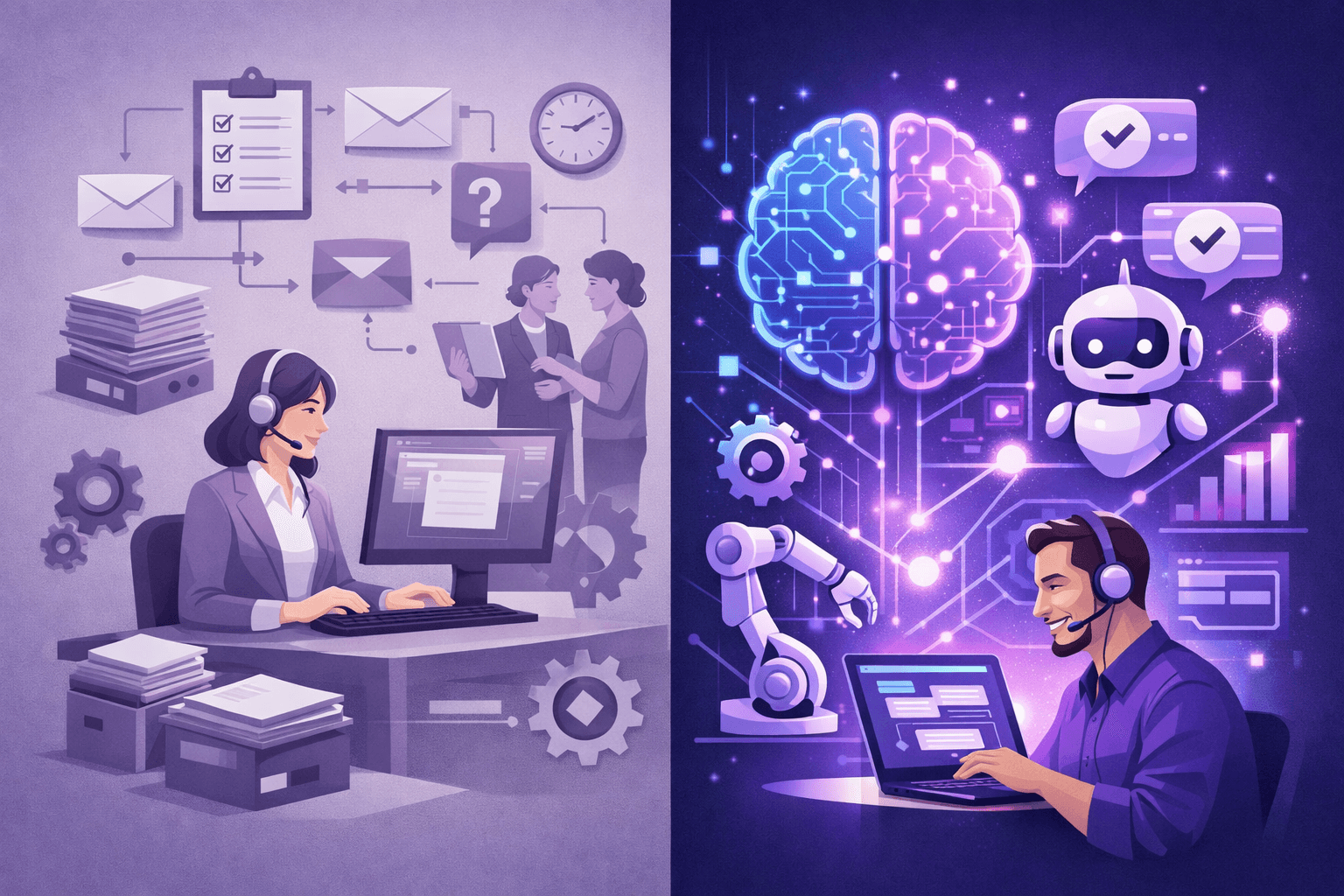
E-commerce store owners face a fundamental choice: AI customer support or traditional helpdesk software?
Traditional helpdesk platforms (Zendesk, Freshdesk, Help Scout) have been the standard for years. They organize tickets, manage agent workflows, and centralize customer conversations. But they're fundamentally built for human agents—AI features are add-ons, not the foundation.
AI customer support tools flip the model. They automate conversations from the start, handling inquiries without human intervention. Humans step in only for complex cases that truly require judgment.
This isn't a simple "old vs new" debate. The right choice depends on your store size, support volume, conversation complexity, and team structure. This guide breaks down when each approach makes sense, what you'll actually pay, and how to decide.
The fundamental difference
Before comparing features and costs, understand the core architectural difference:
Traditional helpdesk: Human-first with automation features
Traditional helpdesks are built around human agents:
- Every conversation starts as a ticket assigned to an agent
- Automation happens through rules: "If subject contains X, send canned response Y"
- Macros and templates help agents respond faster
- AI features (when available) suggest responses to agents or auto-reply to simple questions
- The system assumes humans will handle most conversations
This model works when:
- Your support team needs to collaborate on complex cases
- You handle multi-channel support (email, phone, social, chat) in one place
- Your conversations are unique enough that automation wouldn't help much
- You have the budget and team to support significant human staffing
AI customer support: Automation-first with human escalation
AI-first tools are built around automation:
- Conversations start with AI attempting to resolve them completely
- AI accesses your order data, product catalog, and knowledge base directly
- Human agents only see conversations that AI escalates
- The system assumes AI will handle the majority of conversations
- Humans handle edge cases, complex judgment calls, and escalated issues
This model works when:
- Large portions of your support volume are repetitive (order status, returns, product questions)
- You want to scale support without proportionally scaling headcount
- You need 24/7 coverage without 24/7 staffing
- You value immediate response times (no queue waits)
The choice isn't "which is better?" It's "which model matches how my support actually works?"
Feature comparison: What each does well
Let's compare capabilities across the features that matter for e-commerce.
Handling repetitive inquiries
Traditional helpdesk:
- Manual responses or canned replies sent by agents
- Some platforms offer "intent detection" that suggests responses
- Macros let agents insert common answers with shortcuts
- Each inquiry still requires human review and clicking "send"
- Speed depends on agent availability and workload
Result: Faster than typing from scratch, but still requires human time per ticket
AI customer support:
- Automatically detects inquiry type (order status, return question, etc.)
- Retrieves relevant data from integrated systems
- Generates complete, accurate responses
- Sends immediately without human review
- Works 24/7 regardless of support team availability
Result: Instant responses without human involvement
Winner for e-commerce: AI customer support. Repetitive questions (30-60% of e-commerce tickets) get resolved immediately without agent time.
Complex problem-solving
Traditional helpdesk:
- Humans excel at nuanced judgment
- Can understand emotional context and adapt responses
- Handle multi-step troubleshooting naturally
- Make policy exceptions based on customer value
- Coordinate across teams when needed
Result: Better for complex scenarios requiring empathy, judgment, or cross-functional coordination
AI customer support:
- Handles straightforward troubleshooting well ("How do I reset my password?")
- Struggles with ambiguous situations requiring subjective judgment
- Can follow decision trees but lacks true reasoning for edge cases
- Knows when to escalate complex scenarios to humans
- Transfers full conversation context when escalating
Result: Good for defined troubleshooting, escalates appropriately for complex cases
Winner for e-commerce: Traditional helpdesk (human agents). But the gap is narrowing as AI improves.
Multi-channel support
Traditional helpdesk:
- Unified inbox for email, chat, phone, social media, SMS
- Agents see complete customer history across channels
- Consistent workflow regardless of how customer contacts you
- Can route conversations to specialists by channel
- Strong collaboration features for team coordination
Result: Excellent for managing support across many channels
AI customer support:
- Most tools focus primarily on chat
- Some offer email automation
- Multi-channel support varies widely by platform
- Phone and social media support often limited
- Integration with traditional channels may require additional tools
Result: Strong for chat, variable for other channels
Winner for e-commerce: Traditional helpdesk if you heavily use email, phone, and social support. AI customer support if chat is your primary channel.
Scalability during traffic spikes
Traditional helpdesk:
- Capacity limited by number of agents
- Traffic spikes (Black Friday, product launches) create backlogs
- Scaling requires hiring and training more agents
- Queue times increase during high-volume periods
- Cost scales linearly with volume
Result: Struggles with sudden volume spikes without significant overstaffing
AI customer support:
- Handles unlimited simultaneous conversations
- No degradation during traffic spikes
- Responds instantly regardless of overall volume
- Cost scales slowly or not at all with increased conversations
- No queue times even during 10x traffic surges
Result: Scales effortlessly with demand
Winner for e-commerce: AI customer support. E-commerce stores face predictable spikes (sales events, seasons) that traditional helpdesks handle poorly.
International and multilingual support
Traditional helpdesk:
- Requires hiring agents for each language
- Some platforms offer translation features
- Quality depends on agent language skills
- Expensive to support many languages (requires proportional hiring)
- Cultural adaptation depends on agent knowledge
Result: High quality but expensive and difficult to scale globally
AI customer support:
- Supports 50+ languages simultaneously
- Automatic language detection
- Consistent quality across languages (no accent or proficiency variance)
- Cost doesn't increase with additional languages
- Can adapt communication style by region
Result: Affordable multilingual support at scale
Winner for e-commerce: AI customer support for international stores. Traditional helpdesks only make sense if you operate in one language or have budget for large multilingual teams.
Data access and personalization
Traditional helpdesk:
- Shows agent customer history within the helpdesk
- Requires agents to manually look up order data in other systems
- Integration with e-commerce platforms varies
- Personalization depends on agent effort and system access
- Often requires switching between multiple tools
Result: Personalization possible but requires manual work
AI customer support:
- Direct integration with e-commerce platform
- Automatically pulls customer order history, cart, preferences
- Retrieves product catalog data for questions
- Accesses inventory, shipping, and return information instantly
- All data available to AI without manual lookup
Result: Automatic personalization using integrated data
Winner for e-commerce: AI customer support. Deep e-commerce integration eliminates manual lookup and enables instant, personalized responses.
Team collaboration and workflow
Traditional helpdesk:
- Internal notes and comments on tickets
- Assign tickets to specific agents or teams
- Ticket status tracking (open, pending, resolved)
- Workflow automation and SLAs
- Team performance dashboards
- Approval workflows for refunds or exceptions
Result: Excellent for team coordination and complex workflows
AI customer support:
- Most tools have simpler collaboration features
- Focus is on AI handling conversations, not agent coordination
- Escalated conversations may integrate with helpdesk tools
- Team features vary widely by platform
- Often single-agent focused rather than team-based
Result: Basic collaboration, assumes less human involvement needed
Winner for e-commerce: Traditional helpdesk if you have a large support team requiring coordination. AI customer support if your team is small and conversations are mostly independent.
Reporting and analytics
Traditional helpdesk:
- Detailed agent performance metrics
- Ticket volume, response time, resolution time by agent/team
- CSAT and customer feedback tracking
- Channel performance comparison
- Custom reports and dashboards
- Focus on human agent efficiency
Result: Comprehensive insights into team performance
AI customer support:
- Automation rate (% of conversations resolved without humans)
- AI accuracy and customer satisfaction
- Escalation patterns and reasons
- Cost savings and ROI calculations
- Conversation topic analysis
- Focus on AI effectiveness and improvement opportunities
Result: Strong insights into automation performance and ROI
Winner: Tie—different focus areas. Traditional helpdesk measures agent productivity. AI customer support measures automation effectiveness.
Cost comparison: Real numbers by store size
Let's compare actual costs, including hidden expenses like implementation time and staffing.
Small store (500 conversations/month)
Traditional helpdesk (Zendesk Suite Starter):
- Base cost: $55/agent/month × 2 agents = $110/month
- Additional costs: None for basic features
- Software cost: ~$110/month
- Agent cost: 2 part-time agents @ ~$1,500/month each = ~$3,000/month
- Total monthly cost: ~$3,110/month
- Cost per conversation: ~$6.22
AI customer support (e.g., LiteTalk):
- Base cost: ~$99/month (includes automation)
- AI automation rate: 75%
- Software cost: ~$99/month
- Agent cost for remaining 25%: 1 part-time agent @ ~$750/month
- Total monthly cost: ~$849/month
- Cost per conversation: ~$1.70
- Savings: ~$2,261/month (~73% reduction)
Mid-size store (2,500 conversations/month)
Traditional helpdesk (Zendesk Suite Professional):
- Base cost: $115/agent/month × 5 agents = $575/month
- Additional costs: ~$100/month for add-ons
- Software cost: ~$675/month
- Agent cost: 5 full-time agents @ ~$3,000/month each = ~$15,000/month
- Total monthly cost: ~$15,675/month
- Cost per conversation: ~$6.27
AI customer support (e.g., LiteTalk):
- Base cost: ~$299/month
- AI automation rate: 80%
- Software cost: ~$299/month
- Agent cost for remaining 20%: 1-2 agents @ ~$3,000/month
- Total monthly cost: ~$3,299/month
- Cost per conversation: ~$1.32
- Savings: ~$12,376/month (~79% reduction)
Large store (10,000 conversations/month)
Traditional helpdesk (Zendesk Suite Professional/Enterprise):
- Base cost: $115-150/agent/month × 15 agents = ~$2,000/month
- Additional costs: ~$500/month for add-ons, integrations
- Software cost: ~$2,500/month
- Agent cost: 15 full-time agents @ ~$3,000/month each = ~$45,000/month
- Total monthly cost: ~$47,500/month
- Cost per conversation: ~$4.75
AI customer support (e.g., LiteTalk):
- Base cost: ~$799/month
- AI automation rate: 75% (more complex conversations at scale)
- Software cost: ~$799/month
- Agent cost for remaining 25%: 3-4 agents @ ~$3,000/month each = ~$10,500/month
- Total monthly cost: ~$11,299/month
- Cost per conversation: ~$1.13
- Savings: ~$36,201/month (~76% reduction)
Key insight: AI customer support delivers 70-80% cost savings across all store sizes, with larger absolute savings as you scale.
Hidden costs to consider
The subscription price isn't the full story. Here are costs that often get overlooked:
Traditional helpdesk hidden costs
Implementation time:
- Setup and configuration: 1-2 weeks for basic, 4-8 weeks for enterprise
- Agent training: 2-4 weeks per agent
- Ongoing management: 5-10 hours/week for team coordination
Scaling costs:
- Each new agent requires hiring, onboarding, training
- Seasonal scaling requires temp hiring (expensive and time-consuming)
- Higher tiers required as team grows
Productivity overhead:
- Agents spend time on repetitive questions
- Context switching between tools reduces efficiency
- Manual data lookup adds time per ticket
Turnover costs:
- Average support agent turnover: 30-45% annually
- Recruiting and training replacement costs: $3,000-$5,000 per agent
- Knowledge loss during transitions
AI customer support hidden costs
Implementation time:
- Setup and configuration: 2-4 hours for basic, 1-2 days for custom
- Training on your data: Often automatic, sometimes requires refinement
- Ongoing management: 1-3 hours/week for optimization
Accuracy refinement:
- Initial accuracy may be 70-80%, improves to 90-95% with refinement
- Time investment: 5-10 hours in first month, 1-2 hours/month ongoing
- Some tools include this as part of onboarding
Integration costs:
- Most e-commerce integrations are pre-built (no cost)
- Custom integrations may require development time
- Usually one-time cost if needed
Escalation infrastructure:
- Still need some human agents for complex cases
- May need helpdesk tool for escalated tickets
- Can be basic/affordable since handling much lower volume
When traditional helpdesk makes more sense
AI customer support isn't always the right choice. Traditional helpdesks are better when:
1. Most conversations require human judgment
If 60%+ of your support conversations involve:
- Subjective decisions ("Should we make an exception to our return policy?")
- Complex negotiations ("I'll refund you 50% and send a replacement")
- Emotional situations requiring empathy
- Coordinating across multiple departments
- Investigation and research
Why helpdesk wins: These scenarios require human reasoning that AI can't reliably replicate yet.
Example: Custom furniture store where each inquiry involves design consultation, custom quotes, and installation coordination.
2. You primarily support via phone or email
If chat represents less than 30% of your support volume:
- Email-heavy support workflows
- Phone support for high-touch customers
- Social media as primary support channel
- In-person or video support
Why helpdesk wins: Traditional helpdesks excel at multi-channel support. AI customer support is strongest in chat.
Example: B2B e-commerce company where procurement departments prefer email trails and phone conversations.
3. You have complex internal workflows
If your support requires:
- Multi-tier escalation paths (L1 → L2 → L3)
- Approval workflows for refunds/credits
- Case management across weeks or months
- Extensive internal collaboration
- Integration with CRM, ERP, and other enterprise systems
Why helpdesk wins: Traditional helpdesks offer sophisticated workflow automation and team coordination features.
Example: Large enterprise with dedicated teams for different product lines, regions, and customer tiers.
4. You're already deeply invested in a helpdesk ecosystem
If you've already:
- Customized a helpdesk extensively for your workflows
- Integrated deeply with your tech stack
- Trained your team on the platform
- Built reports and dashboards you depend on
- Achieved good efficiency with current setup
Why helpdesk wins: Switching costs may outweigh benefits, especially if you're already operating efficiently.
Better approach: Consider adding AI as a layer on top of your existing helpdesk rather than replacing it entirely.
When AI customer support makes more sense
AI customer support is the better choice when:
1. High volume of repetitive questions
If 40%+ of your conversations are:
- Order tracking and status
- Return and refund policies
- Shipping and delivery questions
- Product information and availability
- Account and login help
- Payment and checkout issues
Why AI wins: These questions have clear answers that AI can provide instantly and accurately.
Example: Fashion e-commerce with 2,000 monthly inquiries, 70% of which are tracking, sizing, and return questions.
2. You need 24/7 coverage without 24/7 staffing
If you:
- Serve customers across multiple time zones
- Have international customers expecting off-hours support
- Want to convert browsers outside business hours
- Can't afford round-the-clock staffing
- Experience high cart abandonment during off-hours
Why AI wins: AI provides instant responses 24/7 without additional cost or staffing complexity.
Example: International jewelry store serving customers in North America, Europe, and Asia.
3. You face significant traffic spikes
If your support volume:
- Spikes 5-20x during Black Friday or sales events
- Surges during product launches
- Has strong seasonal patterns
- Is unpredictable (viral social media, press coverage)
Why AI wins: AI scales instantly without degrading response quality or requiring temporary hiring.
Example: Gift shop that sees 300 conversations/month normally but 4,000+ during November-December.
4. You need multilingual support economically
If you:
- Serve customers in 3+ languages
- Plan to expand internationally
- Can't afford multilingual support teams
- Need consistent quality across languages
- Want to test new markets without heavy investment
Why AI wins: AI handles 50+ languages at the same cost, with consistent quality.
Example: Beauty products seller expanding from US-only to US, Canada (French), and Latin America (Spanish).
5. Cost reduction is a priority
If you:
- Have high support costs relative to revenue
- Need to improve margins without hurting customer experience
- Want to scale sales without proportionally scaling support costs
- Are bootstrapped or watching cash flow closely
Why AI wins: AI typically reduces support costs by 60-80% while maintaining or improving response times.
Example: Bootstrapped DTC brand spending $8,000/month on support for $100,000/month in revenue (8% of revenue).
6. Fast response time is critical for conversions
If you:
- Lose sales when pre-purchase questions aren't answered immediately
- Compete in markets where speed matters (fast fashion, trending items)
- See high cart abandonment
- Know immediate support increases conversion rates
Why AI wins: AI responds instantly (1-3 seconds) vs. human response times (minutes to hours depending on queue).
Example: Electronics retailer where customers comparison shop and immediate answers to compatibility questions drive purchasing decisions.
The hybrid approach: Best of both worlds
You don't have to choose exclusively. Many successful e-commerce stores use both:
How hybrid works
AI handles the majority:
- Automates 60-80% of conversations completely
- Provides instant responses to common questions
- Available 24/7
- Scales effortlessly during traffic spikes
- Handles multilingual support
Humans handle the complex cases:
- AI escalates when it encounters:
- Complex situations requiring judgment
- Frustrated or upset customers
- Policy exceptions
- VIP customers
- Scenarios outside AI's knowledge
- Humans use a lightweight helpdesk for escalated tickets
- Team stays smaller, focused on high-value conversations
Cost comparison: Hybrid vs. traditional
Mid-size store (2,500 conversations/month)
Traditional helpdesk only:
- Software: $675/month
- 5 agents: $15,000/month
- Total: $15,675/month
Hybrid approach:
- AI tool: $299/month
- Lightweight helpdesk (for 20% escalated): $100/month
- 1-2 agents for escalations: $3,000/month
- Total: $3,399/month
- Savings: $12,276/month (78% reduction)
Implementation strategy for hybrid
Phase 1: Add AI alongside existing helpdesk (Month 1)
- Deploy AI on your website
- Keep existing helpdesk and team unchanged
- AI handles new conversations, existing tickets stay in helpdesk
- Measure AI automation rate and accuracy
Phase 2: Route AI escalations to helpdesk (Month 2)
- Configure AI to create tickets in your helpdesk when escalating
- Agents now handle both direct tickets and AI escalations
- Monitor escalation quality and volume
- Refine AI escalation triggers
Phase 3: Reduce agent capacity gradually (Months 3-6)
- As AI proves reliable, reduce human agent hours
- Let attrition reduce team size naturally (don't immediately lay off)
- Retrain remaining agents to handle complex escalations
- Optimize AI continuously based on what's escalating
Phase 4: Optimize costs (Month 6+)
- Downgrade helpdesk to smaller plan (fewer agents)
- Consider switching to simpler escalation tool if helpdesk is overkill
- Continue expanding what AI automates
- Maintain small expert team for complex cases
This gradual approach reduces risk, proves ROI before major changes, and ensures quality doesn't suffer during transition.
Real-world case studies
Let's look at actual results from e-commerce stores that compared or switched between these approaches.
Case study 1: Fashion boutique switches from Zendesk to AI
Before (Traditional helpdesk):
- Platform: Zendesk Support Professional
- Team: 3 full-time agents
- Volume: 1,500 conversations/month
- Software cost: $345/month (3 agents × $115)
- Agent cost: $9,000/month
- Total monthly cost: $9,345
- Average response time: 45 minutes
- CSAT: 87%
After (AI customer support):
- Platform: LiteTalk
- Team: 1 part-time agent (20 hrs/week)
- Volume: 1,500 conversations/month
- AI automation rate: 78%
- Software cost: $199/month
- Agent cost: $1,500/month (part-time for escalations)
- Total monthly cost: $1,699
- Average response time: 8 seconds (AI) / 22 minutes (escalated to human)
- CSAT: 91%
Results:
- Cost reduction: $7,646/month (82%)
- Response time: 84% faster on average
- CSAT improvement: +4 percentage points
- Implementation time: 3 days
Why it worked: 70% of their tickets were order tracking, returns, and sizing questions—perfect for AI automation.
Case study 2: B2B store keeps traditional helpdesk
Company: Industrial equipment supplier
- Platform: Freshdesk Enterprise
- Team: 8 specialized agents (technical support, sales support, account managers)
- Volume: 800 conversations/month (low volume, high complexity)
- Software cost: $1,200/month
- Agent cost: $32,000/month (specialized technical knowledge required)
- Total monthly cost: $33,200
- Average resolution time: 2.5 days (complex technical troubleshooting)
- CSAT: 94%
Why they stuck with traditional helpdesk:
- Only 15% of conversations could be automated (highly technical, custom solutions)
- Required deep product knowledge and engineering expertise
- Multi-day troubleshooting common
- Strong collaboration needed between support, sales, and engineering teams
- High customer lifetime value justified premium support experience
They evaluated AI and determined: ROI would be minimal (automating 15% of 800 tickets = 120 tickets, ~$400 savings after AI cost)
Case study 3: Supplements brand uses hybrid approach
Company: Subscription vitamin and supplement e-commerce
- AI platform: Rep AI (for product questions and sales)
- Helpdesk: Gorgias (for complex post-purchase support)
- Team: 2 agents handling escalations
- Volume: 3,200 conversations/month
How they split it:
- AI handles (75% of volume, 2,400 conversations):
- Product questions and recommendations
- Subscription modifications (skip, pause, swap)
- Order tracking
- Shipping questions
- Simple return questions
- Humans handle (25% of volume, 800 conversations):
- Medical questions requiring disclaimer
- Subscription cancellation retention
- Complex refund negotiations
- Influencer and wholesale inquiries
Costs:
- AI platform: $279/month
- Helpdesk (Gorgias, small plan): $300/month
- 2 agents: $6,000/month
- Total: $6,579/month
Compared to traditional helpdesk only (estimated):
- Would require 5-6 agents: ~$15,000/month
- Helpdesk: ~$750/month
- Estimated total: $15,750/month
Results:
- Savings: ~$9,171/month (58% reduction)
- Response time: Instant for AI, <30 minutes for escalations
- CSAT: 93% (AI conversations: 94%, human conversations: 91%)
Why hybrid worked: Clear separation between automatable (product/subscription info) and complex (medical, retention) conversations.
Migration guide: Switching from traditional helpdesk to AI
If you've decided AI customer support makes sense, here's how to switch successfully:
Step 1: Measure your baseline (Week 1)
Before changing anything, document:
- Current support costs (software + team)
- Conversation volume by type (track order status, returns, product questions, etc.)
- Average response time and resolution time
- Customer satisfaction scores
- Agent time spent per conversation type
Why this matters: You need a baseline to measure ROI and identify automation opportunities.
Step 2: Calculate potential automation rate (Week 1)
Review your last 100-200 support conversations:
- How many are straightforward questions with clear answers?
- How many require judgment, empathy, or complex troubleshooting?
- What percentage could AI handle with access to your order and product data?
Conservative estimate:
- Order tracking: 95% automatable
- Returns/refund questions: 80% automatable (policies are clear)
- Product questions: 70% automatable (if good product data)
- Shipping questions: 85% automatable
- Payment issues: 60% automatable (some require manual investigation)
- Complaints/complex issues: 20% automatable
Realistic overall automation rate: 60-75% for most e-commerce stores
Step 3: Choose AI platform and trial it (Weeks 2-3)
Select 2-3 AI platforms to trial:
- Connect to your e-commerce platform
- Load your policies and product data
- Test on real customer questions
- Measure accuracy and automation rate
What to test:
- 20-30 common questions from your actual support history
- 5-10 edge cases
- Speed and accuracy of responses
- Escalation behavior when AI doesn't know
- Integration quality with your platform
Choose the platform with the best accuracy and automation rate on your specific data.
Step 4: Parallel deployment (Weeks 4-6)
Run AI and traditional helpdesk simultaneously:
- Deploy AI widget on your site
- Keep existing helpdesk operational
- New conversations go to AI first
- Existing tickets stay in helpdesk
- Monitor every AI conversation manually
Goals for this phase:
- Achieve 85%+ AI accuracy
- Refine escalation triggers
- Build confidence in AI reliability
- Identify any gaps in knowledge or integration
Don't reduce agent capacity yet—use this time to validate AI works as expected.
Step 5: Gradual capacity reduction (Months 2-4)
Once AI proves reliable:
- Reduce agent hours or team size gradually
- Let natural attrition reduce headcount (avoid layoffs if possible)
- Retrain remaining agents to focus on escalations
- Downgrade or cancel helpdesk subscription
Gradual approach:
- Month 2: Reduce to 80% capacity (4 agents → 3, or reduce hours)
- Month 3: Reduce to 50% capacity if AI maintains >75% automation
- Month 4: Settle at optimal capacity for handling escalations
Step 6: Continuous optimization (Ongoing)
AI customer support improves over time:
- Review escalated conversations weekly
- Identify patterns: What's escalating that AI should handle?
- Refine knowledge base and policies
- Adjust escalation triggers
- Expand automation to new use cases
Expect automation rates to improve:
- Month 1: 60-70%
- Month 3: 70-80%
- Month 6+: 75-85%
Decision framework: Traditional helpdesk vs AI customer support
Use this framework to make your decision:
Calculate your support profile
Question 1: What percentage of your conversations are repetitive and straightforward?
- 60%+ → Strongly favor AI
- 40-60% → Favor AI
- 20-40% → Consider hybrid
- <20% → Favor traditional helpdesk
Question 2: What's your monthly conversation volume?
- 2,000+ → Strongly favor AI (high ROI)
- 500-2,000 → Favor AI
- 100-500 → Consider AI if growth expected
- <100 → May not need dedicated support tools yet
Question 3: What's your current support cost as a percentage of revenue?
- >5% → Strongly favor AI (cost reduction critical)
- 3-5% → Favor AI
- 1-3% → Either approach works
- <1% → Cost may not be primary driver
Question 4: How critical is instant response time?
- Critical for conversions → Strongly favor AI
- Important but not critical → Favor AI
- Not a differentiator → Either approach works
- Customers prefer thoughtful, slow responses → Favor traditional
Question 5: Do you need to support multiple languages?
- 5+ languages → Strongly favor AI
- 3-4 languages → Favor AI
- 2 languages → Consider AI
- 1 language → Not a factor
Question 6: Do you face significant traffic spikes?
- Regular 5x+ spikes → Strongly favor AI
- Occasional 3-5x spikes → Favor AI
- Seasonal 2x variations → Consider AI
- Steady traffic → Not a factor
Question 7: How complex are your support conversations?
- Mostly straightforward → Strongly favor AI
- Mix of simple and complex → Favor hybrid
- Often require judgment → Favor traditional with AI add-on
- Highly specialized/technical → Favor traditional helpdesk
Scoring
Count your "Strongly favor AI" and "Favor AI" responses:
- 5-7: AI customer support is clearly the right choice
- 3-4: AI customer support likely delivers better ROI
- 1-2: Consider hybrid approach
- 0: Traditional helpdesk may be better, or add AI features to existing helpdesk
Common mistakes when choosing
Avoid these pitfalls:
Mistake 1: Choosing based on what you already use
"We already pay for Zendesk, so we'll just add their AI features."
Why it fails: Helpdesk AI features are usually less sophisticated than purpose-built AI customer support tools. You'll get mediocre automation rather than excellent results.
Better approach: Evaluate AI tools independently based on accuracy and ROI, even if it means adding a new vendor.
Mistake 2: Assuming you need a "full" helpdesk
"We need all the features a traditional helpdesk offers."
Why it fails: Many e-commerce stores pay for helpdesk features they rarely use (advanced workflows, SLAs, time tracking, etc.)
Better approach: List the features you actually use weekly. If it's just "see tickets, respond to tickets, track customer history," simpler tools cost less.
Mistake 3: Not calculating true total cost of ownership
"This helpdesk is only $55/seat/month, way cheaper than AI tools."
Why it fails: You're ignoring agent costs, which typically dwarf software costs. $55/month + $3,000/month in agent time = $3,055 total cost per seat.
Better approach: Always calculate software + human costs together. AI reduces total cost even if software cost is higher.
Mistake 4: Expecting AI to be perfect immediately
"We tried an AI tool for 2 weeks and it made some mistakes, so we went back to traditional helpdesk."
Why it fails: AI improves with refinement. Week 1 accuracy might be 70%, but month 2 accuracy is often 85-90% after tuning.
Better approach: Give AI tools 4-6 weeks to prove themselves, with active refinement during that period.
Mistake 5: Choosing based only on price
"We'll use the cheapest option."
Why it fails: A $29/month tool that automates 30% of tickets delivers worse ROI than a $299/month tool that automates 80%.
Better approach: Calculate cost per conversation and total cost reduction, not just subscription price.
Final recommendation
For most e-commerce stores, AI customer support delivers dramatically better ROI than traditional helpdesk software.
Choose AI customer support if:
- 40%+ of your conversations are repetitive
- You handle 500+ conversations/month
- Cost reduction matters
- You need 24/7 coverage or multilingual support
- You face traffic spikes
- Fast response time impacts conversions
Keep traditional helpdesk if:
- Conversations are highly specialized or complex
- You primarily support via phone or email (not chat)
- Volume is very low (<100/month)
- You have complex team workflows requiring sophisticated coordination
Consider a hybrid approach if:
- You're already invested in a traditional helpdesk
- Your team is resistant to change
- You want to reduce risk during transition
- You have a mix of simple and complex conversations
Most important: Test before committing. Run a 2-4 week trial with real customer data. Measure automation rate, accuracy, and customer satisfaction. Let results drive your decision, not assumptions.
Related resources
- Best AI Customer Support Software for E-commerce (2026) - Complete comparison of AI customer support solutions
- AI Customer Support for E-commerce: The Complete Guide - Comprehensive overview of AI customer support
- E-commerce Customer Support Use Cases You Can Automate with AI - Specific automation opportunities
- AI Customer Support Metrics That Actually Matter - How to measure AI support effectiveness
- AI Escalation: When and How to Hand Off to Humans - Designing effective escalation workflows
Ready to see if AI customer support is right for your store? Try LiteTalk free for 14 days and compare it directly against your current helpdesk costs and performance.