
AI for Post-Purchase Customer Support in E-commerce
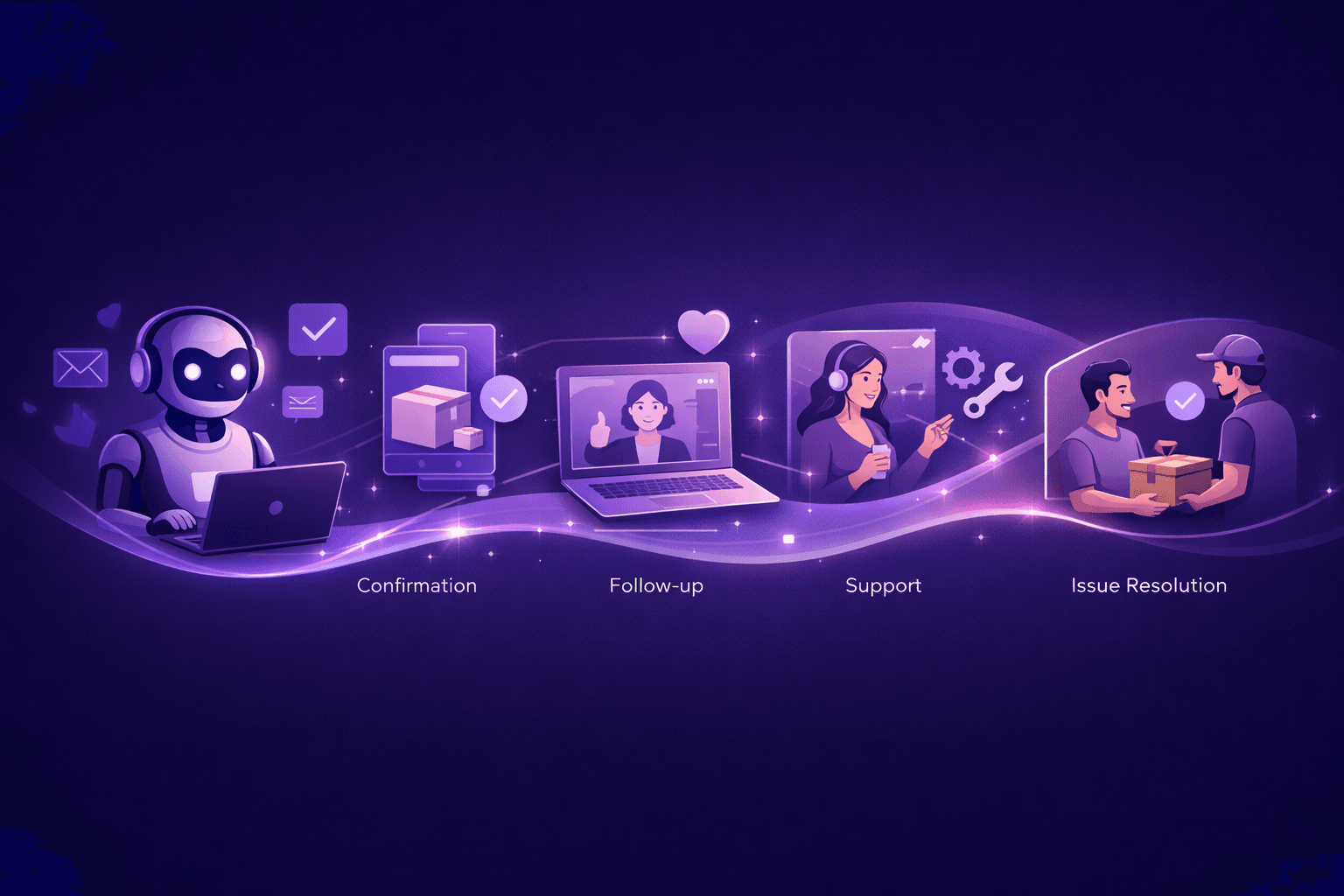
Post-purchase support begins the moment a customer completes checkout and extends through delivery, product usage, and beyond. This phase represents your best opportunity to build lasting customer relationships—or your biggest risk for buyer's remorse and returns.
Traditional e-commerce focuses on acquiring customers and closing sales. But the post-purchase experience determines whether that customer becomes a repeat buyer or files a chargeback. AI transforms post-purchase support from a reactive cost center into proactive relationship-building that drives retention and lifetime value.
Why post-purchase support matters more than you think
The sale doesn't end at checkout. Every post-purchase interaction shapes future purchase decisions:
Immediate post-purchase anxiety: Within minutes of checkout, customers second-guess their decision. "Did my order go through?" "When will it arrive?" "Did I choose the right size?" Without quick reassurance, anxiety turns into cancellation requests.
Delivery anticipation and tracking: Once an order ships, customers obsessively monitor progress. Questions about shipping status, delivery timing, and tracking updates consume support resources while customers wait.
Product setup and usage: After delivery, customers need help getting started. Assembly instructions, setup guides, compatibility questions, and troubleshooting create another wave of inquiries.
Warranty and protection: Customers want to understand coverage, register products, and know their options if something goes wrong. These questions come weeks or months after purchase.
Repeat purchase decisions: How you handle post-purchase support directly impacts whether customers return. Great support builds loyalty; poor support drives customers to competitors.
A store processing 1,000 orders monthly generates approximately 300-500 post-purchase inquiries across order confirmations, tracking, setup help, warranty questions, and subscription management. That's 25-42 hours of support time monthly—time that AI can largely automate while improving customer experience.
How AI handles post-purchase customer support
AI post-purchase support integrates with your e-commerce platform, order management system, shipping carriers, and customer database to provide comprehensive assistance throughout the customer journey:
- Confirms order completion: Immediately reassures customers their purchase was successful
- Provides order details: Answers questions about order contents, pricing, and delivery timeline
- Tracks delivery progress: Monitors shipping status and proactively communicates updates
- Guides product setup: Provides usage instructions, setup guides, and troubleshooting help
- Manages warranty and registration: Explains coverage, facilitates product registration, and handles warranty questions
- Recommends complementary products: Suggests accessories and related items based on purchase history
- Handles subscription changes: Manages modifications, pauses, and cancellations for recurring orders
- Collects feedback: Gathers customer satisfaction data and addresses concerns
This comprehensive automation maintains customer engagement and satisfaction without constant human intervention.
Real conversation examples
Example 1: Order confirmation anxiety
Customer: "I just placed an order but didn't get a confirmation email. Did it go through?"
AI response: "Yes, your order went through successfully! I can see order #47234 was placed 5 minutes ago for $143.50. Here's what you ordered:
- Women's Running Shoes - Size 8 - Navy Blue
- Athletic Socks (3-pack) - Medium
Your confirmation email should arrive within 10 minutes. Sometimes it lands in spam, so check your promotions or junk folder. Your order is being prepared for shipment and should ship within 1-2 business days.
Delivery estimate: January 24-26 to your address at 123 Main St, Brooklyn, NY.
Would you like me to resend the confirmation to a different email address?"
The AI verified the order completed, provided immediate reassurance with full order details, explained the email delay, and offered a solution—all without human involvement.
Example 2: Product setup help
Customer: "I just received my wireless headphones but can't figure out how to pair them with my phone"
AI response: "I'll help you pair your SoundWave Pro headphones. Here's the setup process:
For first-time pairing:
- Make sure your headphones are charged (charge for 2 hours if new)
- Turn on Bluetooth on your phone
- Press and hold the power button on the right earcup for 5 seconds until you see a flashing blue light
- On your phone, look for 'SoundWave Pro' in the Bluetooth device list
- Tap to connect - you'll hear 'Connected' in the headphones
If they don't appear in your device list:
- Make sure the headphones aren't already paired with another device (turn off Bluetooth on other devices)
- Try resetting the headphones: hold power + volume up for 10 seconds until red and blue lights flash
I can also email you the full setup guide with photos if that's helpful. Are you getting the blue flashing light when you hold the power button?"
The AI provided step-by-step instructions, troubleshooting tips, and offered escalation paths without requiring a human agent.
Example 3: Warranty registration
Customer: "How do I register my product for warranty? And what does the warranty cover?"
AI response: "I can help you register your SoundWave Pro headphones for warranty coverage. Based on your purchase on January 18, you have:
Warranty coverage (2 years from purchase):
- Manufacturing defects in materials or workmanship
- Battery failure under normal use
- Audio quality issues (crackling, one side not working, etc.)
- Charging port defects
Not covered:
- Physical damage (drops, water damage, broken parts)
- Normal wear and tear (ear cushion degradation, cosmetic scratches)
- Loss or theft
- Damage from improper use
To register your warranty:
- Visit soundwave.com/warranty
- Enter your email: customer@email.com
- Enter order number: #47234
- Product will auto-populate from your order
Registration takes 2 minutes and ensures faster service if you need warranty support. I can email you this information along with a direct registration link if you'd like."
The AI explained warranty terms specific to the purchased product, provided registration instructions using actual order data, and offered to send documentation.
Example 4: Subscription management
Customer: "I need to skip next month's delivery for my coffee subscription"
AI response: "I can help you skip your next Coffee Club delivery. Let me check your subscription:
Current subscription:
- Product: Premium Dark Roast Coffee (2 bags monthly)
- Next delivery: February 15, 2026
- Billing: $34.99 on February 15
I can skip your February delivery, which means:
- No delivery on February 15
- No charge on February 15
- Your next delivery will be March 15 instead
- Your subscription stays active
Would you like me to skip February? I can also:
- Pause your subscription for multiple months
- Change your delivery frequency
- Swap to a different coffee blend
- Cancel the subscription entirely
What works best for you?"
The AI retrieved subscription details, clearly explained the skip option's impact, and presented additional alternatives—all from integrated subscription data.
Example 5: Complementary product recommendation
Customer: "I love my new camera. What accessories do you recommend?"
AI response: "Based on your Canon EOS R6 purchase, here are the accessories that will enhance your photography:
Most popular with your camera:
-
Extra battery (LP-E6NH) - $79.99
- Your camera came with one battery; most photographers carry 2-3 for full-day shoots
- 89% of R6 owners buy an extra battery
-
64GB SD card (SanDisk Extreme Pro) - $34.99
- Fast enough for 4K video and continuous shooting
- Your camera needs a UHS-II card for best performance
-
Camera bag (Peak Design Everyday Sling 10L) - $149.99
- Fits your R6 with 2-3 lenses plus accessories
- Weather-resistant, perfect for travel
Also consider:
- Lens cleaning kit ($19.99) - Essential for sensor and lens maintenance
- Screen protector ($12.99) - Prevents scratches on your LCD
- Remote shutter release ($29.99) - For long exposures and self-portraits
These are based on what other R6 photographers find most useful. Want more details on any of these, or are you looking for something specific like lenses or lighting?"
The AI made personalized recommendations based on the actual product purchased, explained why each accessory matters, and used social proof from purchase patterns.
What AI can handle for post-purchase support
AI effectively automates most post-purchase inquiries:
Order confirmation and receipt access:
- "Did my order go through?"
- "I need a copy of my receipt"
- "What did I order?"
- "When will my order ship?"
- "Can I add items to my order?"
Delivery tracking and updates:
- "Where is my package?"
- "When will my order arrive?"
- "My tracking hasn't updated"
- "Can I change my delivery address?"
Product setup and usage instructions:
- "How do I set up my product?"
- "Where can I find the user manual?"
- "How do I install this?"
- "My product isn't working correctly"
- "What do the different buttons do?"
Warranty information and registration:
- "What's covered under warranty?"
- "How long is my warranty?"
- "How do I register my product?"
- "I think my product is defective"
- "Can I get an extended warranty?"
Accessory and complementary recommendations:
- "What accessories work with this?"
- "What else do I need for this product?"
- "What do other customers buy with this?"
- "Are there compatible products?"
Subscription management and changes:
- "Can I skip next month?"
- "How do I change my subscription frequency?"
- "What if I want to try a different product?"
- "Can I pause my subscription?"
- "How do I cancel?"
Feedback collection and issue resolution:
- "How was your experience?"
- "Would you recommend this product?"
- "Is there anything we can improve?"
- "I have a concern about my order"
Integration requirements for post-purchase automation
Effective AI post-purchase support requires comprehensive system integration:
E-commerce platform integration
AI needs access to your order management system to retrieve:
- Complete order history and details
- Order status (confirmed, processing, shipped, delivered)
- Payment information (amounts, methods, billing address)
- Customer account data and purchase history
- Shipping address and delivery preferences
This integration allows AI to answer order-specific questions with accurate, personalized information.
Shipping and logistics integration
Real-time delivery support requires carrier API connections:
- Shipping carriers: FedEx, UPS, USPS tracking updates
- Fulfillment providers: 3PL warehouse status and shipping data
- Delivery services: Same-day and local delivery tracking
- International carriers: Cross-border shipping information
Without logistics integration, AI cannot provide current delivery status or proactive shipping updates.
Product information database
AI needs comprehensive product data for setup and usage support:
- Product manuals and setup guides
- Specification sheets and compatibility information
- Instructional videos and visual guides
- Troubleshooting documentation
- Warranty terms and coverage details
- Accessory compatibility and recommendations
This knowledge base enables AI to answer product-specific questions accurately.
Subscription management system
For subscription-based products, AI requires integration with:
- Subscription platform (ReCharge, Bold, custom systems)
- Billing cycle and payment schedule data
- Subscription modification options and rules
- Product swap capabilities
- Pause and cancellation workflows
This allows AI to manage subscription changes without manual processing.
Customer feedback and satisfaction tools
AI can integrate with survey and review platforms:
- Post-purchase satisfaction surveys
- Net Promoter Score (NPS) collection
- Product review solicitation
- Feedback categorization and routing
This enables automated feedback collection while flagging concerns for human follow-up.
When AI escalates post-purchase questions
Not all post-purchase support can be fully automated. AI escalates when:
Complex product issues requiring diagnosis: Customer reports defective product behavior that requires technical troubleshooting beyond documentation—needs expert evaluation.
Order modification after processing: Customer wants to change order contents, split shipment, or modify delivery after fulfillment has begun—requires manual intervention.
Warranty claims requiring approval: Customer seeks warranty replacement or repair requiring inspection, photos, or manager authorization.
Frustrated or dissatisfied customers: AI detects negative sentiment, repeat issues, or escalating frustration—human empathy and problem-solving needed.
Subscription disputes or billing issues: Customer contests charges, reports unauthorized renewals, or has complex billing questions requiring account review.
Returns and refunds: While AI can explain policies and initiate simple returns, complex return scenarios (damaged goods, partial returns, restocking fees) often need human judgment.
High-value customer intervention: Store policy may require personal attention for VIP customers or high-value orders.
Smart AI recognizes these situations early and transfers to human agents with full context, ensuring customers receive appropriate support without delay.
Benefits beyond automation efficiency
Post-purchase AI support delivers strategic advantages beyond cost savings:
Reduces buyer's remorse
Immediate post-purchase reassurance prevents cancellations. When customers get instant confirmation, clear delivery timelines, and easy access to order details, they feel confident about their purchase.
Human support delays (even 1-2 hours) allow doubt to fester. AI eliminates this gap.
Increases product adoption
Fast setup help ensures customers successfully use their purchase. When customers encounter setup friction and can't get immediate help, products sit unused—leading to returns and negative reviews.
AI provides instant guidance that gets customers to successful first use quickly.
Builds repeat purchase behavior
Post-purchase experience is the strongest predictor of repeat business. Customers who receive helpful, responsive post-purchase support are 3-4x more likely to make another purchase within 90 days.
AI maintains consistent, high-quality interactions that build trust and loyalty.
Enables proactive engagement
Advanced AI implementations don't wait for customers to ask:
- "Your order just shipped! Track it here: [link]"
- "Your delivery arrives tomorrow between 2-6 PM. Make sure someone's available to sign."
- "You've had your camera for a week—here are 5 tips to get professional-quality photos"
- "Your warranty expires in 30 days. Want to extend coverage?"
Proactive communication strengthens relationships and prevents issues before they escalate.
Captures expansion revenue
AI identifies cross-sell and upsell opportunities:
- Accessory recommendations based on purchases
- Subscription offers for consumable products
- Extended warranty and protection plans
- Complementary product bundles
This revenue comes naturally within helpful conversations, not pushy sales tactics.
Measuring post-purchase automation success
Track these metrics to evaluate AI performance for post-purchase support:
Automation rate: What percentage of post-purchase inquiries does AI fully resolve? Target: 70-85% for comprehensive post-purchase automation.
First contact resolution: Do customers get complete answers, or do they return with follow-ups? High FCR indicates AI is providing sufficient detail and helpful solutions.
Time to first response: How quickly do customers receive help after inquiry? Should approach instant (under 10 seconds) for automated responses.
Customer satisfaction (CSAT): Are customers happy with AI post-purchase support? Target CSAT of 85%+ for automated interactions.
Repeat purchase rate: Do customers who receive AI post-purchase support buy again? Compare repeat purchase rates for AI-supported vs. traditionally-supported customers.
Setup success rate: For products requiring setup, what percentage of customers successfully complete setup without escalation? Higher success rates indicate effective AI guidance.
Subscription retention: For subscription products, does AI-managed subscription support improve or maintain retention rates compared to human-handled changes?
Cross-sell conversion: When AI recommends complementary products, what percentage of customers make additional purchases? Track both recommendation acceptance and revenue impact.
Implementation best practices
Start with order confirmation and tracking: These high-volume, straightforward inquiries deliver immediate value and build customer trust in AI support.
Create comprehensive product documentation: AI is only as good as the knowledge base. Invest in detailed setup guides, troubleshooting docs, and FAQ content for each product.
Enable proactive notifications: Don't wait for customers to ask. Send shipping confirmations, delivery updates, and helpful post-delivery tips automatically.
Personalize using purchase data: AI should know what the customer bought and provide relevant help. Generic responses feel robotic; specific, contextual help builds trust.
Make escalation seamless: When AI transfers to humans, ensure full conversation context carries over. Customers shouldn't repeat information.
Test product setup flows: Have real users test AI setup guidance for each product category. Identify gaps in instructions or common confusion points.
Monitor sentiment for satisfaction signals: Track customer sentiment during post-purchase interactions. Declining satisfaction indicates AI needs refinement or escalation thresholds need adjustment.
Integrate feedback loops: Use customer feedback and escalation patterns to continuously improve AI responses and expand automation coverage.
Real impact: post-purchase automation case study
A consumer electronics retailer with 3,000 monthly orders implemented comprehensive AI post-purchase support:
Before AI:
- 1,200 monthly post-purchase support tickets (40% of total volume)
- Average response time: 3.8 hours
- Support team spent 100 hours monthly on post-purchase inquiries
- 90-day repeat purchase rate: 18%
- Customer satisfaction (post-purchase): 81%
After AI implementation:
- 1,150 post-purchase inquiries received (similar volume)
- 920 fully resolved by AI (80% automation rate)
- 230 escalated to humans (complex product issues, warranty claims, billing disputes)
- Average response time: 12 seconds
- Support time on post-purchase: 19 hours monthly (81% reduction)
- 90-day repeat purchase rate: 24% (33% increase)
- Customer satisfaction (post-purchase): 89%
- Additional accessory revenue: $8,200 monthly from AI recommendations
The automation freed support agents to focus on complex product troubleshooting and high-value customer relationships while improving both satisfaction and repeat business.
Getting started with post-purchase support automation
If post-purchase support is consuming resources without building customer relationships:
1. Map your post-purchase journey: What questions do customers ask at each stage—immediately after purchase, during shipping, after delivery, during setup, and beyond?
2. Audit current ticket volume: What percentage of support is post-purchase? Which categories (order confirmation, tracking, setup, warranty, etc.) have highest volume?
3. Assess integration requirements: Can your e-commerce platform, shipping providers, and product systems integrate with AI customer support?
4. Build your product knowledge base: Compile setup guides, user manuals, troubleshooting docs, and warranty information for AI training.
5. Start with highest-volume categories: Automate order confirmations and delivery tracking first, then expand to product setup and warranty questions.
6. Enable proactive communication: Once basic automation works, implement shipping notifications, delivery updates, and post-delivery guidance.
7. Monitor and optimize: Track automation rate, satisfaction, and repeat purchase behavior. Expand AI capabilities based on escalation patterns and customer feedback.
Post-purchase support is where customer relationships are won or lost. AI automation ensures every customer receives immediate, helpful, consistent support that builds loyalty and drives repeat business—transforming post-purchase from a cost center into a competitive advantage.
Related reading: For comprehensive coverage of AI customer support automation across all use cases, see E-commerce Customer Support Use Cases You Can Automate with AI. To understand the complete picture of AI support capabilities and implementation, start with AI Customer Support for E-commerce: The Complete Guide (2026).