
Human Support Teams vs AI: Cost Breakdown for E-commerce
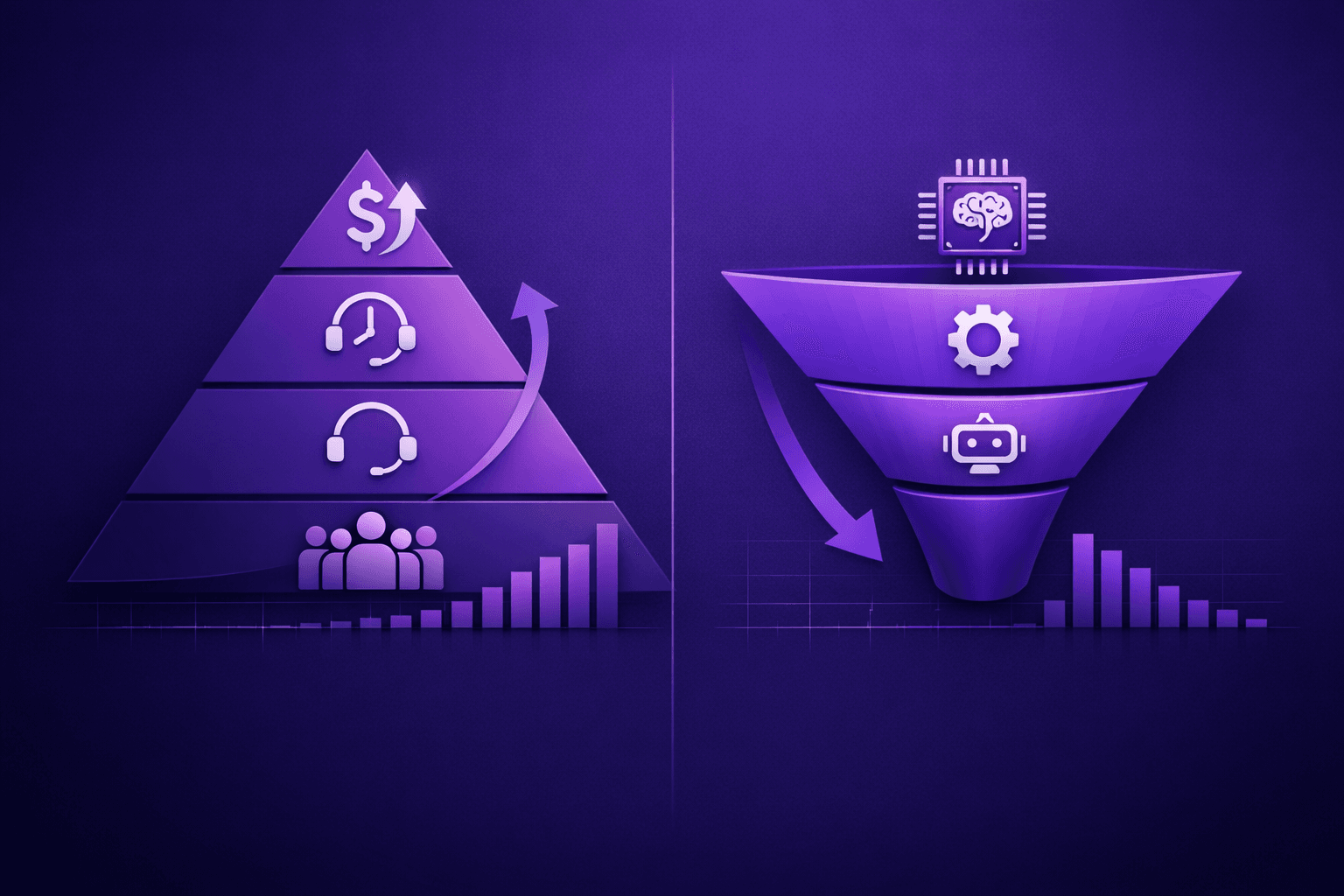
You need to understand the true cost of customer support for your e-commerce store. The real question isn't just "What do I pay for tools?" It's "What does each customer conversation actually cost me?"
Most e-commerce store owners dramatically underestimate their support costs. They see the $99/month helpdesk subscription and think that's their support expense. Meanwhile, they're paying $6,000+/month in agent salaries, $800/month in training costs, and losing thousands more in inefficiencies they never calculated.
AI customer support changes the economics completely. But understanding the cost difference requires breaking down what you're actually paying for with human teams versus what AI automates.
This guide provides a complete cost breakdown: what human support teams actually cost (including hidden expenses most stores miss), what AI customer support costs, and the real ROI calculation for your specific situation.
The true cost of human support teams
Let's start with what you're actually paying for human customer support. Most stores only track direct costs (salaries, software), missing 40-60% of the total expense.
Direct staffing costs
The obvious starting point: what you pay people to answer customer questions.
Base salary or hourly rate:
- Entry-level support agent: $15-22/hour ($31,200-$45,760/year)
- Mid-level support agent: $20-28/hour ($41,600-$58,240/year)
- Senior/team lead: $28-38/hour ($58,240-$79,040/year)
Regional variations:
- US major metro: $18-25/hour average
- US secondary markets: $14-20/hour average
- US rural: $12-18/hour average
- Eastern Europe: $8-15/hour average
- Philippines/India: $4-10/hour average
- Latin America: $6-14/hour average
Reality check: A single full-time US-based support agent costs $31,200-$45,760 annually in salary alone. That doesn't include benefits, taxes, or any other costs.
Employee burden costs
Beyond base salary, you pay additional costs for each employee:
Payroll taxes and mandatory benefits (US):
- Social Security: 6.2% of wages
- Medicare: 1.45% of wages
- Federal unemployment (FUTA): 0.6% on first $7,000
- State unemployment (SUTA): 0.5-5.4% depending on state
- Workers' compensation: 0.5-2% depending on industry
Total burden rate: 8-16% of base salary
For a $40,000/year agent: +$3,200-$6,400 in payroll taxes
Optional benefits (if you offer them):
- Health insurance: $6,000-$12,000/year employer contribution
- 401(k) matching: 3-6% of salary ($1,200-$2,400 for $40k salary)
- Paid time off: ~10% of productive time (adds ~10% to effective hourly cost)
- Sick leave: ~5% of productive time
- Holidays: ~4% of productive time
Total optional benefits: $7,200-$14,400/year for competitive packages
Reality check: A $40,000/year agent actually costs $50,400-$60,800 when you include all employment costs. That's 26-52% more than base salary.
Technology and tools
Every support agent needs software and equipment:
Helpdesk software:
- Basic: $15-30/agent/month ($180-$360/year)
- Mid-tier (Zendesk, Freshdesk): $49-89/agent/month ($588-$1,068/year)
- Premium (Gorgias, Kustomer): $60-120/agent/month ($720-$1,440/year)
- Enterprise: $120-300+/agent/month ($1,440-$3,600+/year)
Additional tools per agent:
- Internal communication (Slack): $8-15/month ($96-$180/year)
- Knowledge base: $10-30/agent/month ($120-$360/year)
- Screen recording/quality assurance: $10-40/month ($120-$480/year)
- Productivity tracking: $5-20/month ($60-$240/year)
Hardware and equipment:
- Computer/laptop: $600-$1,200 (3-year lifespan = $200-$400/year)
- Headset: $50-$150 (2-year lifespan = $25-$75/year)
- Monitor(s): $150-$400 (4-year lifespan = $38-$100/year)
- Keyboard/mouse: $50-$100 (3-year lifespan = $17-$33/year)
Total technology cost per agent: $1,400-$3,100/year
For remote agents, add:
- Internet stipend: $50/month ($600/year)
- Home office stipend: $25-50/month ($300-$600/year)
Reality check: Technology adds $1,400-$3,700/year per agent, and this is often overlooked in cost calculations.
Training and onboarding
Getting agents productive takes time and money:
Initial onboarding:
- Week 1: Company orientation, systems training, product knowledge (40 hours)
- Week 2-3: Supervised practice, shadowing, mock conversations (60-80 hours)
- Week 4: Gradual ramp-up with close supervision (30-40 hours)
Total onboarding time: 130-160 hours before agent reaches even 50% productivity
At $20/hour fully loaded cost: $2,600-$3,200 in onboarding investment
Add supervisor time:
- Training delivery: 20-30 hours
- One-on-ones and feedback: 10-15 hours
- Review and quality assurance: 15-20 hours
Supervisor time investment: 45-65 hours per new hire
At $35/hour supervisor cost: $1,575-$2,275 additional cost
Total onboarding cost per agent: $4,175-$5,475
Ongoing training:
- Product updates: 4-8 hours/quarter (16-32 hours/year)
- New feature training: 10-20 hours/year
- Soft skills development: 8-16 hours/year
- Policy updates: 4-8 hours/year
Total ongoing training: 38-76 hours/year
At $20/hour: $760-$1,520/year in ongoing training costs
Reality check: Training a single agent to productivity costs $4,175-$5,475 upfront, plus $760-$1,520/year ongoing. If you have 20% annual turnover, you're constantly paying these costs.
Management and supervision
Support teams need oversight:
Supervisory ratio: Typically 1 supervisor per 6-10 agents
Supervisor cost:
- Salary: $50,000-$70,000/year
- Burden (taxes + benefits): +$13,000-$20,000
- Technology: +$1,500-$2,000
Total supervisor cost: $64,500-$92,000/year
Allocated per agent (assuming 8 agents per supervisor):
- Cost per agent: $8,062-$11,500/year
Manager activities that consume time:
- One-on-ones: 30 min/agent/week = 4 hours/week for 8 agents
- Performance reviews: 20 hours/quarter
- Quality assurance: 10-15 hours/week
- Escalation handling: 5-10 hours/week
- Reporting and analysis: 5 hours/week
- Hiring and interviewing: 20-40 hours/quarter
Reality check: Management adds $8,000-$11,500 per agent annually. For a 5-person team, that's $40,000-$57,500/year just for supervision.
Space and overhead
If agents work on-site, you pay for space:
Office space:
- Space per agent: 100-150 square feet (including common areas)
- Office rent: $15-$50/sq ft/year depending on market
- Cost per agent: $1,500-$7,500/year
Utilities and services:
- Electricity, internet, water: $100-$200/agent/month
- Cleaning and maintenance: $50-$100/agent/month
- Insurance: $30-$60/agent/month
Total utilities: $2,160-$4,320/agent/year
For remote teams, these costs go to zero (beyond home office stipends already counted).
Reality check: On-site support adds $3,660-$11,820/year per agent. Remote teams avoid this but typically add $900-$1,200 in stipends instead.
Productivity losses and inefficiency
Humans aren't productive 100% of the time:
Non-productive time:
- Breaks and lunch: 1 hour/day (12.5% of 8-hour day)
- Training and meetings: 3-5 hours/week (7-12%)
- System downtime and technical issues: 2-4 hours/week (5-10%)
- Context switching: 10-15% productivity loss
- PTO and sick time: ~15 days/year (6%)
Combined productivity loss: 40-55% of paid time
What this means: A full-time agent (40 hours/week paid) delivers only 18-24 hours of actual customer conversations.
Effective hourly cost:
- Base: $20/hour
- After productivity losses: $33-$44/hour of actual work
Reality check: You're paying for 40 hours but getting 18-24 hours of customer-facing work. This dramatically increases your true cost per conversation.
Turnover and replacement costs
Support roles have high turnover:
Industry averages:
- Customer support turnover: 30-45% annually
- E-commerce support specifically: 35-50% annually
Replacement costs:
- Recruiting (job posts, screening): $500-$1,500
- Interviewing time (manager + team): $400-$800
- Onboarding new hire: $4,175-$5,475 (from earlier calculation)
- Lost productivity during transition: $1,000-$2,000
Total replacement cost: $6,075-$9,775 per departing agent
Annual turnover impact:
- 5-person team with 40% turnover = 2 replacements/year
- Cost: $12,150-$19,550/year
- Allocated per agent: $2,430-$3,910/year
Reality check: High turnover adds $2,400-$3,900/year per agent to your costs, even when you maintain consistent headcount.
Quality issues and errors
Human agents make mistakes:
Error types and costs:
- Wrong refund amount: $10-$100/error
- Incorrect information causing customer action: $20-$200/incident
- Policy misapplication: $15-$150/incident
- Order processing errors: $25-$300/error
Error rates:
- Well-trained agents: 1-3% of conversations have some error
- Average agents: 3-7% error rate
- Poorly trained or new agents: 7-15% error rate
Monthly cost impact:
- Store handling 1,000 conversations/month
- 4% error rate = 40 errors
- Average error cost: $40
- Monthly error cost: $1,600
- Annual: $19,200
Allocated per agent (5-person team):
- Cost per agent: $3,840/year in error-related costs
Reality check: Mistakes cost money. Even good teams spend $3,000-$5,000/year per agent on error-related costs.
Scaling costs
Growing support volume means hiring more people:
Linear scaling:
- 1 agent handles ~300-500 conversations/month
- 2,000 conversations = 4-7 agents
- 5,000 conversations = 10-17 agents
- 10,000 conversations = 20-33 agents
Scaling challenges:
- Each new hire takes 4-6 weeks to reach productivity
- Quality becomes harder to maintain with larger teams
- Need additional supervisors (1 per 8 agents)
- Need dedicated QA roles at 15+ agents
- Need support operations roles at 25+ agents
Cost acceleration:
- Small team (2-4 agents): $50,000-$80,000/year per agent all-in
- Medium team (5-10 agents): $55,000-$90,000/year per agent (overhead grows)
- Large team (15+ agents): $60,000-$100,000/year per agent (need more management layers)
Reality check: Support costs don't scale linearly—they accelerate as teams grow due to increasing overhead.
Total cost per agent: The complete picture
Let's add it all up for a typical US-based support agent:
Small store example (2-3 agents, 500-800 conversations/month):
| Cost category | Annual cost per agent | |--------------|----------------------| | Base salary | $40,000 | | Payroll taxes and benefits | $10,000 | | Technology and tools | $2,500 | | Training and onboarding (amortized) | $2,000 | | Management (allocated) | $9,000 | | Space and overhead (remote) | $900 | | Turnover costs (allocated) | $3,000 | | Error costs (allocated) | $4,000 | | Total cost per agent | $71,400 |
Conversations per agent: ~400/month × 12 = 4,800/year
Cost per conversation: $71,400 ÷ 4,800 = $14.88/conversation
Medium store example (6-8 agents, 2,000-3,500 conversations/month):
| Cost category | Annual cost per agent | |--------------|----------------------| | Base salary | $42,000 | | Payroll taxes and benefits | $11,000 | | Technology and tools | $2,800 | | Training and onboarding (amortized) | $2,500 | | Management (allocated) | $10,500 | | Space and overhead (remote) | $900 | | Turnover costs (allocated) | $3,400 | | Error costs (allocated) | $3,800 | | Total cost per agent | $76,900 |
Conversations per agent: ~400/month × 12 = 4,800/year
Cost per conversation: $76,900 ÷ 4,800 = $16.02/conversation
Large store example (15-20 agents, 6,000-10,000 conversations/month):
| Cost category | Annual cost per agent | |--------------|----------------------| | Base salary | $45,000 | | Payroll taxes and benefits | $12,500 | | Technology and tools | $3,200 | | Training and onboarding (amortized) | $3,000 | | Management (allocated) | $12,000 | | Space and overhead (remote) | $1,000 | | Turnover costs (allocated) | $3,600 | | Error costs (allocated) | $3,500 | | Total cost per agent | $83,800 |
Conversations per agent: ~450/month × 12 = 5,400/year
Cost per conversation: $83,800 ÷ 5,400 = $15.52/conversation
Key insight: True cost per conversation for human support ranges from $14-$18 when you account for all costs. Most stores only track software costs ($1-3/conversation) and miss the other $12-15.
The true cost of AI customer support
Now let's break down what AI customer support actually costs:
Software subscription costs
The obvious direct cost: what you pay for the AI platform.
Pricing models:
Per-conversation pricing:
- Budget tools: $0.20-$0.50/conversation
- Mid-tier platforms: $0.40-$1.20/conversation
- Premium platforms: $0.80-$2.00/conversation
- Enterprise solutions: $1.50-$4.00/conversation (but higher automation rates)
Flat monthly pricing:
- Small store plans: $99-$299/month (typically 500-2,000 conversations included)
- Medium store plans: $299-$799/month (2,000-10,000 conversations included)
- Large store plans: $799-$2,499/month (10,000-50,000 conversations included)
Hybrid pricing:
- Base fee: $199-$499/month
- Plus per-conversation: $0.30-$0.80/conversation over included amount
Effective cost per conversation (examples):
Store handling 2,000 conversations/month:
- Budget tool: $0.35/conversation × 2,000 = $700/month
- Mid-tier: $0.80/conversation × 2,000 = $1,600/month
- Premium: $1.20/conversation × 2,000 = $2,400/month
Store handling 5,000 conversations/month:
- Budget tool: $0.30/conversation × 5,000 = $1,500/month
- Mid-tier: $0.70/conversation × 5,000 = $3,500/month
- Premium: $1.00/conversation × 5,000 = $5,000/month
Reality check: AI subscription costs range from $0.20-$2.00 per conversation depending on platform and volume. This is the primary direct cost.
Integration and setup
Getting AI connected to your systems has upfront costs:
DIY setup (if platform offers self-service):
- Platform training and familiarization: 4-8 hours
- E-commerce platform connection: 1-2 hours
- Product catalog sync: 2-4 hours
- Knowledge base creation: 8-20 hours
- Brand voice customization: 2-4 hours
- Testing and refinement: 8-12 hours
Total DIY time: 25-50 hours
At $50/hour internal cost: $1,250-$2,500 setup investment
Professional setup (if you need help or want faster deployment):
- Implementation services: $2,000-$10,000 depending on complexity
- Custom integrations: $3,000-$15,000 for non-standard platforms or custom workflows
- Training and onboarding: $500-$2,000
Total professional setup: $2,000-$27,000 (but typically $3,000-$8,000 for standard e-commerce)
Amortized over first year:
- DIY: $104-$208/month additional cost
- Professional basic: $166-$666/month additional cost
- Professional complex: $250-$2,250/month (rare except for enterprise)
Amortized over three years (more realistic):
- DIY: $35-$70/month
- Professional basic: $55-$222/month
- Professional complex: $83-$750/month
Reality check: Setup costs add $35-$222/month when amortized over three years for typical stores. This is a one-time investment that decreases over time.
Human escalation handling
AI doesn't handle everything—complex cases escalate to humans:
Escalation rates by AI platform quality:
- Excellent AI: 15-25% of conversations escalate
- Good AI: 25-35% escalate
- Average AI: 35-50% escalate
- Poor AI: 50-70% escalate
What this means for staffing:
Store with 2,000 conversations/month:
- Excellent AI (20% escalation): 400 conversations need humans
- Good AI (30% escalation): 600 conversations need humans
- Average AI (40% escalation): 800 conversations need humans
Staffing requirement:
- 400 escalations/month = 1 part-time agent (20 hours/week)
- 600 escalations/month = 1 part-time to full-time agent (25-30 hours/week)
- 800 escalations/month = 1-2 full-time agents
Monthly human cost (at fully loaded $25/hour):
- 400 escalations: ~$2,000/month (80 hours)
- 600 escalations: ~$3,000/month (120 hours)
- 800 escalations: ~$4,000/month (160 hours)
Reality check: You still need some human support capacity, but dramatically less. A store that previously needed 4-5 full-time agents now needs 0.5-1 agent for escalations.
Monitoring and optimization
AI improves with oversight:
Weekly monitoring (minimal viable):
- Review escalated conversations: 2-3 hours/week
- Check AI accuracy on sample conversations: 1-2 hours/week
- Update knowledge base with new information: 1-2 hours/week
Total: 4-7 hours/week = 16-28 hours/month
At $35/hour internal cost: $560-$980/month
Monthly optimization (recommended):
- Identify new automation opportunities: 2-4 hours/month
- Refine escalation triggers: 1-2 hours/month
- Update product information: 2-4 hours/month
- Analyze performance metrics: 2-3 hours/month
Total: 7-13 hours/month additional
Combined monitoring and optimization: 23-41 hours/month
At $35/hour: $805-$1,435/month
Reality check: Active AI management takes 20-40 hours/month. This improves accuracy and automation rates, making the investment worthwhile. Most stores assign this to existing team members (manager, operations) rather than hiring dedicated roles.
Additional tools and integrations
AI works better with supporting systems:
Knowledge base platform (if you don't have one):
- Basic: $0-$50/month (Notion, Google Docs)
- Dedicated: $99-$299/month (Document360, HelpJuice, Zendesk Guide)
- Enterprise: $300-$800/month
Analytics and reporting (often included in AI platform):
- Most AI platforms include analytics
- Advanced BI tools: $50-$200/month if needed
CRM integration (usually free):
- Most e-commerce platforms integrate natively
- Custom CRMs may need middleware: $50-$200/month
Total additional tools: $0-$500/month (typically $50-$150)
Reality check: Supporting tools add minimal cost if you already have basic systems. Most stores spend $0-$150/month here.
Error handling and quality assurance
AI makes different mistakes than humans:
AI error types:
- Hallucinations (making up information): Rare with good e-commerce integrations
- Misunderstanding complex requests: Escalates rather than guessing
- Outdated information: Only happens if you don't update knowledge base
- Integration failures: Usually fail gracefully (escalate) rather than give wrong answer
Error rates:
- Well-configured AI: 0.5-2% error rate (lower than humans)
- Average AI: 2-5% error rate (similar to humans)
- Poorly configured AI: 5-10% error rate (higher than humans, but these improve quickly)
Error costs:
- Same error impact as human mistakes: $10-$200/error
- But lower frequency with well-configured systems
Monthly error cost (2,000 conversations, 2% error rate):
- Errors: 40/month
- Average cost: $35/error
- Monthly impact: $1,400
- Compare to human team (4% error rate): $2,800
Error cost savings: $1,400/month with AI vs $2,800 with humans = $1,400/month savings
Reality check: Well-configured AI typically has lower error rates than human teams because it consistently follows rules, doesn't get tired, and doesn't misremember policies.
Scaling costs
Here's where AI economics differ dramatically:
Conversation volume scaling:
Handling 2,000 conversations/month:
- Human team: 4-5 agents required
- AI: Same platform, no additional headcount
Handling 5,000 conversations/month:
- Human team: 10-12 agents required (+100-140% cost increase)
- AI: Same platform, potentially higher per-conversation volume discounts (-10-20% per-conversation cost)
Handling 10,000 conversations/month:
- Human team: 20-25 agents required (+200-300% cost increase from 5k level)
- AI: Same platform, better volume pricing (-15-25% per-conversation cost)
Seasonal spike handling:
Black Friday: 5x normal volume for 4 days
- Human team: Can't hire 4x temporary agents, so quality degrades or response times explode
- AI: Handles spike automatically, no cost increase beyond per-conversation pricing
Reality check: AI costs scale sub-linearly (get cheaper per conversation as volume grows) while human costs scale super-linearly (get more expensive per conversation due to overhead).
Total cost of AI customer support: The complete picture
Let's calculate total cost with realistic examples:
Small store example (500-800 conversations/month):
| Cost category | Monthly cost | |--------------|--------------| | AI platform subscription | $400 | | Setup costs (amortized over 3 years) | $60 | | Human escalation handling (25% escalate) | $1,200 | | Monitoring and optimization | $900 | | Additional tools | $75 | | Error costs (allocated) | $200 | | Total monthly cost | $2,835 |
Conversations handled: 650/month average
AI automation rate: 75% (488 conversations)
Cost per conversation (total): $2,835 ÷ 650 = $4.36/conversation
Cost per AI-automated conversation: $400 ÷ 488 = $0.82/conversation
Medium store example (2,000-3,000 conversations/month):
| Cost category | Monthly cost | |--------------|--------------| | AI platform subscription | $1,600 | | Setup costs (amortized over 3 years) | $100 | | Human escalation handling (20% escalate) | $2,500 | | Monitoring and optimization | $1,200 | | Additional tools | $100 | | Error costs (allocated) | $500 | | Total monthly cost | $6,000 |
Conversations handled: 2,500/month average
AI automation rate: 80% (2,000 conversations)
Cost per conversation (total): $6,000 ÷ 2,500 = $2.40/conversation
Cost per AI-automated conversation: $1,600 ÷ 2,000 = $0.80/conversation
Large store example (6,000-8,000 conversations/month):
| Cost category | Monthly cost | |--------------|--------------| | AI platform subscription | $4,200 | | Setup costs (amortized over 3 years) | $150 | | Human escalation handling (18% escalate) | $4,500 | | Monitoring and optimization | $1,500 | | Additional tools | $150 | | Error costs (allocated) | $800 | | Total monthly cost | $11,300 |
Conversations handled: 7,000/month average
AI automation rate: 82% (5,740 conversations)
Cost per conversation (total): $11,300 ÷ 7,000 = $1.61/conversation
Cost per AI-automated conversation: $4,200 ÷ 5,740 = $0.73/conversation
Key insight: Total cost per conversation with AI ranges from $1.60-$4.40 depending on scale, compared to $14-18 for human teams. AI delivers 75-90% cost reduction.
Direct cost comparison: Humans vs AI
Let's compare side-by-side at different scales:
Small e-commerce store (600 conversations/month)
Human support team approach:
- Team size: 2 part-time agents (50 hours/week total)
- Monthly cost: $5,950
- Cost per conversation: $9.92
AI customer support approach:
- AI platform: $400/month
- Human escalations (25%): $1,000/month
- Monitoring: $800/month
- Total: $2,200/month
- Cost per conversation: $3.67
Monthly savings: $3,750
Annual savings: $45,000
Cost reduction: 63%
Medium e-commerce store (2,500 conversations/month)
Human support team approach:
- Team size: 5-6 full-time agents
- Monthly cost: $32,000
- Cost per conversation: $12.80
AI customer support approach:
- AI platform: $1,600/month
- Human escalations (20%): $2,500/month
- Monitoring: $1,200/month
- Total: $5,300/month
- Cost per conversation: $2.12
Monthly savings: $26,700
Annual savings: $320,400
Cost reduction: 83%
Large e-commerce store (7,000 conversations/month)
Human support team approach:
- Team size: 14-16 full-time agents + 2 supervisors
- Monthly cost: $90,000
- Cost per conversation: $12.86
AI customer support approach:
- AI platform: $4,200/month
- Human escalations (18%): $4,500/month
- Monitoring: $1,500/month
- Total: $10,200/month
- Cost per conversation: $1.46
Monthly savings: $79,800
Annual savings: $957,600
Cost reduction: 89%
Pattern: AI delivers greater cost savings at scale. Small stores save 60-70%, medium stores save 75-85%, large stores save 85-90%.
Hidden cost differences you need to understand
Beyond the direct numbers, several hidden factors affect total cost:
Time to scale capacity
Human support:
- Identify need: 1-2 weeks (notice volume trending up)
- Post job, screen candidates: 2-3 weeks
- Interview and decide: 1-2 weeks
- Onboarding and training: 4-6 weeks
- Reach full productivity: 8-12 weeks total
Total time from "we need more capacity" to "new agent is productive": 8-12 weeks
During this time: Existing team works overtime (burnout risk), response times degrade, or you miss conversations
AI support:
- Scale is instant: AI handles 500 or 5,000 conversations the same way
- No hiring, training, or ramp-up period
- Zero degradation in quality or response time
Value: Ability to handle unexpected growth without planning 3 months ahead = significant competitive advantage
Time to reduce capacity
Human support:
- If volume drops (seasonality, market conditions), you're stuck with labor costs
- Layoffs are expensive (severance, unemployment) and damage morale
- Reduced hours affect retention and create uncertainty
- Can't easily ramp back up if you cut too deep
AI support:
- Costs automatically decrease with volume (per-conversation pricing)
- No difficult personnel decisions
- No impact on team morale
- Scales back up instantly when needed
Value: Flexibility to match costs with revenue without personnel trauma
Quality consistency
Human support:
- Quality varies by agent skill, experience, mood, fatigue
- Morning shift may outperform evening shift
- Monday performance differs from Friday
- New agents perform worse than experienced agents
- Sick days and PTO create coverage gaps with quality drops
AI support:
- Identical quality 24/7/365
- No quality degradation at 2am or during holidays
- Newest conversation handled exactly like the 10,000th
- No variation based on agent mood or energy level
Value: Consistent customer experience = higher CSAT and fewer escalations
Knowledge retention
Human support:
- Knowledge lives in agents' heads
- When agent leaves, knowledge leaves
- Training new agents requires rebuilding knowledge
- Tribal knowledge creates inconsistency
- Policy updates must be communicated and remembered
AI support:
- Knowledge stored centrally in knowledge base
- Updates propagate instantly to all conversations
- No knowledge loss when team changes
- Complete accuracy on policies and procedures
- Easy to audit what AI "knows"
Value: Faster updates, better compliance, no knowledge decay
Coverage gaps
Human support:
- Nights and weekends require additional staffing or go uncovered
- Holiday coverage is expensive (1.5-2x pay) or creates gaps
- Sick days and PTO create coverage challenges
- Time zones matter for global customers
AI support:
- 24/7/365 coverage automatically
- No premium for "off hours"
- Holidays are identical to weekdays
- Serves all time zones simultaneously
Value: Better customer experience + capture conversations that would otherwise be missed = higher revenue
Language scaling
Human support:
- Each language requires hiring native speakers
- 5 languages = 5x headcount or time zone juggling
- Rare language pairs are expensive or impossible
- Translation services add cost and delay
AI support:
- 50+ languages simultaneously with no additional cost
- Native-quality responses in each language
- Instant switching based on customer preference
- Handles rare languages as easily as common ones
Value: Serve international customers without proportional cost increase = unlock new markets
Error propagation
Human support:
- One agent misunderstands policy: affects their conversations until corrected
- Training gaps spread across team
- Inconsistent answers to same question
- Errors are random and hard to detect systematically
AI support:
- Single error affects all conversations until corrected (bad)
- But: errors are systematic and easy to detect (good)
- But: fixes propagate instantly to all future conversations (good)
- Knowledge base changes fix all future instances immediately
Value: Faster error detection and correction, more consistent application of fixes
ROI calculation framework
Use this framework to calculate ROI for your specific situation:
Step 1: Calculate your current human support costs
Monthly staffing cost:
- Number of agents: _____
- Fully loaded cost per agent (use $5,000-$7,000 for US-based): $_____ × agents = $_____
- Technology costs (helpdesk, tools): $_____
- Management costs (allocated): $_____
- Space and overhead: $_____
Total current monthly cost: $_____
Monthly conversation volume: _____
Current cost per conversation: $_____ ÷ conversations = $_____
Step 2: Estimate AI costs for your volume
AI platform cost:
- Your monthly volume: _____
- Target price per conversation: $_____ (check actual platform pricing)
- Platform cost: $_____ × volume = $_____
Human escalation cost:
- Expected escalation rate: _____% (use 20-25% for good AI)
- Escalated conversations: volume × escalation% = _____
- Hours required (escalations ÷ 25 conversations/hour): _____
- Cost (hours × $25/hour): $_____
Monitoring cost:
- Hours per month: _____ (use 25-35 hours)
- Cost (hours × $35/hour): $_____
Setup cost (amortized over 36 months):
- One-time setup: $_____ (use $3,000-$8,000)
- Monthly amortized: $_____ ÷ 36 = $_____
Total AI monthly cost: $_____
AI cost per conversation: $_____ ÷ volume = $_____
Step 3: Calculate savings
Monthly savings: Current cost - AI cost = $_____
Annual savings: Monthly savings × 12 = $_____
Payback period: Setup cost ÷ monthly savings = _____ months
3-year total savings: (Annual savings × 3) - setup cost = $_____
ROI: (3-year savings ÷ total 3-year investment) × 100 = _____%
Step 4: Adjust for growth
Expected growth in next 12 months:
- Current monthly volume: _____
- Expected volume in 12 months: _____
- Growth: _____%
Human cost with growth:
- New volume ÷ 400 conversations per agent = _____ agents needed
- New monthly cost: _____ agents × $6,000 = $_____
AI cost with growth:
- New volume × per-conversation cost (or same subscription if flat-rate) = $_____
Savings with growth: $_____ (typically widens significantly)
Example calculation: Medium-sized store
Current state:
- 2,500 conversations/month
- 6 full-time agents
- Fully loaded cost: $6,500/agent/month
- Total cost: $39,000/month
- Cost per conversation: $15.60
AI scenario:
- Platform cost: $1,600/month (at $0.80/conversation, volume pricing)
- Escalations (20%): 500 conversations, ~80 hours, $2,000/month
- Monitoring: 30 hours/month × $35 = $1,050/month
- Setup amortized: $5,000 ÷ 36 = $139/month
- Total: $4,789/month
- Cost per conversation: $1.92
Savings:
- Monthly: $39,000 - $4,789 = $34,211
- Annual: $410,532
- Payback: $5,000 setup ÷ $34,211 monthly savings = 0.15 months (4.5 days)
- 3-year savings: ($410,532 × 3) - $5,000 = $1,226,596
With 50% growth to 3,750 conversations/month:
- Human cost: 9 agents × $6,500 = $58,500/month
- AI cost: ~$6,400/month
- Monthly savings: $52,100
- Annual savings: $625,200
ROI: Exceptional. Pays back in days, saves $400k-$600k+ annually.
When human teams still make sense
AI isn't always the answer. Humans are better for:
Highly specialized or technical products
When your products require deep expertise:
- B2B industrial equipment
- Professional software with complex workflows
- Medical devices or healthcare products
- Technical components requiring engineering knowledge
Why humans win: AI handles FAQs well but struggles with nuanced technical troubleshooting that requires years of domain expertise.
Hybrid approach: AI handles order status, policies, basic questions. Humans handle technical troubleshooting and complex product questions.
High-touch luxury brands
When customer experience is the product:
- Luxury fashion and accessories
- High-end jewelry
- Premium home goods
- Artisanal products
Why humans win: Customers expect and value human interaction. The conversation is part of the luxury experience.
Hybrid approach: AI handles logistics (tracking, returns). Humans handle product consultations, styling advice, and VIP customer relationships.
Complex multi-step problem solving
When most conversations require judgment calls:
- Custom orders with many variables
- Made-to-order or personalized products
- Products with complex compatibility requirements
- Services requiring needs assessment
Why humans win: AI follows decision trees well but struggles with open-ended problem-solving requiring creativity.
Hybrid approach: AI gathers initial information and handles clear-cut cases. Humans handle complex configurations and custom requests.
Very low volume with high complexity
When you handle <200 conversations/month but each is complex:
- Niche B2B products
- Very high AOV products (>$5,000)
- Custom manufacturing or services
Why humans win: Not enough volume to justify AI setup investment, and complexity makes automation difficult.
Decision: Small human team (1-2 people) or founder-led support may be more practical.
Relationship-driven sales support
When support is really sales consultation:
- Products requiring needs assessment before purchase
- High-consideration purchases
- Products where support builds relationships leading to upsells
Why humans win: Humans build rapport and trust better in sales-adjacent conversations.
Hybrid approach: AI handles post-purchase support. Humans handle pre-purchase consultations and relationship building.
Making the decision: Your next steps
Here's how to decide between human teams and AI:
Step 1: Analyze your conversation types (1-2 hours)
Pull 100 recent conversations and categorize them:
Straightforward (AI can handle):
- Order status and tracking: _____%
- Return and refund policies: _____%
- Product specifications from catalog: _____%
- Shipping information: _____%
- Payment and checkout issues (basic): _____%
- Account questions: _____%
Complex (humans needed):
- Custom requests requiring judgment: _____%
- Emotional or escalated situations: _____%
- Technical troubleshooting (multi-step): _____%
- Product recommendations requiring expertise: _____%
- Policy exceptions: _____%
Total "AI-automatable": _____%
Decision point:
- >60% automatable: AI is clearly worth evaluating
- 40-60% automatable: AI likely delivers good ROI
- <40% automatable: Consider hybrid or focus on human efficiency
Step 2: Calculate your costs (30 minutes)
Use the framework above to calculate:
- Current total human cost: $_____/month
- Current cost per conversation: $_____
- Projected AI total cost: $_____/month
- Projected AI cost per conversation: $_____
- Monthly savings: $_____
- Annual savings: $_____
Decision point:
- >$15,000/month savings: Strong business case for AI
- $5,000-$15,000/month savings: Good business case
- <$5,000/month savings: Consider if other factors (24/7 coverage, quality consistency) matter
Step 3: Consider strategic factors (15 minutes)
Rate importance (1-5) and current state (1-5):
| Factor | Importance | Current performance | |--------|-----------|-------------------| | 24/7 coverage | _____ | _____ | | Response time <1 minute | _____ | _____ | | Consistent quality | _____ | _____ | | Multilingual support | _____ | _____ | | Scaling without hiring | _____ | _____ | | Cost predictability | _____ | _____ |
Calculate gaps: (Importance - Current) for each row
Decision point:
- Large gaps on high-importance factors: AI addresses strategic weaknesses beyond cost
- Small gaps across the board: Cost savings may be primary benefit
- Already performing well everywhere: Optimization may not be urgent
Step 4: Assess your readiness (15 minutes)
Requirements for AI success:
- [ ] Knowledge base or documentation exists (or can be created in 20-40 hours)
- [ ] E-commerce platform has API access (Shopify, WooCommerce, BigCommerce, etc.)
- [ ] Someone can dedicate 10-15 hours/week initially to monitor and optimize
- [ ] Team is open to technology change
- [ ] You can maintain at least 1 person for escalations (initially)
Decision point:
- All boxes checked: Ready to evaluate AI platforms
- 1-2 gaps: Address gaps, then evaluate (usually quick fixes)
- 3+ gaps: Focus on prerequisites before evaluating AI
Step 5: Run a trial (2-4 weeks)
Don't decide based on theory—test with real data:
Trial setup:
- Choose 1-2 AI platforms to trial
- Connect to your store
- Run in parallel with existing support for 2-4 weeks
- Track metrics: automation rate, accuracy, CSAT, cost
Metrics to measure:
- Automation rate: What % AI handles without escalation
- Accuracy: What % of AI answers are correct (review samples)
- CSAT: Customer satisfaction compared to human team
- Response time: Average vs current state
- Cost per conversation: Actual cost vs projection
Decision criteria:
- Automation rate >70% + accuracy >90% + CSAT ≥ current: Implement
- Automation rate 50-70% or accuracy 80-90%: Extend trial, optimize, remeasure
- Automation rate <50% or accuracy <80%: Either wrong platform or not ready for AI
Success signal: If trial shows >70% automation at >90% accuracy, business case is typically overwhelming.
Common mistakes when calculating costs
Avoid these errors in your analysis:
Mistake 1: Only comparing software costs
What stores do: "Zendesk is $89/agent and this AI tool is $500/month, so Zendesk is cheaper"
Why it's wrong: Ignores that Zendesk requires 5 agents ($445/month software + $30,000/month labor) while AI requires 1 agent ($500/month software + $6,000/month labor)
Correct approach: Always compare total cost of ownership including human labor
Mistake 2: Using best-case scenarios for humans
What stores do: Calculate based on perfect efficiency, no turnover, no errors, no training time
Why it's wrong: Real-world human costs are 30-50% higher than ideal scenarios due to turnover, training, PTO, inefficiency
Correct approach: Use realistic fully-loaded costs including all overhead
Mistake 3: Using worst-case scenarios for AI
What stores do: Assume AI won't improve, uses highest pricing tier, needs extensive custom development
Why it's wrong: AI accuracy improves over time, pricing often decreases at scale, standard e-commerce integrations are included
Correct approach: Use realistic automation rates (70-80% for good AI), volume pricing, and standard setup costs
Mistake 4: Ignoring growth
What stores do: Calculate costs at current volume, miss that human costs grow linearly while AI costs grow sub-linearly
Why it's wrong: ROI changes dramatically if you expect to grow 50-100% in next 12-24 months
Correct approach: Model costs at current volume AND projected volume in 12-24 months
Mistake 5: Not valuing strategic benefits
What stores do: Only look at cost reduction, ignore response time, 24/7 coverage, multilingual capability, consistency
Why it's wrong: These factors affect revenue and customer experience beyond support costs
Correct approach: Quantify strategic benefits where possible (faster response = X% conversion lift), acknowledge qualitative benefits
Mistake 6: Forgetting transition costs
What stores do: Assume you can immediately reduce human staff once AI is implemented
Why it's wrong: Need overlap period (4-8 weeks) to validate AI, handle escalations, and refine
Correct approach: Include 2-3 months transition period in ROI calculation where you're paying for both systems
Final recommendation: The cost reality
For the vast majority of e-commerce stores, AI customer support delivers 60-90% cost reduction compared to human support teams.
The math is clear:
- Human support: $12-18/conversation (all costs included)
- AI customer support: $1.50-4.50/conversation (all costs included)
- Savings: 70-85% reduction in support costs
AI makes sense if:
- You handle >500 conversations/month
- >40% of conversations are repetitive (order status, returns, basic product questions)
- You care about 24/7 coverage, fast response times, or multilingual support
- You want support costs to scale sub-linearly with growth
Humans still make sense if:
- Volume is very low (<200/month) and highly specialized
- Products require deep technical expertise AI doesn't have
- Customer experience requires human touch (luxury, relationship-driven)
- Most conversations require complex multi-step problem-solving with judgment calls
Hybrid approach for:
- Stores with mix of simple (AI) and complex (human) conversations
- Teams cautious about full transition
- Brands wanting human backup for edge cases
Next step: Don't decide based on this guide alone. Run a 2-4 week trial with real customer conversations. Measure automation rate, accuracy, and customer satisfaction. Let data drive your decision.
The stores that succeed with AI:
- Start with realistic expectations (70-80% automation, not 100%)
- Invest time in initial setup and knowledge base creation (20-40 hours)
- Monitor and optimize actively in first 2-3 months
- Keep humans available for escalations
- Measure results and refine continuously
Most important insight: The cost difference isn't marginal—it's transformational. A medium-sized store spending $40,000/month on human support can reduce to $6,000/month with AI. That's $400,000+/year in savings. For most e-commerce stores, this is one of the highest-ROI investments available.
Related resources
- Best AI Customer Support Software for E-commerce (2026) - Complete comparison of AI customer support platforms with pricing, features, and recommendations
- AI Customer Support for E-commerce: The Complete Guide - Comprehensive overview of how AI customer support works for online stores
- E-commerce Customer Support Use Cases You Can Automate with AI - Specific use cases AI can handle with automation rates and examples
- AI Customer Support Metrics That Actually Matter - How to measure AI support effectiveness and ROI
- AI Escalation: When and How to Hand Off to Humans - Designing effective hybrid workflows
- AI Customer Support vs Traditional Helpdesk Software - Detailed comparison of architecture, features, and costs
- AI Customer Support for Small vs Large E-commerce Stores - How cost dynamics and implementation differ by store size
Ready to see if AI can reduce your support costs by 70-85%? Try LiteTalk free for 14 days and measure actual automation rates and cost savings with your real customer conversations.