
Intercom vs AI Customer Support for E-commerce: Which Scales Better?
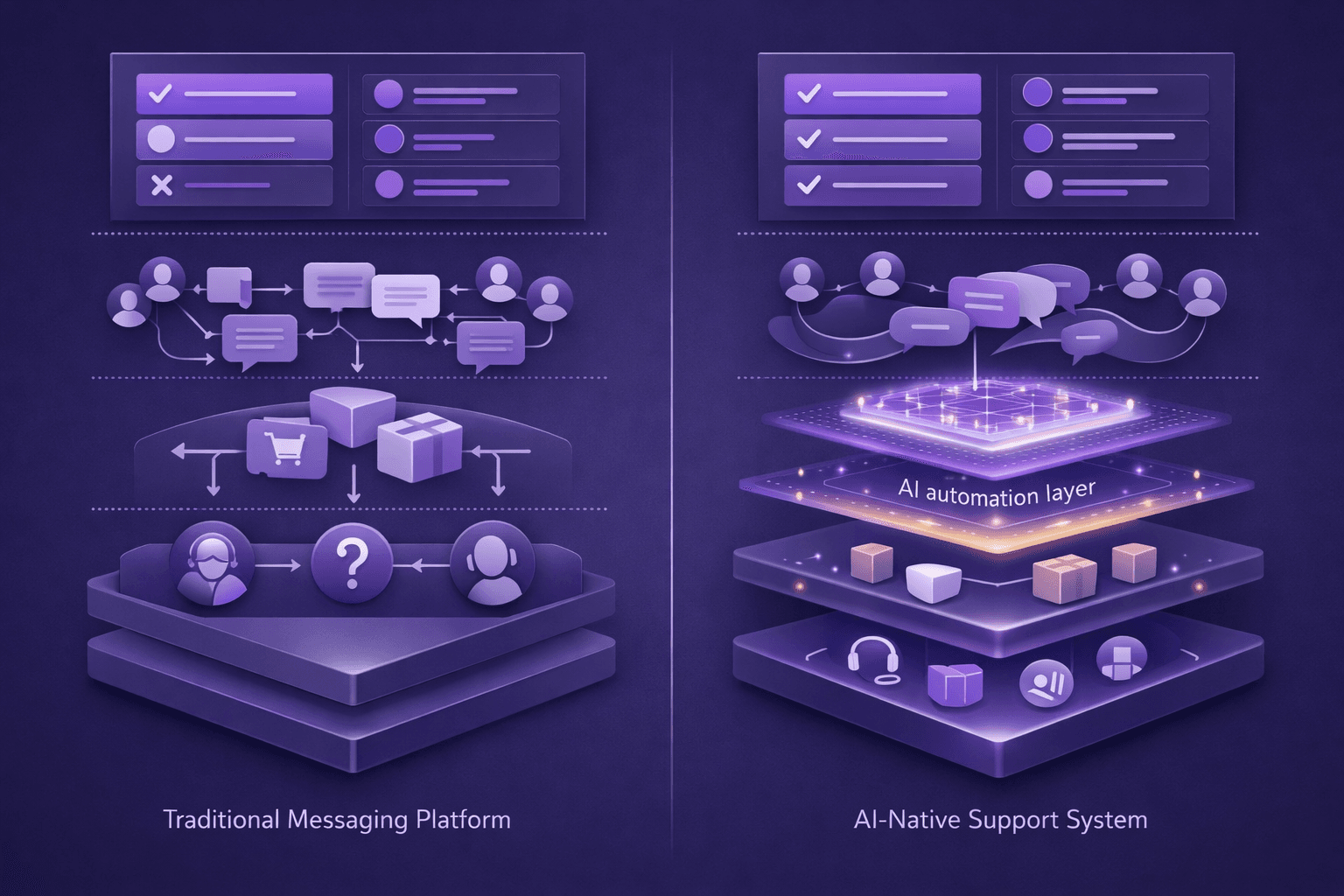
You're comparing Intercom to AI customer support for your e-commerce store. Here's the short answer: Intercom excels at customer engagement and conversational marketing, but AI-first customer support tools automate more support volume at lower cost.
Intercom started as a customer messaging platform, evolved into a comprehensive customer communications tool, and now includes AI features. But it's fundamentally built for human-led conversations with AI assistance, not AI-led conversations with human escalation.
AI-first customer support tools flip this model. They're designed to automate the majority of support conversations completely, escalating only when necessary. For e-commerce stores drowning in repetitive questions about orders, returns, and shipping, this architectural difference matters.
This guide compares Intercom's capabilities, costs, and ideal use cases against AI-first customer support solutions. You'll learn when each approach makes sense, what you'll actually pay at different scales, and how to make the right choice for your store.
What Intercom actually is
Intercom is a customer communication platform that combines:
Live chat and messaging
- Real-time chat widget on your website
- Mobile in-app messaging
- Proactive messages triggered by user behavior
- Conversation routing to the right team members
Customer engagement tools
- Targeted messages based on customer segments
- Product tours and onboarding flows
- Email campaigns integrated with chat
- Banner messages and tooltips
Support ticketing
- Inbox for managing customer conversations
- Team collaboration on tickets
- Macros and saved replies for common questions
- SLA tracking and reporting
AI features (Fin)
Intercom's AI assistant, called Fin:
- Answers questions based on your help center content
- Can resolve some conversations without human agents
- Provides AI-suggested responses to human agents
- Learns from your support content
The key: Intercom is excellent for customer engagement, onboarding, and marketing-driven conversations. Support automation is one feature among many, not the core focus.
What AI-first customer support is
AI-first customer support platforms are built specifically to automate support conversations:
Core capabilities
- Directly integrates with your e-commerce platform (order data, customer history, product catalog)
- Handles complete conversations without human involvement
- Processes actions (initiate returns, update orders, check tracking)
- Escalates to humans only when necessary with full context
E-commerce-specific automation
- Order status and tracking inquiries
- Returns and exchange processing
- Product questions and recommendations
- Shipping and delivery support
- Payment and checkout assistance
- Policy questions
Integration depth
Rather than pulling answers from help articles, AI-first tools:
- Look up real-time order data
- Check actual inventory status
- Process return requests directly
- Generate tracking links automatically
- Update customer information in your systems
The key: These tools are laser-focused on reducing support volume through automation, not on marketing or engagement.
Feature comparison: What each does better
Let's compare how each handles the features that matter for e-commerce support.
Automated order status inquiries
Intercom (with Fin):
- Can answer if you've written help articles about order tracking
- Provides general guidance ("Check your email for tracking")
- Requires customers to click through to carrier sites
- Can't look up specific order details unless integrated with custom API
- Humans still handle most order-specific questions
Automation rate: 20-40% for order inquiries
AI-first customer support:
- Integrates directly with your e-commerce platform
- Looks up customer's specific orders automatically
- Provides real-time tracking status from carriers
- Answers "Where is my order?" with actual shipment details
- No human involvement for standard tracking questions
Automation rate: 85-95% for order inquiries
Winner for e-commerce: AI-first tools. Order status is the #1 support inquiry for most stores.
Returns and refund processing
Intercom:
- Explains your return policy from help docs
- Provides return instructions
- Still requires human agent to process actual returns
- Agents use Intercom interface but switch to your e-commerce admin to process
- Each return requires agent time
Automation rate: 10-25% (informational only, not processing)
AI-first customer support:
- Explains policy and processes returns
- Initiates return in your e-commerce platform automatically
- Generates return shipping labels
- Updates customer on return status
- Escalates only for policy exceptions or unusual cases
Automation rate: 70-85% including actual processing
Winner for e-commerce: AI-first tools automate the full workflow, not just the explanation.
Product questions and recommendations
Intercom:
- Answers based on product descriptions in help docs
- Proactive messages can suggest products during browsing
- Great for conversational product discovery
- Humans handle specific comparison questions
- Excels at engagement-driven sales assistance
Intercom's strength: Product discovery and engagement, especially for complex products
AI-first customer support:
- Answers specification questions from product catalog
- Provides sizing, material, and compatibility info
- Compares products based on actual attributes
- Less sophisticated at discovery, better at answering specific questions
- Focused on answering questions, not driving engagement
Winner: Tie, different use cases. Intercom better for proactive product discovery and complex sales. AI-first better for answering specific product questions at scale.
24/7 availability
Intercom (with Fin):
- Fin provides 24/7 AI responses
- Limited by what's documented in your help center
- Complex questions wait for business hours
- Humans still needed for most e-commerce-specific inquiries
Coverage: AI handles 20-45% outside business hours, rest waits
AI-first customer support:
- Full access to order data and systems 24/7
- Same automation rate day and night
- No queue building overnight
- Customers get actual resolutions, not just information
Coverage: AI handles 75-90% outside business hours with full resolution
Winner for e-commerce: AI-first tools. E-commerce is global and support needs don't respect business hours.
High-volume event support (Black Friday, sales)
Intercom:
- Live chat queue grows rapidly during volume spikes
- Fin can handle some questions but limited by help docs
- Requires scaling human team for events
- Proactive messaging can reduce some inquiries
- Focus shifts to queue management
Scaling approach: Add temporary support staff
AI-first customer support:
- Handles same automation rate regardless of volume
- No queue buildup for automated inquiries
- Human escalations increase but slowly (only complex cases)
- Maintains response times during spikes
- Scales infinitely without adding staff
Scaling approach: AI handles increased load automatically
Winner for e-commerce: AI-first tools. Volume spikes don't require temporary staffing.
Team collaboration and internal tools
Intercom:
- Excellent team inbox with assignment and routing
- Internal notes and @mentions
- Collision detection (two agents answering same ticket)
- SLA tracking and performance metrics
- Great for teams coordinating on complex cases
Best for: Teams needing coordination tools
AI-first customer support:
- Human agents only see escalated conversations
- Simpler agent interface (fewer conversations to manage)
- Context from AI conversation included
- Less focus on team collaboration (fewer conversations need it)
- Metrics focus on automation rate, not agent performance
Best for: Minimal team handling edge cases
Winner for e-commerce: Intercom for large support teams, AI-first for lean teams. If you need extensive team collaboration tools, Intercom wins. If you're minimizing the team through automation, AI-first makes more sense.
Customer engagement and proactive messaging
Intercom:
- Best-in-class proactive messaging
- Behavioral triggers (time on page, exit intent, etc.)
- Customer segmentation and targeting
- Product tours and onboarding flows
- In-app messages and feature announcements
Intercom's biggest strength: This is where Intercom truly excels
AI-first customer support:
- Primarily reactive (responds to customer inquiries)
- Some tools offer basic proactive messages
- Focus is on answering questions, not driving engagement
- Limited segmentation and targeting capabilities
Winner: Intercom, decisively. If customer engagement and proactive messaging matter for your business, Intercom is superior.
Cost comparison: What you'll actually pay
Pricing structures differ significantly. Here's what typical e-commerce stores pay:
Small store (500-1,000 conversations/month)
Intercom:
- Essential plan: ~$39/seat/month (minimum 2 seats) = $78/month base
- Fin AI resolution: ~$0.99 per AI resolution
- If Fin resolves 200 conversations: $78 + $198 = $276/month
- Additional seats for coverage: $39/seat/month each
- Typical total: $300-500/month
AI-first customer support:
- Typical pricing: $200-400/month flat or per-conversation pricing
- No per-seat fees (fewer humans needed)
- Automation rate usually 75-85%
- Typical total: $200-400/month
Cost difference: Roughly similar, but AI-first automates significantly more
Medium store (3,000-5,000 conversations/month)
Intercom:
- Advanced or Expert plan needed: $99-139/seat/month
- 4-6 seats typical: $400-834/month base
- Fin AI resolutions: 1,000-1,500 × $0.99 = $990-1,485/month
- Typical total: $1,400-2,300/month
AI-first customer support:
- Typical pricing: $600-1,200/month
- Flat fee or per-resolution with higher automation
- Automation handles 3,000-4,000 conversations
- 500-1,000 conversations to humans
- Typical total: $600-1,200/month
Cost difference: AI-first typically 40-60% less expensive
Large store (10,000+ conversations/month)
Intercom:
- Expert plan: $139/seat/month
- 8-12 seats needed: $1,112-1,668/month base
- Fin AI resolutions: 3,000-5,000 × $0.99 = $2,970-4,950/month
- Enterprise features may require custom pricing
- Typical total: $4,000-6,500/month
AI-first customer support:
- Typical pricing: $1,500-3,000/month
- Higher automation rate (80-90%)
- 1,000-2,000 conversations need humans
- 2-4 support agents vs 8-12 with Intercom
- Typical total: $1,500-3,000/month
Cost difference: AI-first typically 50-70% less expensive
Hidden cost factors
Intercom's hidden costs:
- Per-seat pricing as you scale support team
- Fin charges per AI resolution (adds up quickly)
- May need separate tools for some integrations
- Team training and onboarding costs
AI-first hidden costs:
- Integration setup time (one-time)
- Knowledge base building (initial)
- Fewer team members may mean less redundancy
- May need separate tool for proactive engagement
True cost comparison: At scale, AI-first platforms typically cost 50-70% less than Intercom while automating significantly more conversations.
When Intercom makes sense for your e-commerce store
Intercom is the better choice when:
Your support needs human judgment frequently
If your products require:
- Complex consultative selling
- Detailed customization discussions
- Nuanced recommendations requiring expertise
- Building customer relationships over time
Example: High-end furniture store where customers need design advice, room planning help, and custom ordering.
Customer engagement drives your business model
If you focus on:
- Proactive customer education and onboarding
- In-app product tours and feature discovery
- Behavioral messaging and conversion optimization
- Lifecycle marketing through messaging
Example: Subscription box service where customer engagement and retention require proactive communication.
You have a large, collaborative support team
If your operation includes:
- Specialized support agents for different product lines
- Complex ticket routing and escalation
- Team collaboration on difficult cases
- Heavy internal documentation and notes
Example: Marketplace platform with multiple seller support tiers and complex operational requirements.
You value the all-in-one platform approach
If you prefer:
- Single platform for support, engagement, and marketing
- Unified customer communication history
- One vendor for messaging, chat, and campaigns
- Consolidated reporting across all customer interactions
Example: B2B e-commerce where sales, support, and success teams need shared customer context.
You're prepared to invest in human support at scale
If you have:
- Budget for per-seat pricing as you scale
- Willingness to hire and train support staff
- Acceptance of AI as enhancement, not primary automation
- Focus on high-touch customer experience
Example: Luxury brand where white-glove support is part of the value proposition.
When AI-first customer support makes sense
AI-first tools are better when:
Repetitive questions dominate your support volume
If your typical inquiries are:
- Order status and tracking
- Returns and refund processing
- Shipping information
- Product specifications and availability
- Policy questions
Example: Fashion e-commerce with 70% of tickets about order status, sizing, and returns.
You need to scale support without scaling headcount
If your goals include:
- Maintaining small, efficient support team
- Handling growth without proportional hiring
- Reducing per-conversation support cost
- Focusing human time on complex cases only
Example: Fast-growing DTC brand going from 2,000 to 10,000 monthly conversations without adding support staff.
24/7 support is critical but expensive
If you need:
- True 24/7 coverage across time zones
- Immediate responses regardless of time
- Weekend and holiday support
- Consistent service without shift scheduling
Example: International store serving customers across Americas, Europe, and Asia-Pacific.
Your support integrates deeply with your e-commerce platform
If automation requires:
- Real-time access to order data
- Ability to process returns/refunds automatically
- Inventory lookups and availability checks
- Integration with shipping carriers
Example: High-volume supplement store where 80% of inquiries can be fully resolved with platform data.
You have predictable support patterns
If you experience:
- Seasonal volume spikes (Black Friday, holidays)
- Flash sale traffic surges
- Product launch inquiry waves
- Predictable question types
Example: Toy store with massive Q4 volume spike that would require 5x temporary staff with Intercom.
Cost efficiency is a primary concern
If you prioritize:
- Reducing support cost per conversation
- Avoiding per-seat pricing as you scale
- Maximizing automation ROI
- Keeping support expenses predictable
Example: Bootstrapped e-commerce business optimizing for profitability.
The hybrid approach: Using both
Some e-commerce stores use both, though this adds complexity:
Common hybrid implementations
Option 1: Intercom for engagement, AI for support
- Use Intercom for proactive messaging and product tours
- Route support inquiries to AI-first tool
- Separate tools, separate purposes
Works for: Stores where engagement and support are equally important
Option 2: Start with AI, add Intercom later
- Launch with AI-first support to handle basics
- Add Intercom when ready to invest in engagement
- Incremental investment as you grow
Works for: Growing stores prioritizing support automation first
Option 3: Intercom + integration with AI backend
- Use Intercom as the interface
- Connect to AI automation for e-commerce-specific queries
- Best of both worlds, but requires custom integration
Works for: Stores with development resources and budget for both
Hybrid approach considerations
Pros:
- Leverage strengths of each platform
- Flexibility to use right tool for each job
- Can phase implementation
Cons:
- Higher total cost (two platforms)
- Integration complexity
- Divided customer conversation history
- Team needs to manage multiple tools
Recommendation: Most e-commerce stores should choose one primary platform rather than mixing. The added complexity usually outweighs the benefits unless you have specific needs requiring both.
Real-world examples: What stores actually chose
Case study 1: Skincare brand chose AI-first
Store profile:
- $2M annual revenue
- 4,000 conversations/month
- 2-person support team
- 65% inquiries about orders/shipping/returns
Originally used: Intercom ($1,800/month with 4 seats + Fin)
Switched to: AI-first customer support ($800/month)
Results after 4 months:
- Automation rate: 78% (up from 35% with Intercom's Fin)
- Support team reduced from 4 to 2 full-time
- Response time: 30 seconds vs 4 hours average
- Cost: $800/month vs $1,800/month (56% reduction)
- CSAT: 4.6/5 (up from 4.3/5)
Why they switched: "Intercom's engagement features were great, but we were paying for capabilities we didn't use. We needed automation for repetitive order questions, and Fin couldn't access our Shopify data directly. The AI-first tool resolved 3x more conversations automatically."
Case study 2: Furniture store stayed with Intercom
Store profile:
- $8M annual revenue
- 2,500 conversations/month
- 6-person support team (sales + support hybrid)
- Complex products requiring consultation
Evaluated: AI-first alternatives
Stayed with: Intercom ($2,400/month)
Why they stayed:
- Support conversations are sales opportunities (average $800 order)
- Proactive engagement during browsing increases conversions 23%
- Product tours educate customers on design tools
- Team collaboration features essential for handoffs
- Complex questions require human expertise (can't automate 80%)
Their take: "We tested AI-first tools but our support is too consultative. Intercom's engagement features drive real revenue. The cost is justified by the sales lift from proactive messaging. We use Fin for after-hours basic questions, but our day support is high-touch by design."
Case study 3: Supplement brand uses hybrid
Store profile:
- $12M annual revenue
- 8,000 conversations/month
- 5-person support team
Uses both:
- AI-first for support automation ($1,500/month)
- Intercom for lifecycle messaging ($400/month, minimal seats)
Results:
- AI handles 82% of support inquiries
- Intercom drives re-order reminders and subscription management
- Combined cost: $1,900/month
- Would cost $4,500/month with Intercom alone for same volume
Their approach: "We split engagement and support. Intercom runs our lifecycle campaigns and proactive messages. When customers have questions, they're routed to our AI support, which handles subscriptions, orders, and returns automatically. Humans only handle complex medical questions and major issues."
Trade-off: Managing two platforms adds overhead, but the cost savings and automation justify it at their scale.
How to decide: Decision framework
Use this framework to choose between Intercom and AI-first customer support:
Step 1: Analyze your conversation types
Calculate what percentage of your monthly conversations are:
Automatable inquiries (order status, returns, shipping, product specs, policy questions):
- Less than 40%: Intercom likely better
- 40-60%: Could go either way
- More than 60%: AI-first likely better
Complex conversations (consultative sales, troubleshooting, custom requests):
- More than 50%: Intercom likely better
- 30-50%: Consider your priorities
- Less than 30%: AI-first likely better
Proactive engagement value (product tours, behavioral messages, onboarding):
- Critical to business model: Intercom
- Nice to have: Either could work
- Not important: AI-first
Step 2: Evaluate integration needs
Your e-commerce platform:
- Shopify, WooCommerce, BigCommerce: AI-first tools integrate deeply
- Custom platform: May need custom work either way
- Multi-platform: Consider integration complexity
Data access requirements:
- Need real-time order/inventory data: AI-first better
- Help articles sufficient: Intercom works
- Complex custom data: Evaluate each platform's API
Step 3: Calculate cost at scale
Project your support volume in 12 months:
Intercom estimated cost:
- Base cost: [seats needed] × [plan price]
- Fin AI cost: [AI resolutions/month] × $0.99
- Total: $ _____/month
AI-first estimated cost:
- Typical: $200-3,000/month depending on volume
- Get quotes from 2-3 providers
- Total: $ _____/month
Cost difference: If AI-first is 40%+ less and automation rate is higher, it's likely the better financial choice.
Step 4: Assess team structure
Current team:
- Large team (8+ agents): Intercom's collaboration tools valuable
- Medium team (3-7 agents): Either could work
- Small team (1-2 agents): AI-first maximizes their time
Growth plans:
- Plan to scale team: Intercom's per-seat model gets expensive
- Plan to minimize team: AI-first enables staying lean
- Uncertain: AI-first provides more flexibility
Step 5: Consider your priorities
Rank these from 1-5 (1 = most important):
- ___ Reducing support cost
- ___ Automating repetitive questions
- ___ Customer engagement and proactive messaging
- ___ Team collaboration tools
- ___ Consultative, high-touch support
If your top 2 are:
- Cost + automation: AI-first
- Engagement + collaboration: Intercom
- Mixed: Evaluate more deeply
Decision matrix
Based on your analysis:
Choose AI-first customer support if:
- 60%+ of conversations are automatable
- Cost efficiency is top priority
- You want to scale without proportional headcount increase
- 24/7 support is important
- Deep e-commerce platform integration matters
Choose Intercom if:
- Customer engagement and proactive messaging drive your business
- You have complex, consultative support needs
- Team collaboration features are essential
- You want an all-in-one platform
- Support is part of high-touch customer experience
Not sure? Start with AI-first for support automation. You can always add Intercom later for engagement if needed. It's easier to add engagement tools than to retrofit automation.
Common mistakes to avoid
Mistake 1: Choosing based on brand recognition alone
The trap: "Intercom is the industry leader, so we should use it."
Reality: Intercom is excellent at what it does, but it's built for engagement-first companies. E-commerce stores with high repetitive support volume often overpay for features they don't need.
Better approach: Evaluate based on your actual conversation patterns and priorities, not brand name.
Mistake 2: Underestimating integration importance
The trap: Assuming help articles will provide enough information for AI.
Reality: E-commerce support requires real-time data access (orders, inventory, tracking). Tools that only reference help docs can't actually resolve inquiries.
Better approach: Verify the platform can integrate directly with your e-commerce system and shipping carriers.
Mistake 3: Ignoring total cost of ownership
The trap: Comparing just the base subscription prices.
Reality: Intercom's per-seat and per-AI-resolution pricing adds up quickly. A $39/month base price becomes $2,000+/month at moderate scale.
Better approach: Calculate total monthly cost including seats, Fin resolutions, and necessary add-ons at your projected volume.
Mistake 4: Expecting AI to replace all humans immediately
The trap: Thinking AI will automate 100% of conversations right away.
Reality: Even excellent AI automation plateaus at 75-90%. You still need humans for edge cases, complex situations, and escalations.
Better approach: Plan for hybrid approach with AI handling majority and humans handling exceptions.
Mistake 5: Choosing for current scale instead of future scale
The trap: Making decision based only on today's conversation volume.
Reality: As you grow from 1,000 to 10,000 conversations/month, cost structures change dramatically.
Better approach: Model costs at 2x and 5x your current volume. Choose the platform that scales economically.
Mistake 6: Not testing with real customer conversations
The trap: Deciding based on feature lists and demos with sample data.
Reality: Every store's conversation patterns are different. A demo with perfect data doesn't reflect your reality.
Better approach: Request trial with your actual data and conversation history. Test with real customer inquiries.
Implementation: Getting started with either platform
If you choose Intercom
Initial setup (Week 1-2):
- Install Intercom widget on your store
- Configure basic routing rules
- Set up team inbox and assignments
- Create macros for common responses
- Train team on Intercom interface
Fin AI setup (Week 2-3):
- Build comprehensive help center content
- Enable Fin AI assistant
- Configure which topics Fin should handle
- Set escalation rules for human handoff
- Test Fin responses with real questions
Optimization (Ongoing):
- Monitor which questions Fin resolves vs escalates
- Expand help center content for common questions
- Adjust routing and assignment rules
- Track per-agent performance metrics
- Optimize Fin resolution rate over time
Timeline to value: 2-4 weeks for basic setup, 2-3 months to optimize Fin automation
If you choose AI-first customer support
Initial setup (Week 1-2):
- Connect to your e-commerce platform (Shopify, WooCommerce, etc.)
- Grant access to order data and customer information
- Integrate with shipping carriers for tracking
- Configure return/refund policies and workflows
- Set up escalation rules for human handoff
Knowledge base and brand voice (Week 2-3):
- Train AI on your product catalog
- Configure brand voice and tone
- Define which questions to automate vs escalate
- Set up test environment
- Run sample conversations to verify accuracy
Soft launch (Week 3-4):
- Enable AI for subset of conversations
- Monitor accuracy and escalation rate
- Adjust based on real customer interactions
- Expand to more conversation types
- Full launch after verification
Timeline to value: 3-4 weeks to full automation, high automation rate from day one
Migration considerations
Moving from Intercom to AI-first:
- Export conversation history for reference
- Keep Intercom active during AI setup to avoid gaps
- Run parallel for 1-2 weeks before switching
- Migrate team to new agent interface
- Update website widget
Adding AI-first while keeping Intercom:
- Set up routing (support → AI, engagement → Intercom)
- Decide on primary customer history location
- Train team on when to use each platform
- Monitor for customer confusion with multiple widgets
Starting fresh with AI-first:
- Cleanest implementation path
- No migration complexity
- Faster time to value
- No legacy workflows to change
What about other platforms?
This comparison focused on Intercom specifically, but similar considerations apply when evaluating:
Other engagement-focused platforms:
- Drift: Similar to Intercom, conversational marketing focus
- HubSpot: Marketing and CRM platform with chat features
- LiveChat: Live chat with basic automation
Other AI-first platforms:
- Multiple vendors offer e-commerce-specific AI automation
- Evaluation criteria remain the same (integration depth, automation rate, cost)
Traditional helpdesks:
- Zendesk, Freshdesk, Help Scout: Different feature set, covered in AI Customer Support vs Traditional Helpdesk Software
Related resources
Want to dive deeper into customer support decisions? Check out these guides:
- Best AI Customer Support Software for E-commerce (2026) - Complete buyer's guide comparing all major platforms
- AI Customer Support for E-commerce: The Complete Guide - Comprehensive overview of AI customer support
- E-commerce Customer Support Use Cases You Can Automate with AI - Specific automation opportunities
- AI Customer Support vs Traditional Helpdesk Software - Broader comparison of approaches
- AI Customer Support Metrics That Actually Matter - How to measure automation success
- AI Escalation: When and How to Hand Off to Humans - Designing effective escalation strategies
Final thoughts
Intercom and AI-first customer support tools solve different problems:
Intercom excels at:
- Customer engagement and lifecycle messaging
- Proactive communication and behavioral triggers
- Consultative, high-touch support at scale
- All-in-one platform for messaging, support, and marketing
AI-first customer support excels at:
- Automating repetitive e-commerce inquiries
- Deep integration with e-commerce platforms
- Scaling support without scaling headcount
- Cost efficiency as conversation volume grows
For most e-commerce stores with high volumes of repetitive support questions, AI-first tools deliver higher automation rates at lower cost. The 75-90% automation typical with AI-first platforms significantly exceeds the 20-45% you'll see with Intercom's Fin.
But if customer engagement, proactive messaging, and consultative support define your business model, Intercom's strengths may justify the higher cost.
The right choice depends on your conversation patterns, business priorities, and budget. Analyze your actual support data, project costs at scale, and test with real conversations before deciding.
Not sure where to start? Most e-commerce stores should default to AI-first customer support for handling repetitive inquiries, then add engagement tools like Intercom later if needed. It's easier to add engagement capabilities than to retrofit automation after the fact.