
Zendesk vs AI Automation for Online Stores: Which Delivers Better ROI?
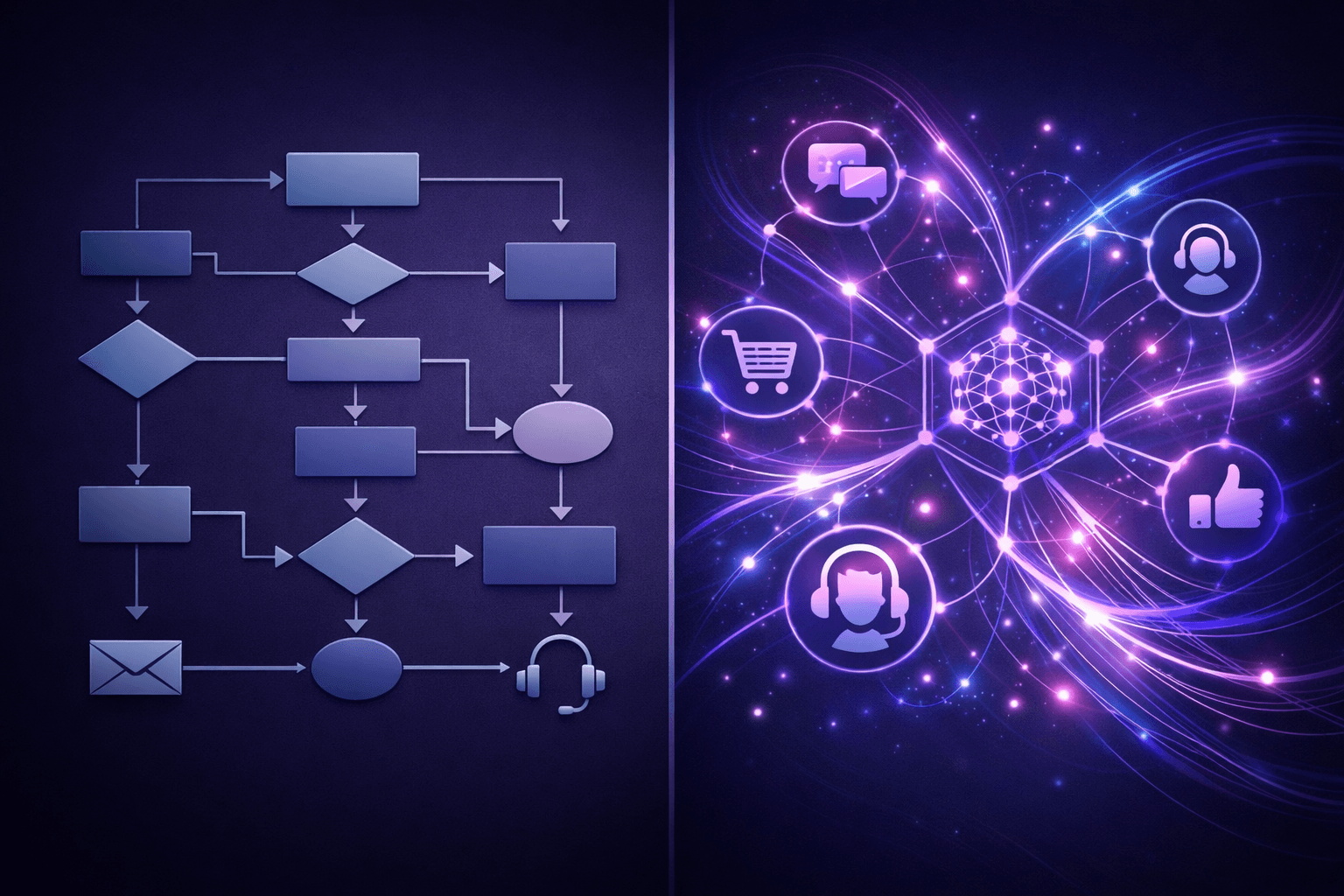
You're comparing Zendesk to AI automation for your online store's customer support. Here's the short answer: Zendesk excels at managing human support teams and complex workflows, but AI automation reduces support volume by 70-85% at a fraction of the cost.
Zendesk is the enterprise standard for support ticketing. It's been around since 2007, handles billions of tickets annually, and offers robust features for managing support teams, tracking SLAs, and analyzing performance. But it's fundamentally built for human agents managing tickets, not AI handling conversations autonomously.
AI automation tools flip this model. Instead of helping humans work faster, they eliminate the need for human involvement in 70-85% of support conversations. For e-commerce stores handling repetitive questions about orders, shipping, returns, and products, this architectural difference changes the economics completely.
This guide compares Zendesk's capabilities, costs, and ideal use cases against AI automation solutions. You'll understand when each approach makes sense, what you'll actually pay at different scales, and how to make the right choice for your store.
What Zendesk actually is
Zendesk is a comprehensive customer service platform that combines:
Support ticketing system
- Multi-channel ticket management (email, chat, phone, social)
- Automatic ticket routing based on skills, load, or priority
- Ticket views and filters for organizing work
- SLA policies and escalation rules
- Custom ticket fields and forms
Team collaboration tools
- Internal notes and private comments
- Side conversations for consulting colleagues
- Team dashboards showing workload distribution
- Agent collision detection to prevent duplicate work
- Light agents for occasional contributors
Knowledge base
- Self-service help center
- Article creation with rich formatting
- AI-powered article suggestions during conversations
- Multilingual content management
- Community forums integration
Analytics and reporting
- Agent performance metrics (first response time, resolution time, CSAT)
- Ticket volume trends and forecasting
- Channel performance comparison
- Custom reports and dashboards
- Advanced analytics for enterprise plans
AI features (Zendesk AI)
Zendesk's AI capabilities include:
- Intent detection to route tickets automatically
- Suggested macros and responses for agents
- Answer Bot that pulls from knowledge base articles
- AI-powered article recommendations
- Sentiment analysis for ticket prioritization
The key: Zendesk is designed to help human support teams work more efficiently. AI assists agents but doesn't replace them for most conversations.
What AI automation actually is
AI automation for e-commerce is built specifically to handle support conversations autonomously:
Core capabilities
- Direct integration with your e-commerce platform (Shopify, WooCommerce, BigCommerce, etc.)
- Autonomous conversation handling from greeting to resolution
- Real-time access to order data, inventory, customer history, and product catalog
- Action execution (process returns, update orders, send tracking links)
- Smart escalation to humans only when necessary with full context transfer
E-commerce-specific automation
Handles complete conversations for:
- Order status and tracking inquiries
- Returns and exchange processing
- Shipping and delivery questions
- Product information and recommendations
- Payment and checkout assistance
- Account management
- Policy questions
- Restock notifications
- Subscription management
Integration depth
Rather than suggesting articles, AI automation:
- Looks up customer orders in real-time
- Checks live inventory availability
- Initiates return labels through shipping APIs
- Provides actual tracking updates from carriers
- Processes refunds through payment gateways
- Updates customer information directly
The key: AI automation eliminates 70-85% of support conversations entirely, rather than making human agents slightly more productive.
Feature comparison: What each does better
Let's compare how each handles the features that matter for e-commerce support.
Order status and tracking inquiries
Zendesk:
- Customer emails "Where is my order?"
- Creates ticket in support queue
- Agent opens ticket, identifies customer
- Agent looks up order in e-commerce platform (separate window)
- Agent copies tracking number, checks carrier site
- Agent replies with tracking information
- Average handling time: 3-5 minutes per inquiry
With Answer Bot:
- Can suggest knowledge base articles about tracking
- Doesn't access actual order data
- Customer still needs agent for specific order details
- Automation rate: 15-25% for order inquiries
AI automation:
- Customer asks "Where is my order?"
- AI identifies customer automatically
- AI retrieves order details from e-commerce platform
- AI fetches real-time tracking from carrier API
- AI responds with current location and estimated delivery
- Customer receives answer in 10-15 seconds
- No human involvement needed
Automation rate: 90-95% for order inquiries
Winner for e-commerce: AI automation. Order status is the #1 inquiry type, and AI handles it completely.
Impact: A store with 500 monthly order inquiries saves 25-40 hours monthly by automating this category.
Returns and refund processing
Zendesk:
- Customer submits return request
- Ticket routed to returns team
- Agent reviews return policy eligibility
- Agent checks order details and purchase date
- Agent initiates return in e-commerce platform
- Agent sends return instructions and label
- Agent sets reminder to process refund after receipt
- Average handling time: 8-12 minutes per return
With macros:
- Pre-written responses speed up some steps
- Still requires agent to verify eligibility and initiate return
- Automation rate: 10-20% for simple returns within policy
AI automation:
- Customer: "I'd like to return my order"
- AI verifies order eligibility (purchase date, return window, item condition)
- AI walks customer through return reason and options
- AI offers exchange alternative if applicable
- AI generates return label through shipping API
- AI sends return instructions
- AI schedules refund processing upon receipt
- Resolution time: 2-3 minutes, no human involvement
For complex cases (outside return window, damaged items, special requests):
- AI recognizes escalation triggers
- AI collects all relevant details first
- AI transfers to human with complete context
- Human makes final decision on policy exception
Automation rate: 75-85% for returns
Winner for e-commerce: AI automation. Returns require policy verification and system actions that AI handles well.
Impact: A store with 200 monthly returns saves 20-32 hours monthly through automation.
Product questions and recommendations
Zendesk:
- Customer asks product question
- Ticket created and routed
- Agent researches product specifications
- Agent compares products if needed
- Agent provides recommendation
- Average handling time: 5-8 minutes
With Answer Bot:
- Can pull from help articles about products
- Can't access real-time inventory or detailed specs
- Generic answers, not personalized to customer needs
- Automation rate: 20-30% for basic product questions
AI automation:
- Customer asks product question
- AI accesses complete product catalog with specifications
- AI considers customer's purchase history and preferences
- AI checks real-time inventory and delivery estimates
- AI provides personalized product recommendations
- AI answers follow-up questions about sizing, materials, compatibility
- Resolution in 1-2 minutes
Escalates when:
- Customer has highly specialized technical requirements
- Question requires subjective judgment about use case fit
- Multiple back-and-forth indicates customer needs human expertise
Automation rate: 70-80% for product questions
Winner for e-commerce: AI automation. Direct catalog access and personalization enable better answers faster.
Impact: Particularly valuable for stores with large catalogs or technical products.
Handling high-volume sales events
Zendesk:
- Hire temporary support agents for peak periods
- Create macros for common Black Friday questions
- Set up additional ticket routing rules
- Monitor queue to prevent SLA breaches
- Still requires significant human staffing to handle volume spikes
Typical approach:
- 3x normal support volume requires 3x support staff
- Training temporary staff takes 1-2 weeks
- Quality varies with temporary agents
- Labor costs spike during peak season
AI automation:
- Handles volume spikes without additional resources
- Same infrastructure serves 100 or 10,000 conversations
- Response time remains consistent during peaks
- No hiring, training, or quality variation
Real example:
- Regular volume: 800 monthly conversations
- Black Friday surge: 10,400 conversations (13x increase)
- AI automation rate: 82%
- Human team handled: 1,872 conversations (2.3x normal)
- Without AI: Would need 13x staffing or accept degraded service
Winner for e-commerce: AI automation. Seasonal volume spikes are fully absorbed.
Impact: Eliminates need for seasonal hiring and maintains service levels during peak periods.
Team management and collaboration
Zendesk:
- Comprehensive agent workspace with ticket history
- Team views showing who's working on what
- Internal notes for agent collaboration
- Side conversations for consulting specialists
- Agent performance dashboards
- Skills-based routing for complex tickets
- Shift scheduling and coverage management
AI automation:
- Minimal team management interface (AI handles most conversations)
- Queue for escalated conversations only
- Full conversation context transferred to human agents
- Basic agent performance metrics for escalated cases
- Smaller team means less management overhead
Winner: Zendesk. If you have a large support team with specialized roles, Zendesk's team management is excellent.
But: Most e-commerce stores find they need a much smaller team when AI handles 70-85% of volume. A team of 2-3 people doesn't need enterprise-grade workforce management.
Multichannel support
Zendesk:
- Unified inbox for email, chat, phone, social media, messaging apps
- Consistent ticket handling across all channels
- Channel-specific SLAs and routing rules
- Voice support with call recording and IVR
- SMS and WhatsApp support
- Social media monitoring
AI automation:
- Primarily focused on chat/messaging channels
- Email support included
- Phone integration varies by platform
- Growing support for WhatsApp, SMS, social DMs
- Less emphasis on voice (though this is changing)
Winner: Zendesk for stores requiring robust phone support and social media monitoring.
But: For most e-commerce stores, 80%+ of support happens via chat and email, where AI automation excels.
Knowledge base and self-service
Zendesk:
- Professional help center builder
- Article creation with rich formatting and media
- AI-powered article suggestions during conversations
- Community forums and discussion boards
- Multilingual content management
- Analytics on article performance
AI automation:
- Uses knowledge base as reference material
- Doesn't require customers to search articles themselves
- AI pulls relevant information automatically during conversations
- Help center often smaller (AI handles questions directly)
- Less emphasis on building extensive self-service portals
Winner: Zendesk for stores wanting a robust, customer-facing knowledge base.
But: If AI can answer questions directly in conversation, fewer customers need to search articles. The goal is solving the problem, not building documentation.
Cost comparison by store size
Let's compare what you'll actually pay at different scales.
Small store (1,000 monthly conversations)
Zendesk costs:
- Suite Team plan: $69/agent/month
- 2 agents needed: $138/month base
- Answer Bot: +$50/month per agent = $100/month additional
- Total: $238/month minimum
With Answer Bot:
- Automates 20% of conversations (200/month)
- Human agents handle 800 conversations
- Cost per resolved conversation: $0.30
- Annual cost: $2,856
AI automation costs:
- Typical pricing: $200-300/month for this volume
- Automates 75% of conversations (750/month)
- 1 part-time agent for 250 escalations ($20-30/hour, ~10 hours/month): $200-300/month
- Total: $400-600/month
Cost per resolved conversation: $0.40-0.60 Annual cost: $4,800-7,200
Financial comparison:
- AI automation costs 68-152% more initially
- But eliminates need for second full-time agent
- As volume grows, AI automation pulls ahead
Best choice for small stores:
- Revenue < $50k/month: Zendesk with macros (cheaper, sufficient)
- Revenue $50-150k/month: Consider AI if growth is rapid
- Revenue > $150k/month: AI automation likely better long-term investment
Medium store (5,000 monthly conversations)
Zendesk costs:
- Suite Team: $69/agent/month
- 6-8 agents needed: $414-552/month base
- Answer Bot: $300-400/month additional
- Advanced AI features: +$50/agent/month = $300-400/month
- Total: $1,014-1,352/month
With Answer Bot and optimization:
- Automates 25% of conversations (1,250/month)
- Human agents handle 3,750 conversations
- Cost per resolved conversation: $0.20-0.27
- Annual cost: $12,168-16,224
AI automation costs:
- Typical pricing: $600-900/month for this volume
- Automates 80% of conversations (4,000/month)
- 2-3 full-time agents for 1,000 escalations: $6,000-9,000/month (salaries)
- Total: $6,600-9,900/month
Cost per resolved conversation: $1.32-1.98 Annual cost: $79,200-118,800
Wait, this looks worse for AI automation. But here's what this analysis misses:
Zendesk's hidden costs:
- 6-8 agent salaries ($30-40k each annually): $180,000-320,000/year
- Training and onboarding: $3,000-5,000 per agent
- Turnover replacement costs: 1-2 agents/year = $6,000-10,000
- Management overhead: 1 supervisor ($50k/year)
- Total annual labor cost: $236,000-380,000
AI automation total cost:
- Platform: $7,200-10,800/year
- 2-3 agents: $60,000-90,000/year (salaries)
- Minimal management: No supervisor needed
- Total annual cost: $67,200-100,800
Savings with AI automation: $136,000-280,000 annually (58-74% reduction)
Cost per resolved conversation (including labor):
- Zendesk: $47.20-76.00
- AI automation: $13.44-20.16
Winner: AI automation saves 58-74% even at medium scale.
Large store (20,000 monthly conversations)
Zendesk costs:
- Suite Professional: $115/agent/month (needed at this scale)
- 24-30 agents needed: $2,760-3,450/month
- Advanced AI features: $1,200-1,500/month
- Enterprise features: $500/month
- Total: $4,460-5,450/month
With optimization:
- Automates 30% of conversations (6,000/month)
- Human agents handle 14,000 conversations
- Annual platform cost: $53,520-65,400
Full cost including labor:
- 24-30 agent salaries ($35-45k each): $840,000-1,350,000/year
- 3 supervisors ($55k each): $165,000/year
- Training, turnover, management: $50,000/year
- Platform: $53,520-65,400/year
- Total annual cost: $1,108,520-1,630,400
Cost per resolved conversation: $55.43-81.52
AI automation costs:
- Platform: $2,000-3,000/month = $24,000-36,000/year
- 5-7 specialized agents: $175,000-245,000/year
- 1 supervisor: $60,000/year
- Total annual cost: $259,000-341,000
Automates 82% of conversations (16,400/month) Human agents handle 3,600 escalations/month
Cost per resolved conversation: $12.95-17.05
Savings with AI automation: $767,520-1,289,400 annually (69-79% reduction)
Winner: AI automation provides massive savings at scale.
Cost trajectory over time
What happens as your store grows?
Year 1: 2,000 conversations/month
- Zendesk: $150k total (3 agents + platform)
- AI automation: $80k total (1 agent + platform)
- Savings: $70k (47%)
Year 2: 5,000 conversations/month (2.5x growth)
- Zendesk: $290k total (7 agents + platform)
- AI automation: $95k total (2 agents + platform)
- Savings: $195k (67%)
Year 3: 10,000 conversations/month (2x growth)
- Zendesk: $540k total (14 agents + platform)
- AI automation: $125k total (3 agents + platform)
- Savings: $415k (77%)
The pattern: As volume increases, AI automation's advantage compounds because human costs scale linearly with volume, but AI costs scale sub-linearly.
When Zendesk makes more sense
Despite AI automation's advantages for most e-commerce stores, Zendesk is the better choice in specific scenarios:
You have a very small store (< $30k monthly revenue)
- Support volume is low (< 500 conversations/month)
- You're answering questions yourself
- Zendesk's free tier or lowest plan ($19/agent) is sufficient
- AI automation is overkill and too expensive
You sell highly complex or custom products
- B2B sales with complex configurations
- Technical products requiring deep expertise (industrial equipment, specialized software)
- Custom manufacturing or bespoke services
- Every customer has unique requirements
Why Zendesk wins:
- These conversations require human judgment and expertise
- AI automation rate would be < 40%
- Better to invest in tooling for your human experts
You need robust phone support
- Significant portion of customers prefer phone
- Complex issues benefit from voice conversation
- Older demographic or high-ticket purchases
Zendesk offers:
- Comprehensive call center features
- IVR and call routing
- Call recording and quality monitoring
- Agent phone productivity tools
AI automation:
- Voice support is emerging but less mature
- Chat/email focused currently
- Phone escalation available but not primary channel
You have specialized support workflows
- Support involves multiple departments (billing, technical, fulfillment)
- Complex SLA requirements vary by customer segment
- Extensive internal knowledge base for agents
- Custom fields and workflows specific to your business
Zendesk excels at:
- Complex routing and escalation rules
- Cross-team collaboration
- Custom ticket lifecycle management
- Integration with internal tools
You already have a large, trained support team
- 15+ experienced support agents
- Significant investment in training and processes
- Team is productive and customers are satisfied
- Support is a competitive differentiator
Switching costs:
- Training team on new system
- Rebuilding workflows
- Change management challenges
- Potential service disruption during transition
Consider: If your current system works well, changing involves risk. Calculate ROI carefully including transition costs.
You need extensive reporting and analytics
- Detailed agent performance tracking
- Custom reports for different stakeholders
- Forecast modeling for workforce planning
- Compliance documentation requirements
Zendesk offers:
- Advanced analytics and custom dashboards
- Extensive reporting capabilities
- Data export and API access
- Enterprise-grade audit trails
AI automation:
- Basic reporting focused on automation metrics
- Less emphasis on agent productivity (fewer agents)
- Growing analytics capabilities but less mature
When AI automation makes more sense
AI automation is the better choice for most e-commerce stores:
You handle repetitive support questions
- 60%+ of conversations are about orders, shipping, returns, products
- Same questions repeated across customers
- Answers are fact-based, not subjective
These are perfect for AI:
- Order status inquiries
- Return eligibility and processing
- Product specifications and availability
- Shipping estimates and tracking
- Account management
- Policy questions
Support volume is growing faster than you can hire
- Scaling from 2,000 to 10,000 monthly conversations
- Can't hire and train agents fast enough
- Response times suffering during growth
- Support costs eating into margins
AI automation:
- Scales instantly with no hiring
- Maintains consistent response time
- Fixed costs regardless of volume
- Frees you to focus on growth instead of hiring
You have seasonal volume spikes
- Black Friday/Cyber Monday surges
- Holiday shopping peaks
- Product launch events
- Flash sales or promotions
Without AI:
- Hire temporary agents
- Training takes 1-2 weeks
- Quality varies
- High turnover after season ends
With AI:
- Same infrastructure handles spikes
- No seasonal hiring needed
- Consistent quality maintained
- Team focuses on complex escalations
Cost-per-conversation matters to your economics
- You're optimizing margins
- Support costs are significant overhead
- Want to allocate resources to growth, not operations
Financial impact:
- 60-75% cost reduction compared to full human teams
- Savings scale as volume grows
- Redirect savings to marketing, product, or margin
You want 24/7 support without 24/7 staffing
- Customers in multiple time zones
- Expectations for instant responses
- Can't afford night shifts
AI automation:
- Always available, no shift coverage needed
- Instant responses regardless of time
- Human team works normal hours on escalations only
Your team spends time on repetitive work
- Agents answering the same questions repeatedly
- Looking up order information in another system
- Copy-pasting tracking numbers
- Processing routine return requests
AI eliminates:
- Repetitive lookups and data entry
- Context switching between systems
- Copy-paste workflows
- Routine policy application
Human agents:
- Focus on complex problems
- Handle policy exceptions
- Build customer relationships
- Work on interesting challenges
You're a growing store ($100k-$10M+ revenue)
- Past early stage but not enterprise yet
- Support volume is manageable but growing
- Want to scale efficiently
- Need to control costs while maintaining quality
AI automation:
- Right-sized for this growth phase
- Scales with you from 1,000 to 100,000 conversations
- Cost-effective throughout growth curve
- Prevents need for major support infrastructure buildout
Hybrid approach: Using both
Some e-commerce stores use Zendesk and AI automation together:
Architecture 1: AI as first line, Zendesk for escalations
Flow:
- AI handles all initial conversations
- AI resolves 70-85% completely
- Escalated conversations route to Zendesk
- Human agents in Zendesk handle complex cases
Benefits:
- Leverage AI's automation for high-volume, repetitive questions
- Keep Zendesk for team management and complex workflows
- Smaller Zendesk footprint (fewer agents, lower cost)
- Retain Zendesk's reporting and analytics
Implementation:
- AI automation platform with Zendesk integration
- Escalation triggers route to Zendesk tickets
- Full conversation history transferred
- Agents see context from AI conversation
Best for:
- Large stores with existing Zendesk investment
- Teams that want gradual transition
- Stores with complex escalation workflows
Cost impact:
- AI platform: $600-2,000/month depending on volume
- Zendesk: Reduced cost (fewer agents, smaller plan)
- Example: 10,000 conversations/month
- Before: 15 agents in Zendesk = $1,725/month + labor
- After: AI platform $1,000/month + 4 agents in Zendesk $460/month + labor
- Platform cost increase, but labor savings of 11 agents = $300k-400k annually
Architecture 2: Zendesk Answer Bot + AI platform
Flow:
- Zendesk Answer Bot handles basic knowledge base lookups
- AI platform handles e-commerce-specific automation (orders, returns)
- Both route to human agents in Zendesk when needed
Benefits:
- Answer Bot covers general questions (hours, policies)
- AI platform covers transactional questions (orders, tracking)
- Combined automation rate higher than either alone
- Unified agent workspace in Zendesk
Implementation:
- Configure Answer Bot for general questions
- Integrate AI platform for e-commerce automation
- Route based on question type
- Zendesk remains central hub
Best for:
- Stores with mix of general and e-commerce questions
- Want to maximize Answer Bot investment
- Need highest possible automation rate
Complexity: Higher integration overhead, more platforms to manage.
Architecture 3: Zendesk for tickets, AI for chat
Flow:
- Chat widget powered by AI automation
- Email support goes to Zendesk
- Separate channels, separate automation
Benefits:
- Optimize each channel differently
- Chat gets instant AI responses
- Email gets human attention via Zendesk
- Clear separation of responsibilities
Drawbacks:
- No unified customer view across channels
- Higher complexity
- Customers might use different channels for follow-ups
Best for:
- Stores transitioning to AI gradually
- Strong preference to maintain email workflows in Zendesk
- Pilot AI automation on chat before full commitment
Real-world examples
Let's look at three stores that made different choices:
Case study 1: Fashion boutique switches from Zendesk to AI automation
Background:
- $2M annual revenue
- 3,500 monthly support conversations
- 5 full-time agents using Zendesk Suite Team
- Average response time: 2-4 hours
- Labor cost: $150,000/year + $500/month Zendesk
Problem:
- Growing faster than they could hire
- Support response time declining
- Agents spending 80% of time on order status, returns, shipping questions
- Wanted to grow support capacity without growing team
Decision: Switched to AI automation
Implementation (90 days):
- Month 1: Set up AI platform, integrated with Shopify, trained on policies
- Month 2: Soft launch to 25% of traffic, monitored quality, refined responses
- Month 3: Full launch, transitioned team, deprecated Zendesk
Results after 6 months:
- Automation rate: 78% (2,730 of 3,500 conversations)
- Average response time: 15 seconds for automated, 1 hour for escalations
- Team: 2 agents (down from 5)
- Cost: $400/month platform + $60,000/year labor = $64,800 total
- Savings: $85,700/year (57% reduction)
Customer satisfaction:
- CSAT before: 82%
- CSAT after: 87%
- "Customers love instant responses for order questions. Complex issues still get the personal touch from our two remaining agents who are now specialists."
Case study 2: Supplement store keeps Zendesk, adds AI front-end
Background:
- $8M annual revenue
- 12,000 monthly support conversations
- 18 agents using Zendesk Suite Professional
- Mature support operation with specialized teams
- Labor cost: $540,000/year + $2,500/month Zendesk
Problem:
- 65% of tickets were routine (orders, shipping, returns)
- Agents wanted to focus on customer health consulting
- Couldn't justify replacing entire Zendesk infrastructure
- Needed to reduce routine volume without disrupting team
Decision: Added AI automation as front-end, kept Zendesk for escalations
Implementation (4 months):
- Maintained Zendesk for ticket management
- Added AI platform for initial conversation handling
- AI resolves routine questions, escalates to Zendesk for complex issues
- Agents work in Zendesk as before, just handle fewer routine tickets
Results after 6 months:
- Automation rate: 72% (8,640 of 12,000 conversations)
- Escalations to Zendesk: 3,360/month
- Team: 12 agents (down from 18), specialized in health consultation
- Cost: $1,200/month AI platform + $360,000/year labor + $1,500/month Zendesk = $376,800 total
- Savings: $181,200/year (32% reduction)
Team satisfaction:
- "Agents are happier focusing on meaningful conversations instead of looking up tracking numbers all day."
- Turnover decreased from 40% to 15% annually
- Agents developed deeper product knowledge
Case study 3: B2B industrial supplier stays with Zendesk
Background:
- $15M annual revenue
- 2,500 monthly support conversations
- 12 specialized technical support engineers
- Complex products requiring deep expertise
- Labor cost: $720,000/year + $1,800/month Zendesk
Problem:
- Evaluated AI automation to reduce costs
- Tested AI platform for 3 months
- Found automation rate was only 28%
Why AI didn't work:
- Products require technical knowledge beyond AI's current capabilities
- Most conversations involve troubleshooting or custom configurations
- Customers have unique use cases requiring judgment calls
- Relationships matter (B2B buyers want to talk to known experts)
Decision: Stayed with Zendesk, optimized human workflows
Optimization:
- Built better knowledge base for common technical questions
- Created technical macros for diagnostic scripts
- Implemented skills-based routing more effectively
- Added Zendesk AI for article suggestions to agents
Results:
- Reduced average handling time from 22 to 16 minutes per ticket
- Improved agent productivity by 27%
- Maintained CSAT at 91%
- Enabled same team to handle 20% more volume
Lesson: For highly technical, consultative support, optimized human workflows beat AI automation.
How to make the right choice
Use this decision framework to evaluate which approach fits your store:
Step 1: Analyze your conversation types
Categorize your last 100 support conversations:
High AI automation potential (>85% automation rate):
- Order status and tracking
- Return eligibility and processing
- Shipping estimates and delivery questions
- Product specifications and availability
- Account password resets
- Policy questions (shipping, returns, exchanges)
Medium AI automation potential (50-70% automation rate):
- Product recommendations and comparisons
- Size and fit guidance
- Payment troubleshooting
- Subscription management
- Restock notifications
Low AI automation potential (<30% automation rate):
- Complex troubleshooting
- Complaints requiring empathy and judgment
- Policy exception requests
- Custom orders or modifications
- B2B negotiations
Calculate your automation potential:
- If 60%+ of conversations are high/medium automation potential: AI automation likely worth evaluating
- If 40-60% are high/medium: Consider hybrid approach
- If <40% are high/medium: Zendesk optimized for human agents makes more sense
Step 2: Calculate costs at your current and projected scale
Use this formula:
Zendesk total cost:
Agents needed = Monthly conversations ÷ (Tickets per agent per month)
  Typical: 600-800 tickets per agent per month

Annual labor cost = Agents × $30,000-45,000 (depending on location)
Annual platform cost = Agents × $69-115/month × 12
+ Answer Bot if used: Agents × $50/month × 12
+ Advanced features if needed: $500-1,000/month × 12

Total annual cost = Labor + Platform
AI automation total cost:
Expected automation rate = 70-85% for typical e-commerce

Escalations = Monthly conversations × (1 - Automation rate)
Agents needed = Escalations ÷ 600-800 per month

Annual labor cost = Agents × $30,000-45,000
Annual platform cost = $200-3,000/month × 12 (volume-based)

Total annual cost = Labor + Platform
Compare at your current volume and at 2x, 3x, 5x projections
Step 3: Evaluate implementation complexity
Zendesk:
- Easier if you have existing support team
- Well-documented, mature platform
- Large ecosystem of consultants and integrations
- But: scaling requires hiring and training
AI automation:
- Requires good e-commerce platform integration
- Need clear product data and policies
- Learning curve for team on new approach
- But: scales without ongoing hiring
Consider: If you're already using Zendesk, switching has transition costs. Factor these into ROI calculation.
Step 4: Assess your growth trajectory
High growth (>50% annual increase in support volume):
- AI automation pulls ahead quickly
- Hiring can't keep pace
- Cost savings compound as you grow
Steady growth (<25% annual increase):
- Either approach can work
- Decision based more on current cost optimization than scaling concerns
Uncertain growth:
- AI automation provides flexibility
- Can scale up or down without hiring decisions
Step 5: Factor in your team preferences
Your team wants to focus on complex, interesting work:
- AI automation eliminates repetitive tasks
- Agents become specialists handling escalations
Your team takes pride in comprehensive service:
- Some agents prefer being the primary point of contact
- Zendesk allows human-first approach with AI assistance
You're building support team from scratch:
- AI automation lets you start small
- Hire specialists for escalations rather than volume handlers
Decision matrix
| Factor | Points toward Zendesk | Points toward AI automation | |--------|---------------------|---------------------------| | Conversation type | <40% routine | >60% routine | | Current volume | <1,000/month | >3,000/month | | Growth rate | <25% annually | >50% annually | | Product complexity | High (B2B, technical) | Standard (B2C, consumer) | | Team size | Large, established | Small or building | | Budget priority | Quality over cost | Cost efficiency | | Phone support importance | Critical | Nice-to-have | | Implementation timeline | Can take 3-6 months | Need results in 1-3 months |
If you checked more items in the Zendesk column: Zendesk is likely the better fit, especially if you're in B2B, have complex products, or need robust phone support.
If you checked more items in the AI automation column: AI automation will probably deliver better ROI and scale more effectively.
Balanced results: Consider hybrid approach with AI handling initial conversations and Zendesk managing escalations.
Common mistakes to avoid
Mistake 1: Choosing based on brand recognition alone
What happens:
- "Everyone uses Zendesk, so we should too"
- Choose familiar tool without evaluating alternatives
- Miss opportunity for better economics
Better approach:
- Evaluate based on your specific needs and conversation types
- Calculate actual costs at your scale
- Test automation rate before committing
Mistake 2: Underestimating true costs
What happens:
- Compare platform subscription costs only
- Forget to factor in agent salaries
- Miss hidden costs (training, turnover, management)
Better approach:
- Calculate total cost including labor
- Include training and onboarding costs
- Factor in management overhead
- Project costs at future scale
Example:
- Zendesk subscription: $1,200/month looks cheaper than AI platform at $1,800/month
- But Zendesk requires 8 agents ($240,000/year) vs AI needs 2 agents ($60,000/year)
- True annual cost: Zendesk $254,400 vs AI $81,600
- AI is 68% cheaper despite higher platform fee
Mistake 3: Expecting 100% automation from day one
What happens:
- Launch AI automation expecting perfection immediately
- Frustrated when some questions aren't handled well
- Declare AI "doesn't work" and give up
Better approach:
- Target 70-85% automation as realistic goal
- Soft launch to portion of traffic first
- Iterate based on actual conversations
- Improve over 2-3 months
Reality:
- Month 1: 60% automation rate while tuning
- Month 2: 75% automation rate with refinements
- Month 3+: 80-85% automation rate stabilizes
Mistake 4: Not defining clear escalation criteria
What happens:
- AI tries to handle everything, including cases it shouldn't
- Customer frustration when AI can't resolve complex issue
- Or: AI escalates too conservatively, defeating purpose
Better approach:
- Define clear escalation triggers upfront
- Policy exceptions escalate immediately
- Emotional distress escalates to human
- After 3 back-and-forths without resolution, escalate
- VIP customers can request human immediately
Mistake 5: Forgetting to maintain AI over time
What happens:
- Launch AI automation successfully
- Forget to update when policies change
- Accuracy degrades as product catalog evolves
- Performance slips over time
Better approach:
- Update AI when policies change
- Refresh product information regularly
- Review escalated conversations monthly
- Tune based on customer feedback
- Treat AI as requiring ongoing maintenance
Mistake 6: Choosing Zendesk for the wrong reasons
What happens:
- "We might need advanced features someday"
- Over-invest in platform for hypothetical future needs
- Pay for enterprise features you don't use
Better approach:
- Choose based on current needs plus 12-18 months growth
- You can always upgrade later
- Start simple, add complexity only when needed
Example:
- Store paying $2,000/month for Zendesk Suite Professional
- Actually only use 20% of features
- Could serve same needs with Zendesk Suite Team ($500/month) or AI automation ($400/month)
Mistake 7: Implementing AI without training team
What happens:
- Launch AI automation
- Team doesn't understand how it works
- Agents duplicate AI's work or undermine escalations
- Internal resistance to new system
Better approach:
- Train team on what AI handles and when it escalates
- Show agents the conversation history when they receive escalations
- Involve team in tuning AI responses
- Celebrate how AI lets them focus on interesting work
Implementation guide
If choosing AI automation
Month 1: Setup and integration
- Select AI platform and sign up
- Connect to e-commerce platform (API access)
- Import product catalog and customer data
- Configure return policies, shipping details, FAQs
- Set up escalation rules and human agent access
Month 2: Soft launch and tuning
- Launch to 25% of traffic
- Monitor conversations daily
- Identify gaps in responses
- Refine product information
- Add edge cases to knowledge base
- Collect team feedback
Month 3: Scale and optimize
- Increase to 50%, then 75%, then 100% of traffic
- Review automation rate by question type
- Optimize escalation criteria
- Train remaining team on specialist role
- Measure cost savings and customer satisfaction
Ongoing:
- Review escalated conversations monthly
- Update policies when they change
- Refresh product information quarterly
- Tune responses based on feedback
- Track automation rate and quality metrics
If choosing Zendesk
Month 1: Setup and configuration
- Select Zendesk plan and sign up
- Set up ticket views and routing rules
- Create macros for common responses
- Build knowledge base articles
- Configure integrations with e-commerce platform
Month 2: Team onboarding
- Train agents on Zendesk interface
- Set up SLA policies
- Establish team workflows
- Create internal documentation
- Run pilot with portion of traffic
Month 3: Optimization
- Implement Answer Bot for basic automation
- Refine routing rules based on actual usage
- Build out knowledge base further
- Set up reporting dashboards
- Optimize macros and saved responses
Ongoing:
- Review agent performance monthly
- Update knowledge base articles
- Optimize ticket routing and automation
- Hire as volume grows
- Manage team training and development
If choosing hybrid approach
Month 1: Foundation
- Set up AI platform for initial automation
- Keep existing Zendesk for escalations
- Configure API connections
- Define escalation triggers
Month 2: Integration
- Connect AI escalations to Zendesk tickets
- Ensure conversation context transfers
- Train team on new workflow
- Test end-to-end flow
Month 3: Optimization
- Measure automation rate
- Optimize escalation criteria
- Right-size Zendesk plan for reduced volume
- Refine integration
Ongoing:
- Maintain both platforms
- Optimize split between AI and human handling
- Consider consolidating as you learn what works
Future trends
Zendesk's AI direction
Zendesk is investing heavily in AI capabilities:
Current state (2026):
- Answer Bot for knowledge base lookups
- AI-suggested responses for agents
- Intent detection for routing
- Sentiment analysis for prioritization
Coming soon:
- Deeper workflow automation
- More sophisticated AI resolution without human involvement
- Better integration between Fin and core Zendesk features
- Proactive support based on customer behavior
The trend: Zendesk is moving toward more AI automation, but maintaining focus on human-agent-first architecture.
AI automation platforms evolving
AI automation is advancing rapidly:
Current capabilities (2026):
- 70-85% automation for routine e-commerce questions
- Basic escalation to humans
- Integration with e-commerce platforms
Coming soon:
- 85-90%+ automation rates
- Voice and video support
- Proactive outreach based on order events
- Deeper personalization using purchase history
- Better handling of edge cases and policy exceptions
The trend: AI platforms are expanding capabilities while remaining focused on autonomous resolution.
The gap is closing (but differently)
Zendesk is adding more AI: Answer Bot improving, more automation features launching
AI platforms are adding team management: Better tools for human agents handling escalations, more reporting
But architectural differences remain:
- Zendesk: Human-first with AI assistance
- AI platforms: AI-first with human escalation
Prediction: By 2028, both approaches will converge somewhat, but the fundamental architecture difference will persist. Your choice will still depend on whether you're optimizing for human productivity or conversation automation.
Related resources
Want to dive deeper? Check out these guides:
- Best AI Customer Support Software for E-commerce (2026) - Comprehensive comparison of all major AI customer support platforms for online stores
- AI Customer Support for E-commerce: The Complete Guide - Everything you need to know about AI customer support
- E-commerce Customer Support Use Cases You Can Automate with AI - Specific automation opportunities by use case
More comparison guides:
- AI Customer Support vs Traditional Helpdesk Software - Broader comparison beyond just Zendesk
- Intercom vs AI Customer Support for E-commerce - How AI stacks up against Intercom's platform
Implementation guides:
- AI Customer Support Metrics That Actually Matter - How to measure success
- AI Escalation: When and How to Hand Off to Humans - Designing effective escalation workflows
- How to Evaluate AI Customer Support Tools for E-commerce - Framework for evaluating solutions
Ready to see if AI automation can reduce your support costs by 60-75%? Start your free trial and test it with your actual support conversations.