
Tidio vs AI Customer Support: Which Scales Better for E-commerce?
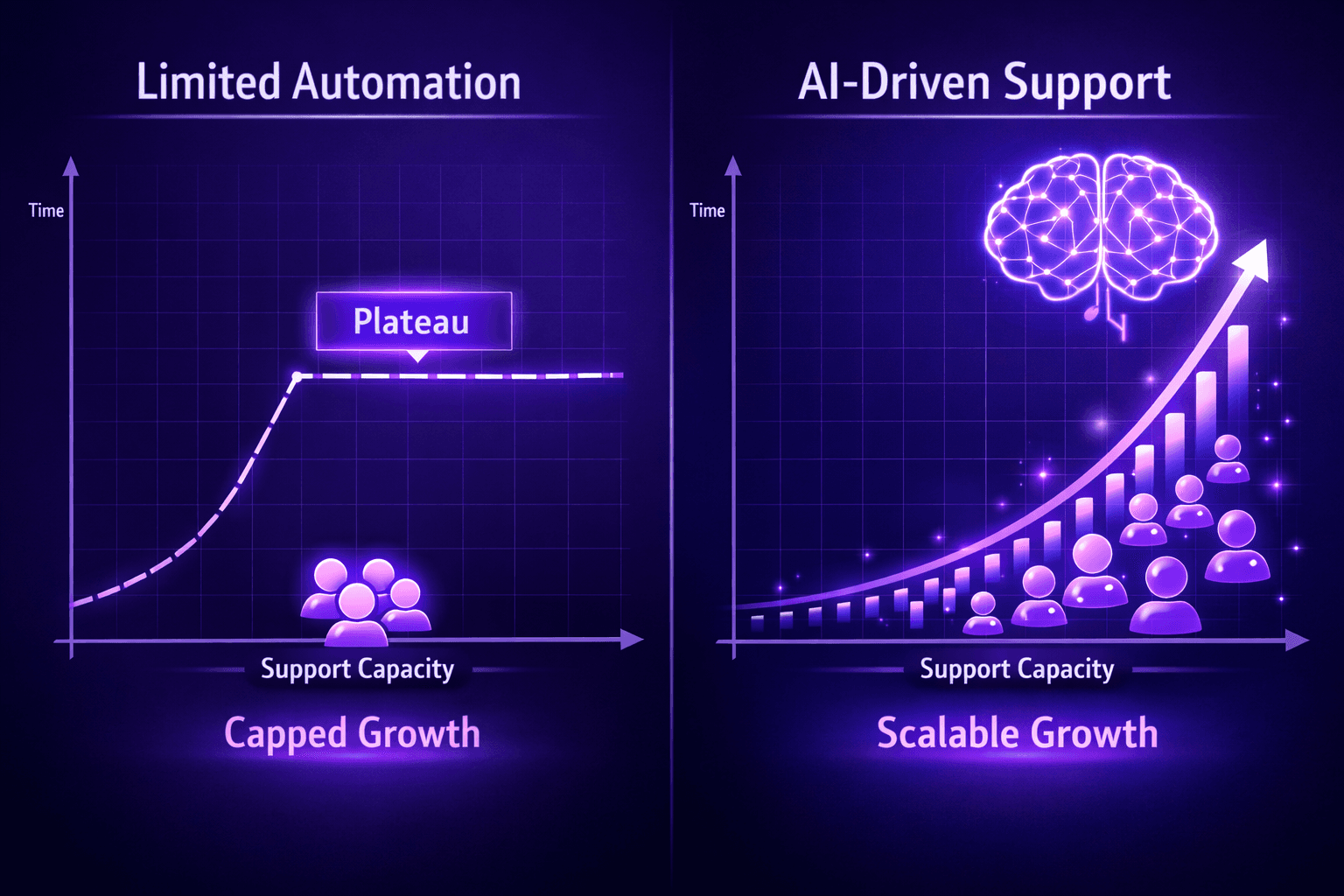
You're evaluating Tidio against AI customer support for your e-commerce store. Here's the short answer: Tidio is affordable and easy to start with for small stores, but AI-first customer support scales better as volume grows.
Tidio combines live chat with basic chatbot automation at an accessible price point. It's popular with small online stores because setup takes minutes, not days, and the entry-level pricing won't break the bank.
But there's a scaling problem. As your support volume grows, Tidio's chatbot builder requires increasingly complex manual configuration. You'll spend hours building decision trees, updating responses, and maintaining flows that break when your product catalog changes.
AI-first customer support tools flip this model. They use natural language understanding to handle conversations dynamically, integrating directly with your e-commerce data to automate support without manual flow building.
This guide compares Tidio's capabilities, costs, and scalability against AI-first customer support solutions. You'll learn when each approach makes sense, what happens as you grow, and how to make the right choice for your store.
What Tidio actually is
Tidio is a customer communication platform that combines live chat with chatbot automation:
Live chat for human agents
- Real-time chat widget on your website
- Mobile apps for agents to respond on the go
- Conversation assignment and routing
- Visitor tracking to see who's browsing
- Canned responses for common questions
Visual chatbot builder
- Drag-and-drop interface for building chatbot flows
- Pre-made templates for common scenarios (welcome messages, abandoned cart, FAQ)
- Trigger-based automation (visitor behavior, time on page, pages visited)
- Integration with forms to collect information
- Conditional logic for branching conversations
AI features (Lyro AI)
Tidio's AI assistant, called Lyro:
- Learns from your FAQ content and past conversations
- Answers simple questions without following predefined flows
- Can handle basic support inquiries
- Falls back to human agents when uncertain
- Separate add-on cost beyond base Tidio plans
E-commerce integrations
- Native apps for Shopify, WooCommerce, BigCommerce
- Can display product recommendations in chat
- Track abandoned carts and send recovery messages
- Basic order lookup functionality (with custom setup)
The key: Tidio excels at getting live chat + basic automation running quickly and affordably. But chatbot maintenance becomes time-consuming as complexity grows.
What AI-first customer support is
AI-first customer support platforms are built specifically to automate e-commerce support conversations at scale:
Core capabilities
- Natural language understanding (no flow building required)
- Deep integration with your e-commerce platform (orders, customers, products, returns)
- Handles complete conversations autonomously
- Takes actions (process returns, check order status, update preferences)
- Escalates to humans only when necessary with full context transfer
E-commerce-specific automation
- Order status and tracking inquiries
- Returns and exchange processing
- Product questions and recommendations
- Shipping and delivery support
- Payment and checkout assistance
- Inventory and restock notifications
- Subscription management
No-maintenance automation
Rather than building and maintaining chatbot flows, AI-first tools:
- Understand customer intent from natural language
- Look up real-time data from your e-commerce platform
- Respond accurately to questions they've never seen before
- Learn from escalations without manual flow updates
- Adapt when your products, policies, or systems change
The key: These tools are designed to handle support conversations end-to-end without requiring ongoing chatbot maintenance or complex flow building.
Feature comparison: What each does better
Let's compare how each handles the features that matter for e-commerce support.
Automated order status inquiries
Tidio:
- Requires building chatbot flow to collect order number
- Can integrate with e-commerce platform API with custom setup
- Needs conditional logic for different order states
- Breaks if order statuses or shipping carriers change
- Complex flows required for edge cases ("What if I have multiple orders?")
- Maintenance needed when you add shipping carriers or change providers
Setup time: 2-4 hours to build comprehensive order tracking flow Maintenance: 1-2 hours/month to update and fix broken flows Automation rate: 40-60% of order inquiries
AI-first customer support:
- Integrates directly with your e-commerce platform
- Understands "Where's my order?" in any phrasing
- Looks up customer's orders automatically (no order number needed)
- Provides real-time tracking from all carriers
- Handles edge cases naturally ("I have two orders, where's the blue jacket?")
- No maintenance when shipping setup changes
Setup time: Configure once during implementation Maintenance: Zero—adapts automatically Automation rate: 85-95% of order inquiries
Winner for e-commerce: AI-first tools. Order tracking is the #1 support question, and Tidio's flow-based approach requires too much ongoing work.
Returns and refund processing
Tidio:
- Can collect return reason and order number through chatbot
- Generates ticket for human to process return
- Can't actually initiate returns without custom integration
- Flow breaks if return eligibility rules change
- Requires separate flows for exchanges, partial returns, defects
- Limited ability to check return eligibility automatically
Automation rate: 15-30% (mostly just information collection)
AI-first customer support:
- Checks return eligibility automatically
- Initiates return process directly in your system
- Generates return shipping labels when applicable
- Handles exchanges, partial returns, store credit
- Explains return policies in context
- Escalates only policy exceptions or fraud concerns
Automation rate: 75-85% of return requests
Winner for e-commerce: AI-first tools. Returns require decision-making and system actions that flow-based chatbots can't handle effectively.
Product questions and recommendations
Tidio:
- Can display product recommendations in chat
- Answers product questions if you've pre-written responses
- Requires building separate flows for different product categories
- Can't understand nuanced questions ("Which jacket is warmer?")
- Product catalog changes break existing flows
- Limited ability to compare products or suggest alternatives
Example question: "Do you have this jacket in navy?"
Tidio response: Would require separate flows for each product + color combination, or would say "Let me connect you with our team"
AI-first customer support:
- Integrates with complete product catalog
- Understands product attributes (size, color, material, specifications)
- Answers comparison questions across products
- Suggests alternatives when items are out of stock
- Handles complex queries ("I need a waterproof jacket under $100 in size medium")
- Updates automatically when products are added or changed
Example question: "Do you have this jacket in navy?"
AI response: "Yes! The Explorer Jacket comes in navy blue. We have it in stock in sizes S through XL. It's the same price as the forest green you're looking at. Want me to send you the link?"
Winner for e-commerce: AI-first tools. Product questions require understanding catalog data and context that static flows can't provide.
24/7 support availability
Tidio:
- Chatbot runs 24/7 for questions it's been programmed to handle
- Falls back to "We'll get back to you during business hours" for anything outside predefined flows
- Can collect contact info for follow-up
- Limited value outside business hours since most questions need human escalation
After-hours resolution rate: 20-40%
AI-first customer support:
- Handles full conversations 24/7 without business hour limitations
- Same capabilities at 3am as at 3pm
- Escalates only when human judgment required
- Truly resolves customer issues overnight, not just collects information
After-hours resolution rate: 70-85%
Winner for e-commerce: AI-first tools. If you're paying for 24/7 coverage, it should actually resolve issues, not just collect contact information.
Handling high-volume events
Tidio:
- Same chatbot flows handle increased volume
- Can prevent some tickets from reaching humans
- Requires pre-planning flows for common sale questions
- Humans still handle surge in questions chatbot can't answer
- No automatic adaptation to event-specific questions
- Need to update flows before/after sales events
Example Black Friday scenario: You add 100 new products. Your existing product recommendation flows don't include them. Chatbot can't answer questions about the new items.
AI-first customer support:
- Automatically handles new products added for sales
- Understands event-specific questions without flow updates
- Scales to handle 10x volume without degradation
- Adapts to actual questions being asked
- No pre-planning or flow updates needed
Example Black Friday scenario: Automatically answers questions about all new products by pulling from updated product catalog. Handles shipping cutoff questions based on current shipping policies.
Winner for e-commerce: AI-first tools. High-volume events reveal the limitations of manually-built flows.
Team collaboration and handoffs
Tidio:
- Strong live chat features for human agents
- Easy conversation assignment and transfers
- Agent performance tracking
- Mobile apps for agents on the go
- Good for stores with dedicated support teams
AI-first customer support:
- Handles majority of conversations without team involvement
- Escalations include full context and customer data
- Fewer conversations reach humans, making collaboration less critical
- Focus is on automation, not team management
- Best for stores wanting to minimize human support workload
Winner: Depends on strategy. If you're building a support team, Tidio's collaboration features are stronger. If you're trying to minimize the need for a team, AI-first wins.
Engagement and marketing
Tidio:
- Proactive messages based on visitor behavior
- Abandoned cart recovery campaigns
- Popup messages for promotions
- Welcome messages for new visitors
- Good for stores using chat as a marketing channel
AI-first customer support:
- Focused purely on support, not marketing
- Some tools offer basic proactive support ("Need help finding your order?")
- Not designed for marketing campaigns or abandoned cart recovery
- This is a feature gap if you want chat for marketing
Winner for marketing: Tidio. AI-first tools don't try to compete here.
Cost comparison: What you'll actually pay
The cost gap between Tidio and AI-first support widens as your volume grows.
Small store (0-500 conversations/month)
Tidio:
- Communicator plan: $29/month (includes 100 live chat conversations)
- Chatbots add-on: +$29/month (includes basic automation)
- Lyro AI add-on: +$39/month (AI-powered responses)
- Total starting cost: ~$97/month for chat + automation + AI
Plus: Agent time for conversations chatbot can't handle
- 250 conversations require human handling @ $3/conversation = $750/month
- Total monthly cost: ~$847/month
AI-first customer support:
- Typical pricing: $200-400/month for small store tier
- Automation rate: 75-85%
- 75-125 conversations require human handling @ $3/conversation = $225-375/month
- Total monthly cost: ~$425-775/month
Winner: Comparable pricing, slight edge to AI-first when factoring agent time.
Medium store (500-2,000 conversations/month)
Tidio:
- Higher-tier plans needed for conversation volume: ~$289/month
- Chatbots add-on: +$29/month
- Lyro AI add-on: +$39/month
- Tidio costs: ~$357/month
Plus: Agent time for conversations requiring human handling
- 800-1,200 conversations need humans @ $3/conversation = $2,400-3,600/month
- Flow building and maintenance: 5 hours/month @ $50/hour = $250/month
- Total monthly cost: ~$3,007-4,207/month
AI-first customer support:
- Typical pricing: $500-900/month for medium store tier
- Automation rate: 80-90%
- 200-400 conversations require human handling @ $3/conversation = $600-1,200/month
- No flow maintenance required: $0/month
- Total monthly cost: ~$1,100-2,100/month
Savings with AI-first: $1,900-2,100/month (~50-60% reduction)
Winner: AI-first tools. The cost gap widens as volume increases.
Large store (2,000-10,000 conversations/month)
Tidio:
- Enterprise pricing needed (custom quote, typically $500-1,000+/month)
- Chatbots + AI add-ons: ~$100/month
- Tidio costs: ~$600-1,100/month
Plus: Agent costs and maintenance
- 4,000-6,000 conversations need humans @ $3/conversation = $12,000-18,000/month
- Flow maintenance becomes complex: 15 hours/month @ $50/hour = $750/month
- Potentially need to hire support team or outsource
- Total monthly cost: ~$13,350-19,850/month
AI-first customer support:
- Typical pricing: $1,200-2,500/month for large store tier
- Automation rate: 85-92%
- 800-1,500 conversations require human handling @ $3/conversation = $2,400-4,500/month
- No flow maintenance: $0/month
- Total monthly cost: ~$3,600-7,000/month
Savings with AI-first: $9,750-12,850/month (~70-75% reduction)
Winner: AI-first tools. At scale, the automation and maintenance gap creates massive cost differences.
Hidden costs to factor in
Tidio ongoing costs:
- Flow building for each new product category: 2-4 hours
- Updating flows when policies change: 1-2 hours
- Fixing broken flows after e-commerce platform updates: 1-3 hours
- Training new agents on complex flow-based escalations: 2-3 hours per agent
- Testing flows before high-volume events: 3-5 hours
- Monthly maintenance total: 10-20 hours (~$500-1,000/month at $50/hour)
AI-first ongoing costs:
- Configuration updates when major policies change: 15-30 minutes
- Monthly maintenance total: 0.5-1 hour (~$25-50/month at $50/hour)
When each approach makes sense
Choose Tidio if:
You're a small store with simple support needs:
- Under 300 conversations per month
- Most questions are basic FAQs that can be answered with simple flows
- You want live chat for browsing visitors
- You're using chat for marketing (abandoned cart, promotions)
- You have time to build and maintain chatbot flows
- Budget is extremely tight (under $200/month for all support software)
Example profile: New online store with $10-30K/month revenue, 1-2 person team, 50-200 support conversations monthly, mostly basic questions about shipping and returns.
You want engagement features:
- Proactive chat for marketing
- Abandoned cart recovery
- Welcome messages and popup campaigns
- Chat is part of your conversion strategy, not just support
You already have a support team:
- You've invested in building support team processes
- Tidio's collaboration features fit your existing workflows
- Team prefers handling most conversations with chatbot assistance
- You're optimizing agent efficiency, not trying to eliminate agent workload
Choose AI-first customer support if:
You want support to scale without proportional cost increases:
- Conversations growing faster than revenue
- Can't hire support staff proportional to volume
- Need to maintain profitability as you scale
- Want to invest support budget in growth, not headcount
Example profile: Growing e-commerce store doing $100K-500K+/month, 500+ support conversations monthly, team of 2-5 people, support taking too much time away from growth initiatives.
You want to minimize ongoing maintenance:
- Don't have time to build and update chatbot flows
- Product catalog changes frequently
- Running seasonal promotions with new products
- Policies or shipping options change regularly
- Small team wearing multiple hats
Your support volume is dominated by repetitive questions:
- Most conversations are about orders, shipping, returns, products
- You're answering the same questions repeatedly
- Support questions follow predictable patterns
- High percentage of after-hours inquiries about standard topics
You're in a high-growth phase:
- Planning to 2-5x revenue in next 12 months
- Can't scale support team proportionally
- Need automation that grows with you without rework
- Want to maintain customer experience while scaling
You sell internationally:
- Customers in multiple time zones requiring 24/7 support
- Multiple languages needed
- Tidio's flow-based approach would require building separate flows for each language
- AI-first tools handle multilingual support without proportional complexity
Hybrid approach: Using both
Some stores use Tidio for marketing and AI-first for support:
Marketing with Tidio:
- Abandoned cart recovery
- Proactive engagement for browsers
- Promotional popup messages
- Welcome campaigns for new visitors
Support with AI-first:
- All order, shipping, and return inquiries
- Product questions from existing customers
- Post-purchase support
- After-hours support
Implementation:
- Display Tidio widget on product and cart pages (marketing focus)
- Display AI-first widget on order confirmation, account, and help pages (support focus)
- Or use Tidio for proactive outreach, AI-first for inbound support requests
Cost: Higher total cost, but leverages strengths of each platform.
Makes sense for: Stores doing $200K+/month where marketing chat has proven ROI and support automation provides clear cost savings.
Real-world scenarios: What actually happens
Scenario 1: Home goods store ($80K/month revenue)
Initial situation:
- 450 support conversations per month
- Using Tidio: $97/month (base + chatbot + AI)
- Chatbot handling ~30% of simple questions
- 1 part-time support person spending 20 hours/week on chat
With Tidio:
- Built flows for common questions over 3 months
- Reached 45% automation rate (200 conversations automated)
- Still needed part-time support person
- Spent 3-5 hours monthly maintaining flows
- Cost: $97 Tidio + $1,000 part-time support = $1,097/month
Switched to AI-first customer support:
- Implementation: 1 week
- Automation rate after 30 days: 78% (350 conversations)
- Part-time support reduced to 5-6 hours/week
- Zero maintenance time for flows
- Cost: $350 AI-first + $400 reduced support hours = $750/month
Result: 32% cost reduction, better customer experience (faster responses, 24/7 coverage), hours saved reinvested in growing the business.
Key insight: "We kept thinking we just needed to build better Tidio flows. Once we switched, we realized the problem wasn't our flows—it was the flow-based approach." — Store owner
Scenario 2: Fashion boutique ($180K/month revenue)
Initial situation:
- 1,200 conversations per month (growing 15% monthly)
- Started with Tidio at $50K/month revenue
- Built extensive chatbot flows over 12 months
- Team of 2 people handling support
Scaling challenges with Tidio:
- Launched 50 new products—existing flows didn't cover them
- Added international shipping—required rebuilding flows
- Black Friday: 3x normal volume broke complex flows
- Maintenance time increased to 15 hours/month
- Had to hire third support person to keep up
- Cost: $289 Tidio + $4,500 for 3 part-time support people = $4,789/month
Evaluated AI-first but stayed with Tidio because:
- Already invested 100+ hours building flows
- Team familiar with Tidio workflows
- Concerned about switching costs
Six months later:
- Maintenance burden kept growing (now 20+ hours/month)
- Support team stressed during sales events
- Customer satisfaction declining (slow responses during peak times)
- Finally switched to AI-first support
After switching:
- Automation rate jumped to 83% within 60 days
- Reduced to 1.5 support people
- Zero maintenance time on flows
- Better handling of sales events
- Cost: $650 AI-first + $2,250 reduced support team = $2,900/month
Result: 39% cost reduction, but more importantly, support no longer a bottleneck to growth.
Key insight: "The sunk cost fallacy kept us on Tidio longer than we should have stayed. We kept thinking 'We've already built all these flows' but we were spending more time maintaining flows than the AI would have cost." — Operations Manager
Scenario 3: Supplement store ($45K/month revenue)
Started with AI-first, considered switching to Tidio:
- 280 conversations per month
- Using AI-first support: $300/month
- 82% automation rate
- Saw Tidio's lower entry price and considered switching
Evaluated Tidio:
- Base cost would be lower ($97 vs $300/month)
- But automation would drop to ~40-50%
- Would need to build flows for products, returns, shipping
- Estimated 10-15 hours to build initial flows
- Ongoing maintenance: 3-5 hours monthly
Calculation:
-
Tidio: $97/month + 140-170 conversations needing humans @ $3 = $517-607/month total
-
Plus 4 hours monthly maintenance @ $50/hour = $200/month
-
Total: $717-807/month
-
AI-first: $300/month + 50 conversations needing humans @ $3 = $450/month total
-
Plus zero maintenance time
-
Total: $450/month
Decision: Stayed with AI-first support.
Key insight: "The upfront cost looked tempting, but when we calculated total cost including our time and human handling, AI-first was actually cheaper even at our small size." — Founder
Common mistakes when choosing
Mistake #1: Choosing based only on monthly subscription cost
The problem: Tidio's $29-97/month looks much cheaper than AI-first at $300-900/month, but the subscription is only part of total cost.
What to calculate instead:
- Subscription cost
- Agent time for conversations not automated (conversations × % not automated × cost per conversation)
- Flow building and maintenance time (hours × hourly cost)
- Opportunity cost of team time spent on support instead of growth
Reality: When factoring all costs, AI-first is often cheaper even for small stores, and dramatically cheaper as you scale.
Mistake #2: Underestimating flow maintenance burden
The problem: Building initial Tidio flows seems manageable. But maintenance compounds over time.
What changes over time:
- Product catalog grows (new flows needed)
- Policies evolve (flows need updates)
- Shipping carriers change (flows break)
- Platform updates change API responses (flows break)
- Edge cases emerge (flows need expansion)
- Support team turnover (new people need to learn complex flows)
Reality: Stores often spend 10-25 hours/month maintaining Tidio flows after the first year. This maintenance burden never decreases—it only grows.
Mistake #3: Not testing automation rates before committing
The problem: Assuming chatbot automation rates without testing with real conversations.
How to test properly:
- Take your last 100 support conversations
- Categorize by type (order status, returns, products, shipping, etc.)
- Estimate which could be automated by each approach
- Calculate realistic automation rates
- Factor into cost calculations
Reality: Tidio's automation rates are often 30-50 percentage points lower than AI-first tools for e-commerce support. This gap matters enormously for cost and scaling.
Mistake #4: Choosing Tidio for AI features when you actually want automation
The problem: Seeing "Lyro AI" in Tidio and assuming it provides similar automation to AI-first tools.
The reality:
- Lyro AI is a helpful feature but limited compared to AI-first platforms
- Still requires flow building for complex scenarios
- Doesn't integrate deeply with e-commerce data
- AI-first tools are architecturally different, not just "more AI"
Better approach: Evaluate based on automation capabilities and integration depth, not just "has AI" checkbox.
Mistake #5: Staying with Tidio too long due to sunk cost
The problem: "We've already invested 50 hours building flows, we can't switch now."
The math:
- 50 hours already spent (sunk cost—can't get back)
- Tidio maintenance: 10 hours/month ongoing = 120 hours/year
- AI-first maintenance: 1 hour/month ongoing = 12 hours/year
- Switching saves: 108 hours/year (worth $5,400/year at $50/hour)
- Plus increased automation saves agent costs
Reality: The sooner you switch, the more you save. Past investment is irrelevant to future decision.
Mistake #6: Not considering growth trajectory
The problem: Choosing based on current volume instead of where you'll be in 12 months.
Growth scenario:
- Today: 300 conversations/month
- 12 months: 900 conversations/month (realistic for growing stores)
Tidio total costs:
- Today: ~$600/month
- 12 months: ~$2,200/month
- Will need to rebuild or switch mid-year when volume becomes unmanageable
AI-first total costs:
- Today: ~$550/month
- 12 months: ~$1,100/month
- No rebuilding or switching needed
Reality: Starting with AI-first avoids the pain of migrating later when you're overwhelmed with volume.
Decision framework: Tidio or AI-first?
Use this framework to make the right choice:
Step 1: Calculate your true conversation volume
Not just tickets—all support conversations across channels (email, chat, social media, SMS).
- Current monthly volume: _______
- Expected volume in 12 months: _______
- Expected volume in 24 months: _______
Step 2: Categorize your conversation types
Review last 100 support conversations:
- Order status and tracking: _______%
- Returns and refunds: _______%
- Product questions: _______%
- Shipping and delivery: _______%
- Payment and checkout: _______%
- Account and login: _______%
- Marketing and sales (pre-purchase): _______%
- Other: _______%
Step 3: Estimate realistic automation rates
For Tidio:
- Order/shipping/returns: 40-55% (requires flow building)
- Product questions: 30-45% (limited by catalog integration)
- Marketing/pre-purchase: 50-65% (Tidio's strength)
- Overall expected automation rate: _______% (typically 40-50% for e-commerce)
For AI-first:
- Order/shipping/returns: 80-92%
- Product questions: 70-85%
- Marketing/pre-purchase: 40-60% (not AI-first's focus)
- Overall expected automation rate: _______% (typically 75-88% for e-commerce)
Step 4: Calculate true monthly costs
Tidio:
- Subscription: $_______ (based on volume tier + add-ons)
- Conversations not automated: _______ × $3 = $_______
- Flow building (initial): _______ hours × $50 = $_______ (one-time)
- Flow maintenance (monthly): _______ hours × $50 = $_______
- Total first month: $_______
- Total ongoing (monthly): $_______
AI-first:
- Subscription: $_______ (based on volume tier)
- Conversations not automated: _______ × $3 = $_______
- Initial setup: Usually included, or _______ hours × $50 = $_______ (one-time)
- Ongoing maintenance (monthly): _______ hours × $50 = $_______ (typically $25-50)
- Total first month: $_______
- Total ongoing (monthly): $_______
Step 5: Factor in strategic considerations
Score each factor (1 = not important, 5 = very important):
Tidio advantages:
- Need marketing chat features: _____
- Want abandoned cart recovery: _____
- Need strong live chat for team: _____
- Have time to build/maintain flows: _____
- Support volume under 300/month: _____
- Total: _____
AI-first advantages:
- Want to minimize support costs: _____
- Support scaling faster than revenue: _____
- Don't have time for maintenance: _____
- Product catalog changes often: _____
- Need 24/7 actual resolution: _____
- Growth trajectory aggressive: _____
- Total: _____
Step 6: Make the decision
Choose Tidio if:
- Total ongoing monthly cost (from Step 4) is genuinely lower
- Tidio advantages score (from Step 5) is 8+ points higher
- Volume under 300/month AND not growing quickly
- Marketing chat features are critical to your strategy
Choose AI-first if:
- Total ongoing monthly cost is lower (most common outcome)
- Volume over 500/month or growing 10%+ monthly
- Time constraints make flow building unsustainable
- E-commerce support (orders, returns, shipping) is majority of volume
- Scaling support cost-effectively is priority
Consider hybrid if:
- Revenue over $200K/month
- Both marketing chat and support automation have proven ROI
- Budget allows both platforms
- Can separate marketing (Tidio) and support (AI-first) clearly
How to implement your choice
If choosing Tidio:
Week 1: Setup
- Install Tidio on your e-commerce platform
- Configure basic live chat settings
- Add agents and set availability hours
- Customize chat widget appearance
Week 2-3: Build core flows
- Start with highest-volume questions
- Build order tracking flow (collect order number, show status)
- Build return information flow (policy, basic guidance)
- Build FAQ flow for common questions
- Create fallback to human agent for anything else
Week 4: Test and refine
- Test all flows thoroughly with real scenarios
- Have team members test from customer perspective
- Fix broken logic and edge cases
- Add analytics tracking
Ongoing:
- Review chatbot analytics weekly
- Update flows when products/policies change
- Build new flows for emerging question patterns
- Budget 5-10 hours/month for maintenance initially
- Expect maintenance time to grow as complexity increases
Plan transition to AI-first when:
- Volume exceeds 500 conversations/month
- Maintenance time exceeds 10 hours/month
- Automation rate plateaus below 50%
- Support costs growing faster than revenue
If choosing AI-first:
Week 1: Setup and integration
- Connect AI platform to e-commerce system
- Configure product catalog sync
- Set up order and customer data access
- Configure brand voice and guidelines
Week 2: Configure automation scope
- Define which conversation types to automate
- Set escalation criteria (when to send to humans)
- Configure business hours and fallback messaging
- Set up human agent escalation workflows
Week 3: Soft launch
- Start with limited traffic (10-20%)
- Monitor automation rate and accuracy
- Review escalated conversations for patterns
- Adjust configuration based on learnings
Week 4: Full launch
- Expand to 100% of traffic
- Monitor key metrics daily for first week
- Review customer satisfaction scores
- Fine-tune based on initial results
Months 2-3: Optimization
- Review conversations AI couldn't handle
- Update training for common edge cases
- Optimize escalation criteria
- Add new automation capabilities as needed
Ongoing:
- Monthly review of automation metrics
- Quarterly review of cost savings
- Update product catalog and policies as they change (typically 15-30 minutes)
- Minimal ongoing maintenance required
The scaling reality: What happens at each stage
Stage 1: Starting out (0-500 conversations/month)
Tidio:
- Easy to set up and start
- Affordable monthly cost
- Basic automation helps
- Team can handle what chatbot misses
- Feels manageable
AI-first:
- Higher upfront cost
- More sophisticated than needed initially
- Handles high automation rate from day one
- Positions you for growth
- Feels like over-engineering
Verdict: Tidio tempting here, but AI-first prevents future pain if you grow.
Stage 2: Growing (500-1,500 conversations/month)
Tidio:
- Flows getting complex
- Maintenance time increasing
- New products breaking existing flows
- Team spending more time on support
- Considering hiring dedicated support person
- Starting to feel strained
AI-first:
- Handling growth effortlessly
- No maintenance burden increase
- Automation rate holding steady
- Team time not increasing with volume
- Feels sustainable
Verdict: This is where Tidio starts showing cracks. AI-first pulls ahead clearly.
Stage 3: Scaling (1,500-5,000 conversations/month)
Tidio:
- Flow maintenance consuming 15-20 hours/month
- Need dedicated support team
- Automation rate declining (flows can't keep up with complexity)
- High-volume events overwhelming
- Actively looking to switch
- Painful and expensive
AI-first:
- Automation rate stable or improving
- Minimal team needed
- Handling sales events smoothly
- Costs scaling sublinearly with volume
- Competitive advantage
Verdict: Tidio becomes unsustainable. Most stores switch by this point.
Stage 4: Established (5,000+ conversations/month)
Tidio:
- Few stores reach this stage with Tidio
- Would require large support team
- Flow-based approach fundamentally can't scale
- Enterprise support software needed
- Not viable
AI-first:
- Designed for this scale
- Automation maintains high rates
- Cost per conversation decreasing
- Support is strategic advantage, not cost center
- Scales efficiently
Verdict: AI-first is the only viable path at this scale.
Bottom line: Which scales better?
Short term (months 1-6):
- Tidio might look cheaper on paper
- But AI-first saves time and handles more automatically from day one
- Total cost often comparable or better with AI-first even initially
Medium term (months 6-18):
- AI-first clearly wins on cost and time
- Tidio maintenance burden grows
- Support volume increasing makes gap wider
- Most growing stores switch to AI-first during this phase
Long term (18+ months):
- Tidio can't scale effectively past ~1,500 conversations/month
- AI-first handles 10,000+ conversations efficiently
- Cost difference becomes massive (often 60-75% savings)
- Time savings compound (thousands of hours over time)
The scaling answer: AI-first customer support scales dramatically better. Tidio can work for very small stores with simple needs and slow growth, but any store planning to grow should start with AI-first to avoid the painful (and expensive) transition later.
The question isn't really "which scales better?" (that's clearly AI-first), it's "are you going to stay small forever?" If the answer is no, start with AI-first customer support.
Next steps
Ready to implement AI customer support?
- Best AI Customer Support Software for E-commerce (2026) - Complete guide to evaluating and choosing AI customer support solutions, with detailed comparison of top platforms and decision framework
- AI Customer Support for E-commerce: The Complete Guide - Comprehensive guide covering how AI customer support works, what it can handle, implementation strategies, and realistic expectations
- E-commerce Customer Support Use Cases You Can Automate with AI - Detailed breakdown of every major support use case AI can handle, with automation rates, implementation requirements, and real examples
Compare other support solutions:
- AI Customer Support vs Traditional Helpdesk Software - Complete comparison of AI-first versus traditional helpdesk platforms for e-commerce support
- Intercom vs AI Customer Support for E-commerce - Detailed comparison of Intercom versus AI-first support, covering costs, automation capabilities, and when each makes sense
- Zendesk vs AI Automation for Online Stores - In-depth comparison of Zendesk versus AI automation, with real cost analysis and implementation guidance
Learn about automation:
- Using AI to Answer Order Status Questions Automatically - Deep dive on automating order tracking inquiries with AI
- Automating Returns and Refund Questions with AI - Complete guide to handling returns and refunds automatically
- AI Customer Support Metrics That Actually Matter - Learn which metrics to track and how to measure AI support success
- AI Escalation: When and How to Hand Off to Humans - Comprehensive guide to designing effective escalation workflows