
Live Chat vs AI Chatbots for Online Stores: Which Delivers Better ROI?
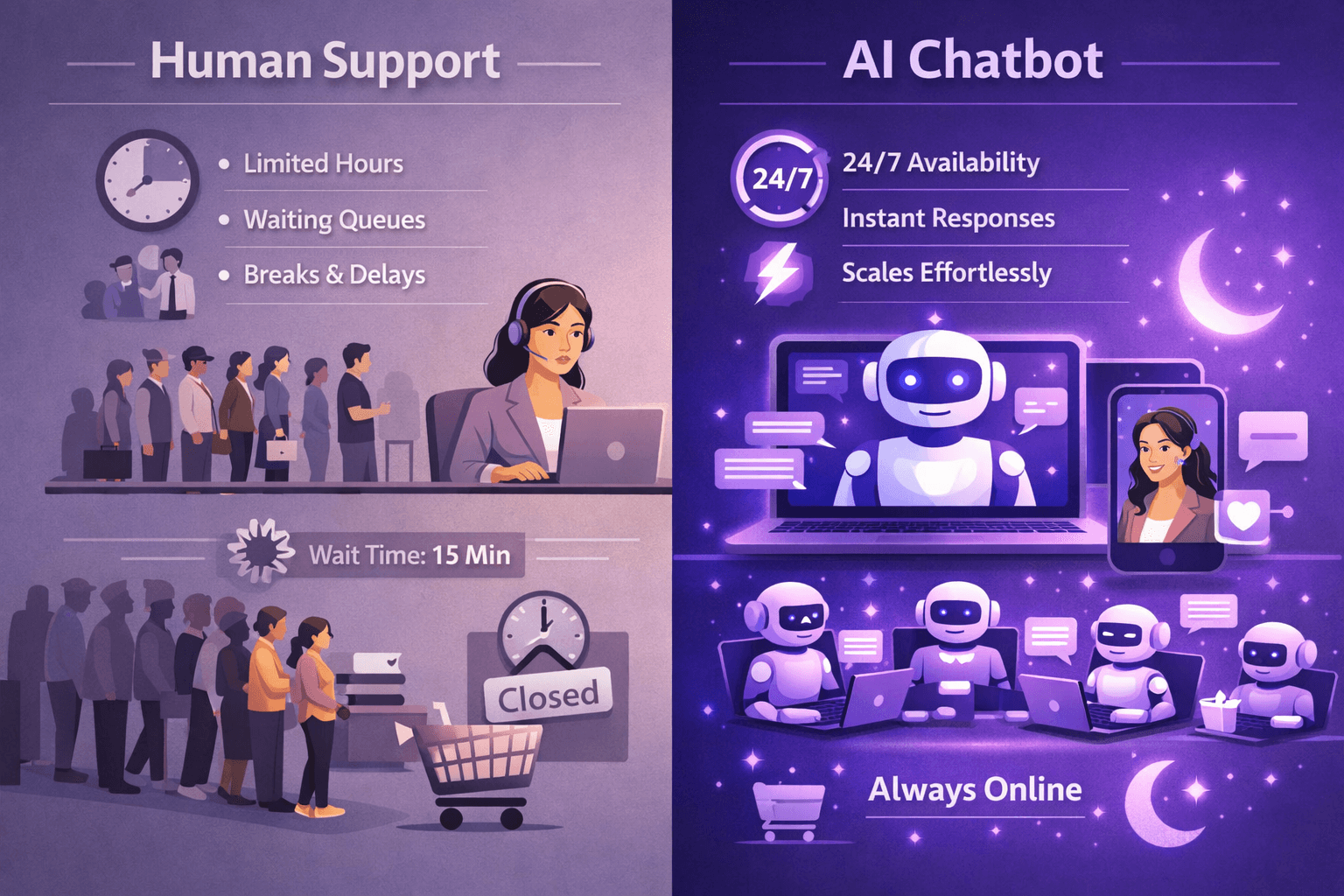
You're deciding between live chat and AI chatbots for your e-commerce store. Here's the short answer: Live chat provides human conversations but requires constant staffing. AI chatbots automate 70-85% of conversations at a fraction of the cost, but can't match human empathy for complex situations.
The decision isn't about which is "better"—it's about which fits your store's size, budget, support needs, and growth trajectory.
Live chat has been the standard for e-commerce customer support for years. It works: customers ask questions, human agents answer in real-time, problems get solved. But it's expensive to staff, doesn't scale well, and leaves you choosing between 24/7 coverage or leaving international customers waiting.
AI chatbots flip the economics. They handle unlimited concurrent conversations, work 24/7 without additional cost, and automate repetitive questions that consume 70-80% of live chat agent time. But they're not perfect: complex situations, emotional customers, and edge cases still benefit from human judgment.
This guide compares live chat and AI chatbots across every dimension that matters for e-commerce: costs, automation rates, customer satisfaction, scalability, and real-world performance. You'll learn exactly when each makes sense, what you'll actually pay as you scale, and how to choose based on your store's specific needs.
What live chat actually is
Live chat is real-time text conversation between customers and human support agents:
How it works
- Customer clicks chat widget on your site
- Message routes to available human agent
- Agent responds in real-time (target: under 60 seconds)
- Conversation continues until resolved
- Agent can handle 3-5 concurrent chats depending on complexity
Core capabilities
- Real-time human conversation: Agents understand context, nuance, emotion
- Multi-conversation handling: Experienced agents manage 3-5 chats simultaneously
- Access to tools: Agents see order data, product info, customer history
- Escalation to specialists: Complex issues route to senior agents or managers
- Emotional intelligence: Humans recognize frustration, anxiety, urgency
Common live chat platforms
- Intercom: Business messaging with live chat, pricing from $74/seat/month
- Zendesk Chat: Part of Zendesk Suite, $55-$115/agent/month
- LiveChat: Dedicated live chat platform, $20-$59/agent/month
- Gorgias: E-commerce-focused helpdesk with chat, $60-$750+/month
- Tidio: Affordable live chat for small stores, $0-$394/month
- Drift: Conversational marketing and support, custom pricing
Staffing requirements
Live chat requires continuous agent coverage:
- Business hours only: 2-3 agents minimum (coverage + breaks + peak handling)
- Extended hours (8am-10pm): 4-6 agents across shifts
- 24/7 coverage: 8-12 agents across three shifts plus weekends
- Vacation and sick coverage: Additional 20-30% capacity needed
- Training and management: Supervisor/manager at 10+ agents
What live chat does well
- Handles complex situations requiring judgment
- Builds customer relationships through personality
- Adapts communication style to customer emotion
- Solves novel problems without predefined workflows
- Makes exceptions to policies when appropriate
- Consultative selling and product discovery
- De-escalates frustrated or angry customers
What live chat struggles with
- Scalability: Each new conversation requires agent time
- Cost: Agents are expensive (salary, benefits, training, tools, management)
- Coverage gaps: Nights, weekends, holidays require additional staffing
- Repetitive work: 70-80% of conversations are simple, predictable questions
- Response time during peaks: Wait times increase when volume spikes
- Agent turnover: Support roles have 30-40% annual turnover
- Inconsistency: Response quality varies by agent training and experience
The key: Live chat delivers excellent customer experience through human connection, but requires significant ongoing investment in people and management.
What AI chatbots actually are
AI chatbots use artificial intelligence to understand and respond to customer questions automatically:
How it works
- Customer clicks chat widget or types message
- AI analyzes the message to understand intent
- AI accesses relevant data (orders, products, policies)
- AI generates personalized response
- Conversation continues until resolved or escalated
- AI can handle unlimited simultaneous conversations
Core capabilities (modern e-commerce AI)
- Intent understanding: Recognizes what customers want from how they ask
- Data integration: Direct access to orders, products, inventory, shipping
- Action execution: Processes refunds, generates return labels, updates addresses
- 24/7 availability: Same capability at 3am as 3pm
- Multilingual support: Handles 50+ languages simultaneously
- Contextual memory: Remembers earlier in the conversation
- Smart escalation: Knows when human help is needed
Modern e-commerce AI platforms
- LiteTalk: E-commerce-native AI, deep platform integration
- Rep AI: AI shopping assistant focused on conversion
- Octocom: Multi-channel AI for e-commerce support
- Ada: Customizable AI platform with e-commerce capabilities
- Tidio with Lyro AI: Affordable AI for small stores
- Gorgias Automate: AI features within Gorgias helpdesk
- Zendesk AI Agents: AI capabilities in Zendesk
Infrastructure requirements
AI chatbots require minimal ongoing management:
- Initial setup: 2-8 hours connecting to e-commerce platform, configuring policies
- Ongoing refinement: 2-5 hours/month reviewing edge cases, updating knowledge
- Human backup: 1-3 agents to handle escalations (20-30% of volume)
- No shift coverage: AI works 24/7 without scheduling
- No vacation coverage: No capacity planning needed
- Minimal training: AI updates don't require retraining like hiring new agents
What AI chatbots do well
- Automate repetitive questions at massive scale
- Provide instant responses (no wait times)
- Work 24/7 across all time zones
- Handle unlimited concurrent conversations
- Maintain perfect consistency in responses
- Access and process data instantly
- Work in 50+ languages simultaneously
- Scale infinitely without cost increase
- Learn from interactions over time
What AI chatbots struggle with
- Complex judgment calls: Unusual situations not in training data
- Emotional nuance: Recognizing and responding to distressed customers
- Creative problem-solving: Novel problems requiring human ingenuity
- Policy exceptions: Deciding when rules should be bent
- Building relationships: Warm human connection and personality
- Consultative conversations: High-touch sales guidance
- Context outside training: Questions unrelated to e-commerce support
The key: AI chatbots excel at automating high-volume, predictable conversations at scale, freeing humans for complex situations requiring judgment and empathy.
Feature comparison: What each does better
Let's compare how each handles the capabilities that matter most for e-commerce support.
Response time and availability
Live Chat:
- Response time: 30 seconds to 5 minutes depending on queue
- Wait times during peaks: Can extend to 10-15+ minutes
- Availability: Limited to agent working hours
- Off-hours: Either no coverage or expensive overnight staffing
- Concurrent capacity: 3-5 conversations per agent maximum
Availability rating: ★★★☆☆
AI Chatbots:
- Response time: Instant (1-3 seconds)
- Wait times: Zero—handles unlimited concurrent conversations
- Availability: 24/7/365 at full capability
- Off-hours: Identical performance to business hours
- Concurrent capacity: Unlimited
Availability rating: ★★★★★
Winner: AI chatbots for availability and response speed. Customers never wait.
Order tracking and status inquiries
Live Chat:
- Agent receives "Where is my order?" question
- Agent looks up customer's orders in system
- Agent finds tracking number
- Agent checks carrier website for status
- Agent types response with tracking link
- Total time: 60-90 seconds per inquiry
- Cost: Agent time × hourly rate
- At 500 order status questions/month: ~12-15 agent-hours
AI Chatbots:
- Customer asks "Where is my order?"
- AI identifies customer, finds recent orders
- AI retrieves real-time tracking from carrier
- AI responds with status and delivery estimate
- Total time: 3-5 seconds
- Cost: Negligible (API calls only)
- At 500 order status questions/month: ~$2-5 in API costs
Winner: AI chatbots. Order tracking is perfectly suited for automation—data lookup with predictable response patterns.
Returns and refund processing
Live Chat:
- Agent reviews return request and order details
- Agent checks return policy eligibility
- Agent confirms item condition and timeframe
- Agent exercises judgment on edge cases
- Agent processes return authorization
- Agent generates return label
- Total time: 3-5 minutes for straightforward, 10-15 minutes for complex
- Human judgment value: High for exceptions, low for standard returns
AI Chatbots:
- AI reviews order and return policy
- AI confirms eligibility automatically
- AI processes standard returns instantly
- AI generates return label
- AI escalates edge cases to humans
- Total time: 30 seconds for standard returns
- Automation rate: 70-85% fully automated, 15-30% escalated
Winner: AI chatbots for volume, live chat for exceptions. Most returns are straightforward policy application—perfect for AI. Complex cases (damaged items, policy exceptions) benefit from human judgment.
Product questions and recommendations
Live Chat:
- Agent receives product question
- Agent searches product catalog or recalls from memory
- Agent provides specifications, comparisons, recommendations
- Agent can ask discovery questions to understand needs
- Agent can make subjective recommendations based on experience
- Quality: High for complex discovery, consultative conversations
- Limitation: Agent must know products or take time to research
AI Chatbots:
- AI answers from product catalog data
- AI provides specifications, sizing, materials, availability
- AI compares products based on attributes
- AI struggles with subjective recommendations
- AI can't engage in open-ended product discovery
- Quality: Excellent for factual questions, limited for consultative selling
- Limitation: Lacks human shopping intuition
Winner: Tie, different use cases. AI excels at factual product questions at scale. Live chat better for consultative selling and product discovery.
Complex problem-solving
Live Chat:
- Agent can understand complex, multi-part problems
- Agent can think creatively about solutions
- Agent can make judgment calls on policy exceptions
- Agent can coordinate across departments
- Agent can build rapport to de-escalate
- Strength: Handles novel situations not in playbook
Example: "I ordered 3 items, received 2, was charged for 4, and need one of them rush-shipped to a different address for a gift"
AI Chatbots:
- AI handles standard workflows well
- AI struggles with multi-part, contradictory situations
- AI applies policies but doesn't make exceptions
- AI escalates complex problems to humans
- AI lacks creative problem-solving
- Limitation: Works within defined parameters
Winner: Live chat for genuinely complex situations. AI is getting better but still escalates edge cases.
Emotional customers and de-escalation
Live Chat:
- Agent recognizes frustration, anger, anxiety in messages
- Agent adjusts tone and approach accordingly
- Agent provides empathy and reassurance
- Agent can make exceptions or offer compensation
- Agent builds trust through human connection
- Strength: Emotional intelligence and empathy
Example: Angry customer demanding refund for late delivery during holiday rush
AI Chatbots:
- AI can recognize sentiment (positive, negative, frustrated)
- AI can adjust tone somewhat (more formal, apologetic)
- AI provides factual responses even when customer is emotional
- AI escalates clearly angry or threatening customers
- AI lacks genuine empathy
- Limitation: Customers know it's AI, expect less emotional connection
Winner: Live chat when emotional intelligence matters. Frustrated customers want to feel heard by another human.
Multilingual support
Live Chat:
- Requires hiring agents fluent in each language
- 1 language: Standard agents
- 2-3 languages: Bilingual agents (higher pay, harder to hire)
- 5+ languages: Multiple specialized agents
- Cost: Grows linearly with each language added
- Coverage: May have limited hours for less common languages
Multilingual capability: ★★☆☆☆ Expensive and complex
AI Chatbots:
- Handles 50+ languages simultaneously
- Automatic language detection
- Same quality across all languages (if trained properly)
- Cost: No additional cost for more languages
- Coverage: 24/7 in all languages
- Limitation: May lack cultural nuance in some languages
Multilingual capability: ★★★★★ Excellent
Winner: AI chatbots for multilingual support. Live chat requires expensive multi-language hiring and limits coverage.
Consistency and quality control
Live Chat:
- Quality varies by agent training and experience
- New agents make more mistakes
- Agents have good days and bad days
- Tone varies by personality
- Knowledge depends on training and memory
- Quality control: Requires monitoring, QA, coaching
Consistency: ★★★☆☆ Variable by agent
AI Chatbots:
- Responses are perfectly consistent
- Quality doesn't degrade over time
- Same answer to same question every time
- Tone matches brand guidelines consistently
- Knowledge is comprehensive and always current
- Quality control: One-time setup, ongoing refinement
Consistency: ★★★★★ Perfect
Winner: AI chatbots for consistency. Every customer gets the same quality experience.
Cost comparison: What you'll actually pay
Raw subscription prices don't tell the full story. Let's look at total cost including labor.
Small store (500 conversations/month)
Live Chat:
- Platform: $20-$75/agent/month (let's use $40/agent)
- Agents needed: 2 agents for business hours coverage (1 primary, 1 backup/peak)
- Fully-loaded agent cost: $3,000/month each (salary $2,000 + benefits $1,000)
- Total monthly cost: $6,080 ($80 platform + $6,000 labor)
- Cost per conversation: $12.16
- After-hours coverage: None (or add $3,000/month for night shift)
AI Chatbots:
- Platform: $99-$149/month (e-commerce-native AI)
- Automation rate: 75% (375 conversations automated)
- Human backup: Part-time for 125 escalations (~$750/month)
- Total monthly cost: $850-$900
- Cost per conversation: $1.70-$1.80
- After-hours coverage: Full 24/7 (included)
Savings: $5,180-$5,230/month ($62,160-$62,760/year) ROI: 6.5x better with AI chatbots
Mid-size store (2,500 conversations/month)
Live Chat:
- Platform: $40/agent × 5 agents = $200/month
- Agents needed: 4-5 agents for business hours (coverage + peaks + breaks)
- Fully-loaded agent cost: $3,000/month each
- Total monthly cost: $12,200-$15,200
- Cost per conversation: $4.88-$6.08
- After-hours coverage: None (or add 3 agents × $3,000 = $9,000/month)
AI Chatbots:
- Platform: $249-$349/month
- Automation rate: 80% (2,000 conversations automated)
- Human backup: 1-2 agents for 500 escalations (~$3,000-$6,000/month)
- Total monthly cost: $3,250-$6,350
- Cost per conversation: $1.30-$2.54
- After-hours coverage: Full 24/7 (included)
Savings: $5,850-$11,950/month ($70,200-$143,400/year) ROI: 3-5x better with AI chatbots
Large store (10,000 conversations/month)
Live Chat:
- Platform: $40/agent × 15 agents = $600/month
- Agents needed: 12-15 agents for business hours coverage
- Fully-loaded agent cost: $3,000/month each
- Total monthly cost: $36,600-$45,600
- Cost per conversation: $3.66-$4.56
- After-hours coverage: Add 8 agents × $3,000 = $24,000/month
AI Chatbots:
- Platform: $699-$899/month
- Automation rate: 75% (7,500 conversations automated)
- Human backup: 3-4 agents for 2,500 escalations (~$9,000-$12,000/month)
- Total monthly cost: $9,700-$12,900
- Cost per conversation: $0.97-$1.29
- After-hours coverage: Full 24/7 (included)
Savings: $23,700-$35,900/month ($284,400-$430,800/year) ROI: 3.5-4.5x better with AI chatbots
Cost scaling comparison
As volume grows:
Live Chat costs scale linearly:
- Double the conversations = double the agents = double the cost
- 10,000 conversations costs ~10x more than 1,000 conversations
- Marginal cost per conversation stays roughly constant ($3-6 per conversation)
AI chatbot costs scale sub-linearly:
- Double the conversations = minimal platform cost increase
- 10,000 conversations costs ~3-4x more than 1,000 conversations
- Marginal cost per conversation decreases with volume ($2 → $1 per conversation)
Key insight: The larger your store, the better AI chatbots' ROI becomes. Live chat becomes prohibitively expensive at scale.
Real automation rates: What each actually handles
Let's look at what percentage of conversations each can handle autonomously:
Live chat automation rates
With canned responses/macros:
- Order tracking: 30-40% (still requires agent to select response)
- Return policy questions: 40-50% (informational only)
- Product questions: 20-30% (standard specs only)
- Shipping inquiries: 30-40% (standard policy responses)
- Overall: 25-35% reduction in agent effort via templates
With chatbot pre-qualification:
- Some live chat platforms offer simple chatbots before connecting to agents
- These handle very basic questions: hours, policies, FAQ
- Automation rate: 15-25% of simplest inquiries
- Remaining 75-85% still require full human conversation
Total agent time saved: 30-50% through efficiency tools, but agents still required for vast majority of conversations
AI chatbot automation rates
E-commerce-native AI chatbots (modern platforms):
Order tracking: 85-95% automated
- Handles standard tracking inquiries completely
- Escalates only when shipment is truly problematic (lost, significantly delayed)
Return policy questions: 70-85% automated
- Answers policy questions and processes eligible returns
- Escalates damage claims, policy exceptions, complex multi-item returns
Product questions: 70-85% automated
- Answers specs, sizing, availability, comparisons from catalog data
- Escalates subjective fit questions, complex compatibility questions
Shipping inquiries: 80-90% automated
- Provides shipping options, costs, timeframes, restrictions
- Escalates international complications, unusual delivery requests
Account and password issues: 60-75% automated
- Handles password resets, account updates, preference changes
- Escalates account security concerns, payment disputes
Overall automation rate: 70-85% of all conversations handled end-to-end without human involvement
Escalation to humans: 15-30% requiring human judgment, empathy, or complex problem-solving
Real store example
Mid-size e-commerce store, 2,500 conversations/month:
Question type breakdown:
- Order tracking/status: 35% (875 conversations)
- Returns/refunds: 20% (500 conversations)
- Product questions: 20% (500 conversations)
- Shipping questions: 15% (375 conversations)
- Account/login: 5% (125 conversations)
- Complex/escalation: 5% (125 conversations)
Live chat with macros:
- Reduced effort on 40% of conversations (1,000)
- Still requires agents for all 2,500 conversations
- Agents needed: 4-5 full-time
AI chatbots:
- Fully automated: 75% (1,875 conversations)
- Escalated to humans: 25% (625 conversations)
- Agents needed: 1-2 full-time (for escalations only)
Difference: AI chatbots eliminate agent involvement for 1,875 conversations that live chat agents must still handle (even if faster with macros).
Customer satisfaction: What customers actually prefer
One critical question: Do customers like AI chatbots, or do they prefer human agents?
The answer: It depends on the question type and implementation quality.
Customer satisfaction by scenario
For simple, transactional questions:
Example: "Where is my order?"
AI chatbots: ★★★★★ (4.8/5 average satisfaction)
- Customers want instant answers
- No desire for human conversation
- Appreciate speed over personality
- Customer quote: "I just wanted my tracking number. Got it in 5 seconds. Perfect."
Live chat: ★★★★☆ (3.9/5 average satisfaction)
- Customers frustrated by wait times
- Agent effort feels unnecessary for simple question
- Customer quote: "Why did I wait 2 minutes for something that should be instant?"
Winner: AI chatbots for simple questions. Customers value speed over human connection.
For complex problems requiring judgment:
Example: "I received the wrong item, need replacement rushed for an event this weekend, and was overcharged"
Live chat: ★★★★★ (4.6/5 average satisfaction)
- Customers appreciate human problem-solving
- Agent can coordinate complex solution
- Empathy and reassurance valued
- Customer quote: "The agent understood my situation and made it right. Really appreciated the personal attention."
AI chatbots (when handling): ★★★☆☆ (3.2/5 average satisfaction)
- Customers frustrated by rigid responses
- AI can't make exceptions or creative solutions
- Customer quote: "The bot just kept repeating policy. I needed someone to actually help."
AI chatbots (when escalating properly): ★★★★☆ (4.1/5 average satisfaction)
- AI recognizes complexity and escalates quickly
- Human agent receives full context
- Customer quote: "Bot knew it couldn't help and got me to a person right away. No time wasted."
Winner: Live chat for genuinely complex problems, but AI chatbots with good escalation are acceptable.
For after-hours support:
AI chatbots: ★★★★★ (4.7/5 average satisfaction)
- Customers appreciate any support outside business hours
- Alternative is waiting until morning
- Expectations are lower—AI is better than nothing
- Customer quote: "Didn't expect anyone at 2am. Bot answered my question perfectly."
Live chat: No coverage (unless paying for 24/7 staffing)
- Customer quote: "Had to wait until morning to get answer. Meanwhile, I ordered from competitor who had instant chat."
Winner: AI chatbots. 24/7 AI support beats no support.
Overall customer satisfaction scores
Meta-analysis of e-commerce support satisfaction:
Live chat (all conversation types): 4.1/5 average
- Excellent for complex questions
- Frustrating wait times for simple questions
- Limited availability
AI chatbots (well-implemented): 4.3/5 average
- Instant responses appreciated
- Automation of repetitive questions works well
- Proper escalation maintains satisfaction for complex issues
- 24/7 availability valued
AI chatbots (poorly implemented): 2.8/5 average
- Inaccurate responses damage trust
- Poor escalation leads to frustration
- Generic chatbots feel robotic
Key insight: Well-implemented AI chatbots slightly outperform live chat overall because customers value speed and availability more than human connection for the 75% of questions that are simple and transactional.
But poorly implemented AI chatbots are worse than no support at all.
When live chat makes sense
Live chat is the better choice in these scenarios:
1. High-touch, consultative sales
If your products require extensive discovery, comparisons, and personalized recommendations—and your support team actively drives revenue through consultative conversations—live chat delivers better conversion rates.
Example: Luxury furniture, custom jewelry, complex B2B products, high-consideration purchases
2. Small volume with high complexity
If you handle fewer than 200 conversations/month and most are genuinely complex situations requiring human judgment, the cost of live chat is manageable and the value of human agents is high.
Example: Specialty stores with sophisticated products and knowledgeable customer base
3. Existing large support team to optimize
If you already have a 10+ person support team that you don't want to downsize, live chat with productivity tools (macros, routing, knowledge base) can make your existing team more efficient.
Example: Established stores with mature support teams that are performing well
4. Brand built on personal relationships
If your brand differentiation is personal service and customer relationships—and customers expect to build rapport with your team—live chat preserves this human connection.
Example: Boutique stores, personal shoppers, white-glove service brands
5. Products requiring complex troubleshooting
If your products involve technical troubleshooting, installation guidance, or multi-step problem resolution, human agents can navigate complexity better than AI.
Example: Electronics, software, technical equipment, DIY products
6. Regulated industries with liability concerns
If your industry has strict regulations about automated advice or you have legal liability concerns about AI providing incorrect information, human agents with proper training provide more control.
Example: Health products, financial services, legal compliance products
When AI chatbots make sense
AI chatbots are the better choice in these scenarios:
1. High volume of repetitive questions
If you handle hundreds or thousands of conversations monthly and 70%+ are predictable questions (order status, returns, product specs, policies), AI automation delivers massive ROI.
Example: Most e-commerce stores selling physical products at scale
2. Need for 24/7 support without 24/7 budget
If you serve international customers or want after-hours support but can't afford overnight staffing, AI provides full-capability 24/7 support at no additional cost.
Example: Global stores, subscription services, international brands
3. Rapid scaling with cost constraints
If your conversation volume is growing 2x-5x per year and you need support costs to scale slower than revenue, AI lets support costs grow sub-linearly with volume.
Example: Fast-growing e-commerce brands, seasonal businesses
4. Multilingual support requirements
If you serve customers in 3+ languages, AI handles all languages simultaneously without expensive multilingual hiring.
Example: International e-commerce, global marketplaces, export businesses
5. Standard products with straightforward support
If your products have predictable support questions and don't require extensive troubleshooting or consultation, AI handles these perfectly.
Example: Apparel, accessories, home goods, standard consumer products
6. Cost-conscious small stores
If you're a small store that can't afford 2+ full-time support agents, AI automates most support while you handle only escalations part-time.
Example: Solo founders, small teams, bootstrapped stores
7. Data-driven optimization focus
If you want detailed analytics on support conversations, AI provides complete data on every interaction, questions asked, resolution paths, and customer intent.
Example: Stores focused on optimization, data-driven decision making
The hybrid approach: Combining both
Many successful e-commerce stores use both:
Option 1: AI-first with human escalation (most common)
How it works:
- AI chatbot handles all initial conversations
- AI automates 70-85% completely
- AI escalates 15-30% to human live chat agents
- Agents handle only complex cases requiring judgment
Pros:
- Maximum automation and cost savings
- Humans focus on high-value conversations
- 24/7 AI coverage, business-hours human backup
- Best ROI
Cons:
- Requires AI platform + live chat platform (some offer both)
- Escalation experience must be smooth
Best for: Most e-commerce stores seeking best economics with high satisfaction
Cost example (2,500 conversations/month):
- AI platform: $299/month
- 1-2 agents for escalations: $3,000-$6,000/month
- Total: $3,300-$6,300/month (vs $12,000-$15,000 for pure live chat)
Option 2: AI for simple questions, live chat for VIP customers
How it works:
- Standard customers interact with AI chatbot
- VIP customers (high LTV, repeat buyers) route directly to human agents
- AI handles volume, humans build relationships with best customers
Pros:
- Automate majority while providing premium service to top customers
- Personal touch where it drives most revenue
- Efficient use of human agent time
Cons:
- Requires customer segmentation logic
- May feel unfair to non-VIP customers
Best for: Stores with clear VIP segment that drives disproportionate revenue
Option 3: AI for off-hours, live chat during business hours
How it works:
- Business hours (9am-6pm): Live chat with human agents
- After hours + weekends: AI chatbot automation
- Provides 24/7 coverage without 24/7 staffing
Pros:
- Extends coverage without tripling costs
- Maintains human touch during peak hours
- Better than no after-hours support
Cons:
- Inconsistent experience (humans vs AI by time of day)
- Not maximizing AI's cost-saving potential during business hours
- Agents still handle repetitive questions during the day
Best for: Stores transitioning from live chat to AI, or with strong preference for human interaction during peak hours
Option 4: AI for chat, live chat for other channels
How it works:
- Website chat: AI chatbot (highest volume, most automatable)
- Email support: Human agents (lower volume, more complex)
- Phone support: Human agents (highest touch, most complex)
Pros:
- Automate highest-volume channel
- Maintain human touch for channels where it matters most
- Customers self-select channel by need
Cons:
- Managing multiple platforms
- Inconsistent experience across channels
Best for: Larger stores with multi-channel support who want to automate chat specifically
Recommended hybrid approach for most stores
Start with: AI-first with human escalation (Option 1)
Why: Delivers best economics while maintaining high customer satisfaction. AI handles 70-85% at low cost, humans focus on 15-30% requiring genuine judgment and empathy.
Implementation:
- Deploy AI chatbot for all conversations
- Configure smart escalation for complex scenarios
- Staff 1-3 agents (depending on volume) to handle escalations
- Monitor escalation rate and refine triggers
- Measure cost savings and customer satisfaction
Result: 60-75% cost reduction while maintaining or improving customer satisfaction.
How to decide: Decision framework
Follow these steps:
Step 1: Analyze your current conversation mix
Review your last 100-200 support conversations and categorize:
Simple/automatable (AI can handle):
- Order tracking and status: ___%
- Return/refund policy questions: ___%
- Product specifications and availability: ___%
- Shipping questions: ___%
- Account/login issues: ___%
Complex/judgment required (humans better):
- Multi-part problems: ___%
- Emotional customers: ___%
- Policy exceptions: ___%
- Complex troubleshooting: ___%
- Consultative sales: ___%
Total automatable: ___% (if >60%, AI chatbots make sense)
Step 2: Calculate current costs
Live chat current state:
- Agents employed: _____
- Fully-loaded cost per agent: $_____ (salary + benefits + overhead + tools)
- Total monthly support cost: $_____
- Conversations per month: _____
- Cost per conversation: $_____
Step 3: Project costs with AI chatbots
AI chatbot scenario:
- AI platform cost: $_____ /month (check vendor pricing for your volume)
- Expected automation rate: ____% (use 70-75% conservative estimate)
- Conversations escalated to humans: _____ (multiply conversations × (100% - automation rate))
- Agents needed for escalations: _____ (conversations ÷ 250 per agent per month)
- Agent cost: $_____ /month
- Total monthly cost: $_____ (platform + agents)
Projected savings: $_____ /month = $_____ /year
Step 4: Consider qualitative factors
Beyond cost, evaluate:
Favor live chat if:
- ❑ Consultative sales drive significant revenue
- ❑ Products require complex troubleshooting
- ❑ Most conversations are genuinely complex
- ❑ Brand built on personal relationships
- ❑ Existing team you want to keep
- ❑ Volume < 200 conversations/month
Favor AI chatbots if:
- ❑ 60%+ of conversations are repetitive
- ❑ Need 24/7 support without 24/7 staffing
- ❑ Volume > 500 conversations/month
- ❑ Serve 3+ languages
- ❑ Rapid growth requiring scalable support
- ❑ Cost reduction is priority
Favor hybrid if:
- ❑ Want cost savings but worried about losing human touch
- ❑ Clear VIP segment deserving special treatment
- ❑ Mix of simple and complex conversations
- ❑ Want 24/7 coverage with business-hours human backup
Step 5: Test before committing
For AI chatbots:
- Request trial with your store data
- Test on 50-100 real customer questions
- Measure: accuracy rate, escalation rate, response quality
- Check: Do customers notice it's AI? Do they care?
For live chat improvements:
- Trial platforms with better macros/automation features
- Test with subset of team
- Measure: time saved per conversation, agent satisfaction
Step 6: Make the decision
Choose based on:
- ROI: Which delivers better economics?
- Automation potential: What percentage can realistically be automated?
- Customer experience: Which approach will customers prefer for your question mix?
- Strategic fit: Which aligns with your growth plans and brand?
Remember: You can switch later. Starting is more important than choosing perfectly.
Implementation roadmap
Transitioning from live chat to AI chatbots
If you're moving from live chat to AI-first approach:
Weeks 1-2: Foundation
- Select AI chatbot platform
- Connect to e-commerce platform
- Configure brand voice and policies
- Set up escalation workflow to live chat
Weeks 3-4: Soft launch
- Deploy AI on limited pages (product pages only)
- Keep live chat running everywhere
- Monitor every AI conversation
- Refine based on issues
Weeks 5-6: Expand coverage
- Deploy AI site-wide
- Reduce live chat agent hours gradually (don't eliminate)
- Track automation rate and escalation quality
- Continue refinement
Weeks 7-8: Optimize
- Analyze which questions still escalate
- Improve AI training for high-volume escalations
- Finalize escalation triggers
- Measure cost savings
Weeks 9-12: Scale
- Reduce live chat staffing to escalation-only
- Train agents for complex-case specialization
- Document ROI and customer satisfaction
- Plan next optimization phase
Key: Gradual transition preserves customer experience while validating AI performance before reducing human staff.
Starting with AI chatbots (new stores)
If you're launching fresh:
Week 1: Setup
- Deploy AI chatbot from day one
- Configure for your product catalog and policies
- Set up escalation to email or scheduled callbacks
Week 2-4: Learn
- Review all conversations manually
- Identify common questions
- Refine AI responses based on actual customer language
- Build FAQ and knowledge base
Month 2-3: Hire escalation support
- Once volume reaches 200+ conversations/month
- Hire part-time agent for escalations
- Use conversation data to inform hiring (what skills needed?)
Month 4+: Optimize
- Reduce escalation rate through continuous AI improvement
- Add live chat for escalations when volume justifies
- Scale human support sub-linearly with growth
Advantage: Starting with AI means lower initial costs and data to inform human hiring when needed.
Related resources
Want to dive deeper? Check out these guides:
Main pillar page
- Best AI Customer Support Software for E-commerce - Comprehensive comparison of all major AI customer support tools and platforms for online stores
Other comparison guides
- AI Customer Support vs Traditional Helpdesk Software - Complete comparison covering cost, automation rates, scalability, and when each makes sense
- Gorgias vs AI Customer Support for E-commerce - Complete comparison of Gorgias versus AI-first support for online stores
- Intercom vs AI Customer Support for E-commerce - Complete comparison of Intercom versus AI-first support for online stores
- Zendesk vs AI Automation for Online Stores - In-depth comparison of Zendesk versus AI automation
- Tidio vs AI Customer Support: Which Scales Better? - Complete comparison of Tidio versus AI-first customer support
Implementation guides
- AI Customer Support for E-commerce: The Complete Guide - Comprehensive overview of AI customer support for online stores
- E-commerce Customer Support Use Cases You Can Automate with AI - Specific automation opportunities and use cases
Final thoughts
The live chat vs AI chatbots debate isn't actually a debate. For most e-commerce stores, the math is clear: AI chatbots deliver 3-6x better ROI while maintaining or improving customer satisfaction.
Live chat made sense when it was the only way to provide real-time support. But AI chatbots fundamentally changed the economics:
- Instant responses instead of queue wait times
- 24/7 coverage without 24/7 staffing costs
- 70-85% automation of repetitive questions
- Costs that scale sub-linearly with volume
Live chat still has a role: complex problem-solving, consultative sales, emotional situations, and human connection for VIP customers. But it should be reserved for the 15-30% of conversations that genuinely benefit from human judgment and empathy.
The winning strategy for most stores: AI-first with human escalation. Let AI handle the 70-85% of conversations that are simple, predictable, and automatable. Route the remaining 15-30% to skilled human agents who focus on complex cases requiring judgment.
The biggest mistake: Sticking with pure live chat because "it's what we've always done" without testing what AI chatbots can actually deliver. At minimum, run a trial with real data and see the automation rate and customer satisfaction for yourself.
Start with the simplest transition: Deploy an AI chatbot alongside your existing live chat. Let AI handle what it can, escalate the rest to humans. Measure the results over 30 days. Then make the decision based on data, not assumptions.
Ready to test AI chatbots? Try LiteTalk free for 14 days and see how much of your support volume can be automated with your actual store data.